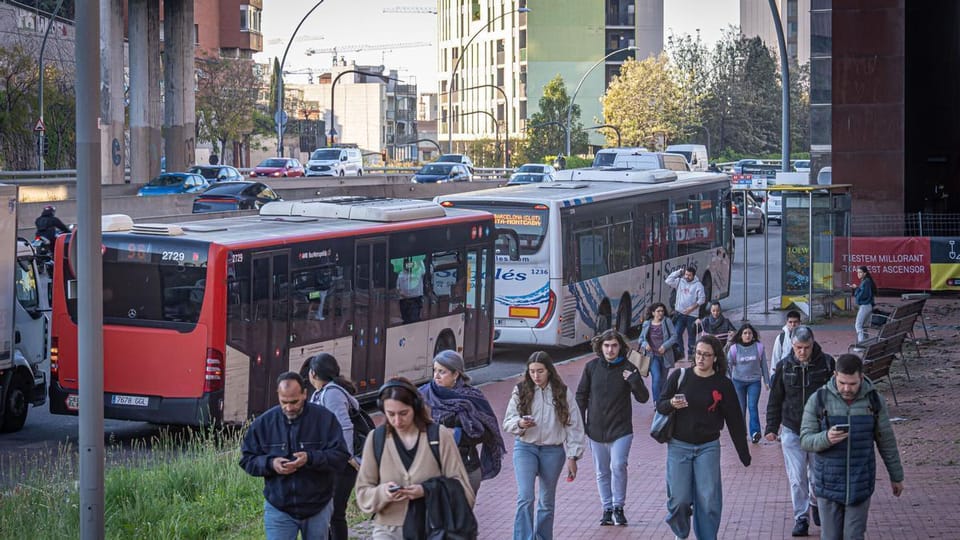
Barcelona City Council is studying ambitious plans to significantly overhaul the city's bus transport network this year. These plans aim to alleviate severe morning congestion on major access corridors.
The council's analysis focuses on prioritising public transport. It specifically includes extending the C-58 Bus VAO lane on Meridiana Avenue directly to the future La Sagrera intermodal station. This extension seeks to improve commercial speed for interurban bus lines heading to La Sagrera, a major transport hub.
Meridiana Bus Lane Extension
Additionally, officials are considering a major reform of the existing Fabra i Puig bus station. They are also exploring relocating it to a subterranean site under the park between Avinguda Rio de Janeiro, Porta Football Pitch, and Carrer Andreu Nin. This new location could expand its capacity to between 20 and 27 bus bays, addressing current saturation issues.
Municipal sources explained that the proposal for Fabra i Puig is contingent on evaluating whether mobility benefits justify the significant investment required. The current Fabra i Puig station serves as a crucial interchange for interurban bus passengers connecting to the L1 Metro line.
Fabra i Puig Station Relocation
Both the Fabra i Puig bus and Metro stations experience severe overcrowding during peak hours, particularly since January. Problems with Rodalies commuter rail services have pushed many users towards interurban buses, exacerbating existing congestion. The City Council's overarching strategy for city access corridors rejects adding more lanes for private vehicles. It argues this only creates larger bottlenecks within the urban area. Instead, the focus is on doubling bus users to approximately 400,000 daily passengers, ensuring fast and efficient service.
Addressing Peak-Hour Congestion
Congestion primarily occurs between 07:00 and 09:00 during morning entries, as afternoon departures are more staggered. At the start of the academic year, 200,000 people entered Barcelona by bus daily, while 250,000 used Rodalies. Now, both figures are comparable, highlighting the shift to bus transport.
The council plans to implement double bus lanes on entry corridors. This includes Diagonal Avenue and both northern and southern ends of Gran Via, in addition to Meridiana. Urban buses will use the right-hand lane near pavements. This allows interurban buses to use a dedicated left-hand lane for more direct routes to underground intermodal stations.
New Intermodal Hubs and Meridiana Redesign
New intermodal stations are already planned for Plaça Espanya and La Sagrera. The council also considers another station at the Diagonal entrance, possibly at Zona Universitària or Francesc Macià. A potential station near Plaça de les Glòries is also under review. However, this last option remains less certain due to its proximity to Estació del Nord.
The Ajuntament states, "Offering a good public transport service is the only way to pacify Meridiana." The third phase of Meridiana's remodelling, from Fabra i Puig to the city exit, involves dismantling the urban motorway. It will transform the avenue into two roadways separated by a landscaped median.
This redesign aims to integrate both sides of the avenue. It will remove the large wall and segregated road on the Sant Andreu side, past Carrer Concepció Arenal, and the Can Dragó bridge. This will increase Transports Metropolitans de Barcelona (TMB) bus services and ensure fully accessible pavements along the entire length of the road.
The roadway towards Llobregat will align with Nou Barris, and the Besòs-bound roadway with Sant Andreu, increasing crossing points. Studies will assess local mobility interference, including neighbourhood accessibility and bus stops, with city entry and exit movements. Preliminary studies also propose a bidirectional cycle lane in the median. Its placement on the laterals, as seen in the La Sagrera section, is also under consideration.
Future of Barcelona's Commute
These comprehensive studies, currently underway, will determine the feasibility and specific implementation details of these significant infrastructure projects. Their successful execution could fundamentally reshape daily commutes for hundreds of thousands of residents and visitors to Barcelona.
Sign up for our new entrepreneurs community Bizcelona, now accepting our second wave of applicants.
Originally published by El Periódico Barcelona. Read original article.