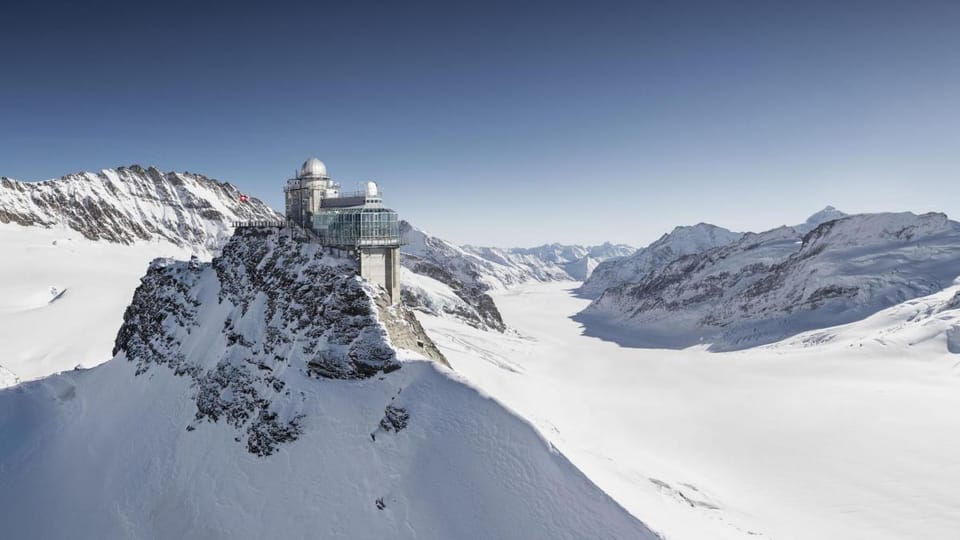
Castellers de Barcelona will attempt to build what their public relations manager describes as the "highest altitude human tower in history" on 25 June. The group travels to the Jungfraujoch in the Swiss Alps, known as the "Top of Europe," located at 3,454 metres above sea level, for this record-breaking cultural performance.
Jordi Planas, public relations manager for Castellers de Barcelona, expressed enthusiasm for the challenge. He told La Vanguardia, "It will be spectacular, we will perform in a scenic location; we could not miss the opportunity." The group plans to construct a 7-level castell and a 4-level pillar at this iconic European site.
Alpine Record Attempt
Additionally, the Castellers de Barcelona intend to raise a pillar at the Sphinx observatory's viewpoint. This is the complex's highest point, reaching a dizzying 3,571 metres. The Jungfraujoch itself hosts Europe's highest train station, nestled between the Jungfrau (4,158 metres) and Mönch (4,107 metres) peaks. It also provides access to the Aletsch glacier, a UNESCO natural heritage site.
This international endeavour forms part of a broader effort to expand Catalan culture globally. It includes the official baptism of Castellers de Lausana, a new group formed in 2023 by Albert García del Campo. Castellers de Barcelona, known for their distinctive red shirts, will sponsor this new formation. Joan Blanco, an ex-casteller, started preparing this step in 2025, according to Planas.
Promoting Catalan Tradition
Castellers de Barcelona, founded in 1969, has a long history of promoting human tower building. They previously built a 3-level castell at the base of the Eiffel Tower in 1989 during its centenary celebrations. The group has also helped establish around 20 other human tower groups worldwide. This demonstrates their commitment to sharing this UNESCO-recognised cultural tradition with international audiences.
The Swiss Tourism office in Spain has played a key role in the logistics of this expedition. They facilitated travel within Switzerland using the Swiss Travel Pass. This pass covers trains, buses, boats, and some cable cars. The office also mediated with Jungfrau officials to organise the cultural event at the "Top of Europe."
Logistical Challenges and Support
A representative from Swiss Tourism highlighted the collaboration as a way to "do something important for the dissemination of Catalan culture in Switzerland and the world, uniting the two cultures." They also noted the significant logistical challenge of moving "a group of nearly 200 people from Barcelona to the emblematic Alpine location." The expedition involves a large contingent of participants, requiring careful coordination.
The current record for the highest altitude human tower belongs to Castellers de l'Alt Maresme, also known as Maduixots. In August 2017, they built a 4-level pillar on the Pica d'Estats, Catalonia's highest peak, at 3,143 metres. That achievement involved a two-day ascent on foot from the Vallferrera refuge.
Overcoming Altitude and Cold
Jordi Planas distinguished the two efforts, stating, "They are different situations, the way they carried it out is different." He added, "What matters is enjoying the castells wherever they are." Unlike the Maduixots, Castellers de Barcelona will reach the high altitude via Swiss railway engineering, not by climbing. However, the extreme cold and thin air will present significant challenges for the nearly 200 participants, testing their endurance and focus.
Beyond the Jungfraujoch performance, the Castellers de Barcelona expedition includes other events. On 26 June, the Castellers de Lausana baptism will take place, with Castellers de Zúrich also expected to participate. The groups will also perform for local audiences at Chillon Castle in Montreux and the Olympic Museum in Lausanne. These events aim to further embed Catalan human tower culture within Switzerland.
Come and join our Barcelona English Speakers community on WhatsApp.
Originally published by La Vanguardia Barcelona. Read original article.