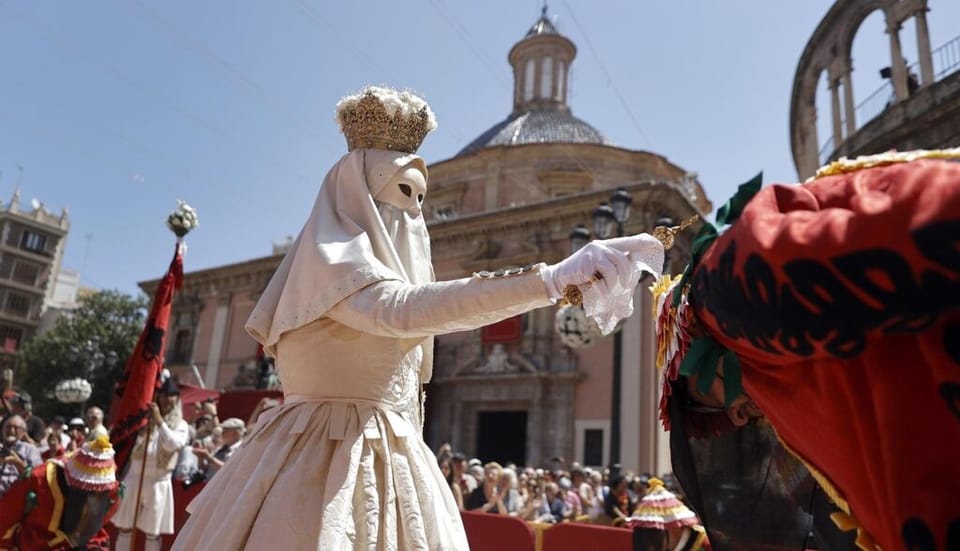
Barcelona will mark Corpus Christi 2026 from 4 to 7 June, with the city’s best-known tradition, L'Ou com Balla, plus giants, devils and processions in the Gothic Quarter and beyond. The programme brings together religious roots and street culture in a format that still draws big crowds each year.
L'Ou com Balla, or the Dancing Egg, is one of Barcelona’s most recognisable Corpus Christi customs. A hollow egg shell spins on the jet of water from a fountain, using only water, eggs and flowers. Records place the tradition at Barcelona Cathedral in the 15th century, and this year it will be shown from 4 to 7 June in cloisters and courtyards including the Arxiu de la Corona d’Aragó, the Arxiu Històric de la Ciutat, Barcelona Cathedral, the Ateneu Barcelonès, the Museu Frederic Marès, the Museu Marítim and the Reial Monestir de Santa Maria de Pedralbes.
The main street action comes on Saturday 6 June, when the community programme includes the return of the Ball de Diables, Revenedors, after its recovery last year. It starts at 20:00 in Plaça de Sant Jaume, then moves along Carrer del Bisbe, Carrer de la Pietat and Carrer dels Comtes before reaching the steps of Barcelona Cathedral around 20:30. A solemn fire procession follows.
Also on Saturday, individual giants’ parades begin at 18:30 from City Hall, the Basílica de Santa Maria del Pi and the Basílica de Santa Maria del Mar. A joint parade starts at 19:00 from Carrer de Santa Llúcia, passes through Plaça del Rei and ends in Plaça Sant Jaume. At 20:30, there will be a final dance and fireworks display in the square.
On Sunday 7 June, the celebrations continue in Plaça de Sant Jaume. The Falcons de Barcelona perform just before 19:00, followed by a dance with the Gegants Nous de la Casa de la Caritat and the Corpus giants. The main festive procession starts at 19:00 and finishes around 21:00 at Pla de la Seu, where more giant dances and the Àliga, or Eagle, will appear.
Corpus Christi means Body of Christ, and the feast dates back more than 700 years. In Catalonia, it has grown into a wider cultural event that helped shape many popular traditions, including giants, bestiary figures, music and dance. For readers following the city’s summer calendar, you can also keep an eye on our sport coverage and other local listings as more June events are announced.
Outside Barcelona, other Catalan towns also mark Corpus Christi in their own way. Berga hosts La Patum, a UNESCO-recognised festival with more than 600 years of history. Sitges is known for its flower carpets and also stages L'Ou com Balla at Palau Maricel. La Garriga makes around 30 floral carpets using 240,000 carnations, while Santa Coloma de Gramenet, in the Barcelona metropolitan area, holds flower carpets and a traditional trepitjada led by giants, capgrossos and Draconaires.