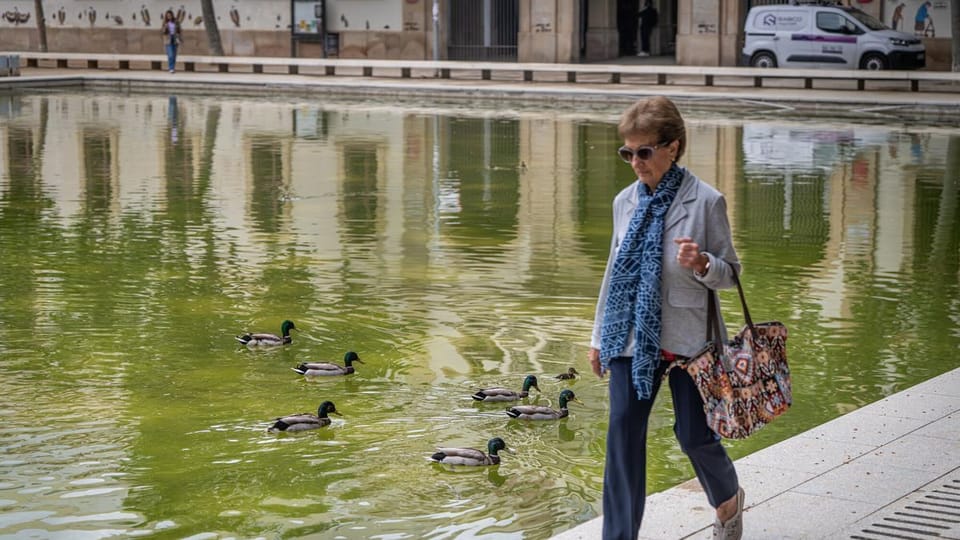
The mallard population in Barcelona's Jardins del Baix Guinardó is growing rapidly, posing a significant threat to the local ecosystem. This issue persists despite the ducks recently “winning” a four-year dispute over a market relocation plan.
Barcelona City Council initially announced plans in March 2022 to move the Estrella Market to these gardens. The temporary marquee was intended to house stallholders during renovations at the market's usual site in the Gràcia district. Local residents, however, strongly opposed the move, launching an intense campaign that included legal challenges.
Carlos, a regular visitor to the park, observes the duck population's rapid increase. "Two weeks ago, six were born, the smallest ones," he explained. "Others are medium and others large. You see them small, and in a weekend, they suddenly grow. Then one day you see them running, as if practising, and a weekend later the older ones remain. I have counted 22 ducks. Sometimes they leave and return."
Market Relocation Controversy Ends
The controversy surrounding the market relocation lasted four years. It highlighted notable differences between residents and the City Council, and between stallholders and local groups. Organisations such as 'Salvem el Parc' (Save the Park) rejected the provisional market. They cited concerns about necessary tree felling, the loss of public space for residents, and the impact on the ducks.
Officials also considered the duck community a concern when the relocation seemed certain. In May 2025, when the marquee installation was expected to start, the City Council considered what to do with the birds. These ducks have frequented the gardens since 2020, and their presence is visibly appreciated by human visitors.
However, this interaction between park visitors and ducks includes a common phenomenon with negative effects: people feed them. This practice alters the ducks' natural balance. In March 2024, Jaume Collboni's government announced the cancellation of the marquee installation in Jardins del Baix Guinardó. The City Council decided to carry out the renovation work at the market's original location, without requiring stallholders to move.
Ecological Impact of Human Feeding
Sergi Garcia, an environmentalist and member of the Galanthus association, confirms the problem. "The increase in mallards in Barcelona and its metropolitan area is an undeniable fact," Garcia states. He attributes this partly to increased aquatic vegetation in some artificial ponds. "Although a good part of the population is resident, migratory birds join them in winter depending on the severity of northern European winters," he adds.
Garcia indicates that the duck community's growth is artificially inflated. "Direct feeding by citizens allows for much higher breeding rates than natural ponds could naturally sustain," he explains. This has a potential negative effect on the ecosystem. "The result is a semi-domesticated population with altered behaviours. Overpopulation severely degrades urban aquatic ecosystems, as ducks intensely prey on dragonflies and amphibians in the ponds where they live and those they visit."
He concludes that sacrificing the ecological potential of these ponds to maintain a generalist species in domestic conditions is contradictory. The Jardins del Baix Guinardó, located in the Horta-Guinardó district, is a vital green space for local residents. Its ecological health directly impacts the quality of life for those living nearby.
City Council's Response and Warnings
Barcelona City Council monitors the mallards, though it did not need to activate a specific plan after cancelling the marquee installation. Municipal sources confirm the City Council understands these gardens are not the birds' natural habitat. They try to support the ducks, in some areas installing ramps to help their movement.
Meanwhile, the City Council consistently warns citizens not to feed the birds. This human feeding has been a decisive factor in the ducks living there. The City Council has conducted communication campaigns on this issue, covering various species. They aim to discourage Barcelona residents from feeding pigeons and wild boars, for example, which also receive human-provided food.
"If people feed them, a process of loyalty to certain green spaces in the city begins," municipal sources indicate. "These spaces often do not have the optimal characteristics for their development." The ducks in Jardins del Baix Guinardó, unaware of this debate, enjoy their victory, celebrate the good weather, and eat heartily. The City Council continues to encourage responsible interaction with urban wildlife to protect Barcelona's delicate ecosystems.
Come and join our Barcelona English Speakers community on WhatsApp.
Originally published by El Periódico Barcelona. Read original article.