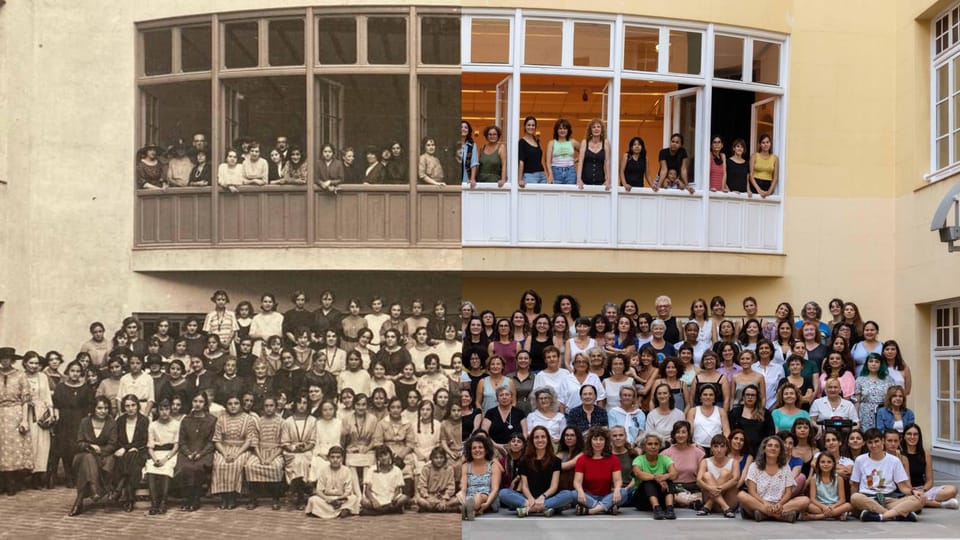
Barcelona feminist cultural centre La Bonne has formally claimed ownership of its Ciutat Vella building, on Sant Pere Més Baix, from the Diputació de Barcelona. The group says the Francesca Bonnemaison centre was confiscated during the Franco regime and that the Democratic Memory Law could now support a return of the property.
The claim follows years of strained talks between La Bonne and the Diputació, which is the current owner. Marta Vergonyós, director of La Bonne, said: "This decision does not come out of nowhere. We have spent years trying to find solutions and what we have found are increasing difficulties."
The dispute dates back to a 2003 campaign by around 80 organisations linked to culture and feminism, which called for the Bonnemaison centre to return to its original purpose. The building had become vacant after the Institut del Teatre moved out, and the groups argued it was the right moment to return the space to women. That pressure led to a user agreement that allowed La Bonne to set up as a feminist cultural centre.
That agreement lasted ten years. When it expired in 2013, negotiations began but did not reach a final solution, according to La Bonne. The centre has since operated under extensions, temporary agreements and exceptional authorisations. Since 2018, it has been in the building without a stable agreement. Vergonyós said: "We live in a permanent situation of uncertainty. We maintain that legal formulas exist to maintain a direct transfer like the one made in 2003, but the Diputació holds a different position."
La Bonne says the latest proposal from the Diputació, to reclaim one of the floors for its own administrative offices, showed how far apart the two sides remain. The centre argues that would not fit the building’s historical role, given that more than 100 organisations and women linked to culture work there.
The organisation’s case is based on historical research and legal documents that it says show the transfer in the early years of the Franco regime was not voluntary, but a covert confiscation. It also points to the legacy of Francesca Bonnemaison, who founded Europe’s first public library for women and created a project that became a reference point for thousands of Catalan women in the early 20th century. La Bonne says recovering the building would be more than a property dispute, it would be a way to restore the space to the purpose it was created for.
Over the years, La Bonne says it has grown into a network of more than 80 feminist and cultural organisations, with over 4,000 sympathiser members and hundreds of active members. It says it has promoted hundreds of training courses, dozens of audiovisual productions and thousands of cultural activities, with more than 13,000 people taking part last year alone. The Parliament of Catalonia has declared it an organisation of public interest, and hundreds of entities have backed its work. For more on local civic groups, see our Community coverage and related Barcelona stories.