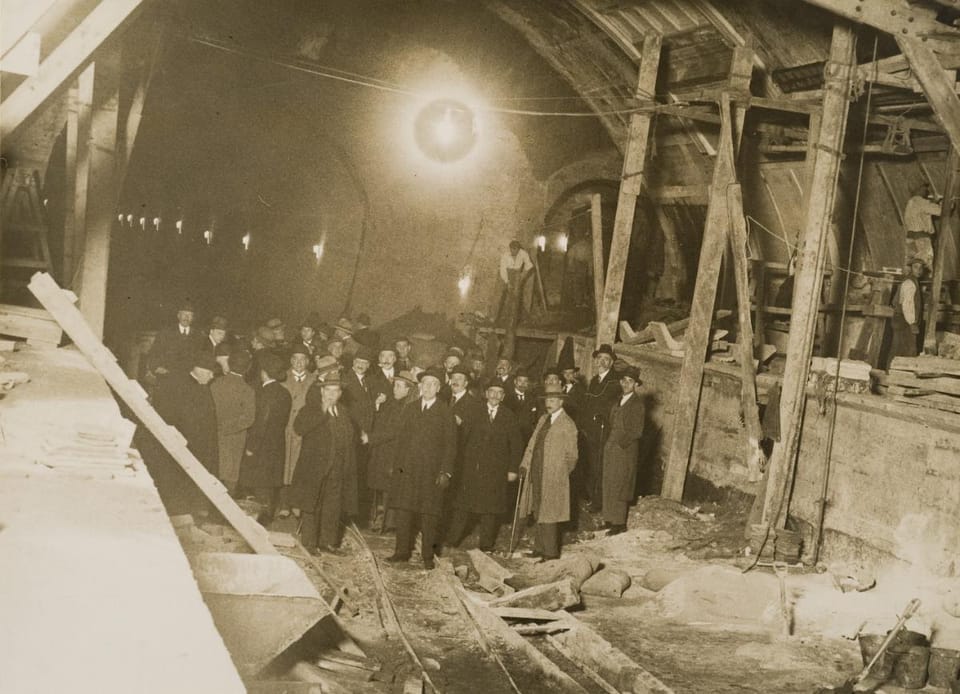
Barcelona is marking a rare double centenary this year, 100 years since Antoni Gaudí died and the first four-kilometre section of the line now known as L1 opened to the public. Both events happened on 10 June 1926, and both remain part of the city’s history.
Gaudí was hit by a tram on 7 June 1926 on Gran Via de les Corts Catalanes, between Bailèn and Girona streets, while walking towards Sant Felip Neri church to pray and meet his confessor, Father Agustí Mas i Folch. Because of his appearance and lack of identification, people first thought he was a homeless man.
A Civil Guard officer stopped a taxi and Gaudí was taken to the Hospital de la Santa Creu. He stayed unconscious with severe injuries, and Father Gil Parés i Vilasau, a priest from the Sagrada Família, later identified him at the hospital. Gaudí died at 73, and his funeral on 12 June drew thousands of people before he was buried in the crypt of the basilica he designed.
The metro side of the story began with the Metropolitano Transversal, which construction started in 1923. According to Transports Metropolitans de Barcelona, it was meant to link eastern Barcelona with the metropolitan municipalities along the Besòs river. The first section, known at the time as the Transversal, ran 4,063 metres and had nine stations, including Bordeta, Mercat Nou, Sants, Hostafrancs, Espanya, Rocafort, Universitat and Catalunya.
The line was extended in 1932, with Urquinaona and Triunfo Norte, now Arc de Triomf, added. Bordeta Cocheras also opened, but it was short-lived and later replaced by Santa Eulàlia. The L1 is still unusual in Barcelona’s metro network because it is the only line built with Iberian gauge tracks.
Today, the L1 runs between Hospital de Bellvitge and Fondo, covering 20.7 kilometres and 30 stations across Barcelona, L'Hospitalet de Llobregat and Santa Coloma de Gramenet. For more on the city’s transport network, see our community coverage and sport updates for what is happening across Barcelona.
The line’s construction also had a darker side. On 12 April 1924, a tunnel collapse beneath Gran Via de les Corts Catalanes, between Villarroel and Casanova streets, killed 11 workers and injured 12 more. The tragedy was kept quiet at the time, as investors pushed to finish the project quickly.