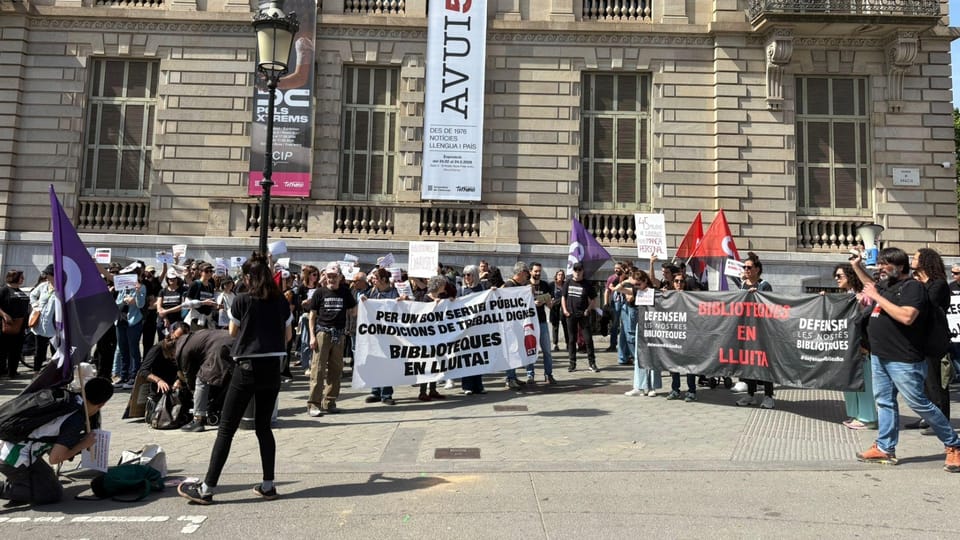
Library workers in Barcelona started an indefinite Saturday strike on 25 April, protesting for better working conditions and quality public service. Around 100 employees from the Barcelona Library Consortium marched through the city, supported by the General Confederation of Labour (CGT) and Intersindical unions. This action follows a week of prior protests and stoppages.
The demonstration began at Palau Robert, a cultural centre on Passeig de Gràcia. Protesters then proceeded down Rambla de Catalunya, a major thoroughfare in the Eixample district. They paused at the Diputació de Barcelona headquarters before reaching Plaça de Sant Jaume, outside the Ajuntament de Barcelona. This marks the first joint strike and mobilisation involving all libraries across the province of Barcelona, highlighting widespread discontent.
Workers highlight five major issues contributing to precarious employment within the library system. These include a lack of purchasing power, meaning low wages, and insufficient staff numbers to meet public demand. They also cite abusive working hours, making it difficult for employees to balance work and family life, and a growing lack of recognition for their efforts.
Pau Solsona, a CGT union delegate for the Barcelona Library Consortium, stated, "We oppose agreements that precariousise feminised collectives and cut rights." He added that these conditions particularly affect women, who form a significant portion of the library workforce. Laura Solà, a CGT union delegate at the Diputació de Barcelona, also spoke during the protest. She criticised the current system for evaluating staffing needs.
Demands for Fairer Metrics
Laura Solà explained that staffing levels are currently based on quantitative items, such as population numbers in a given area. She called for socio-economic realities to be considered more thoroughly. Solà noted this is especially important in "areas of maximum socio-economic complexity," where library services often play a critical social role. She requested support from social technicians to address these complex needs.
Solà also claimed that library staff hours often "cover the shortcomings that city councils have" in social provision. She stressed that these deficiencies are shared by both the Diputació and the city councils, indicating a systemic issue. Auxiliary library workers present at the demonstration echoed these concerns, stating the situation "comes from many, many years ago."
Long-Standing Staffing Issues
These workers expressed regret over persistent staff shortages and a lack of generational replacement within the profession. They also find it very difficult to reconcile their work with family life due to demanding schedules. The indefinite strike will continue every Saturday until an agreement is reached between the workers and the authorities. This ongoing action aims to pressure the Ajuntament and Diputació to address the workers' demands for improved conditions and better public service. The strike impacts library access for residents across Barcelona, particularly on weekends.
Sign up for our new entrepreneurs community Bizcelona, now accepting our second wave of applicants.
Originally published by betevé. Read original article.