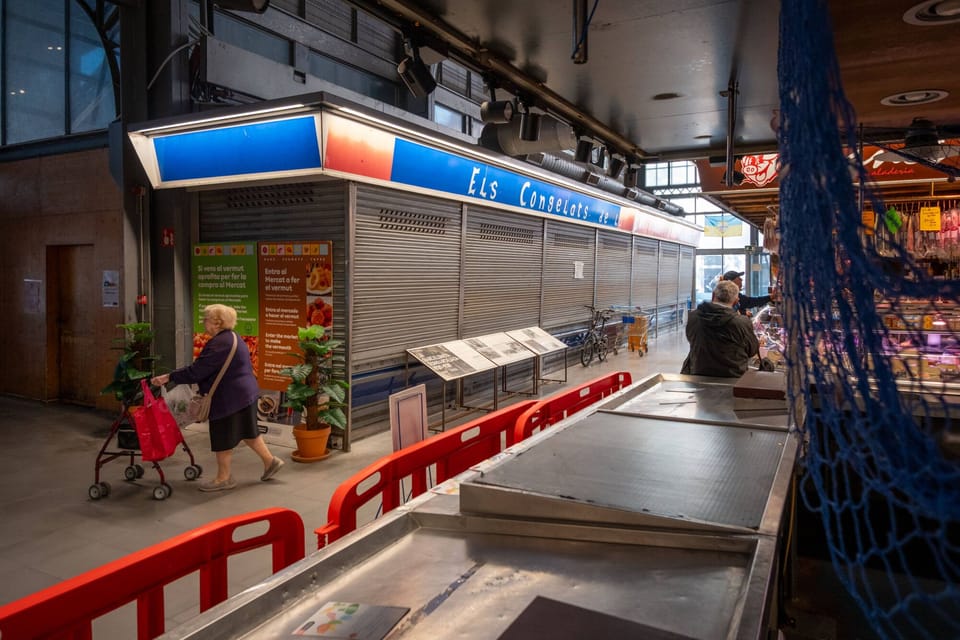
Fourteen municipal markets in Barcelona, representing nearly a third of the city's total, now receive financial assistance from the city council. This support helps cover utility and maintenance costs for empty commercial spaces, as over 20% of their stalls remain vacant.
The Municipal Institute of Markets of Barcelona (IMMB), which is part of the city council, reported an increase in vacant establishments last year. This situation means the council takes on costs to relieve a third of the city's food markets. Municipal regulations exempt merchants from certain expenses when 20% or more of the sales area is empty.
Under these rules, the council pays for water and electricity consumption, maintenance, and other services for the proportional area that remains inoperative, according to Barcelona Municipal Markets official website. This measure aims to reduce excessive common expenses for cleaning, security, supplies, and promotion, which stalls would otherwise share.
City Council Steps In
"By the end of 2025, 14 markets received this support for exceeding 20% of their vacant commercial space," the city council stated. This figure accounts for 32.5% of the city's 43 markets, according to List of Barcelona markets Wikipedia. It also surpasses the 2024 count, when 11 markets required aid for exceeding the vacancy threshold.
The markets with more than a fifth of their commercial area unoccupied at the end of 2024 included Barceloneta, Bon Pastor, Canyelles, Ciutat Meridiana, Concepció, Estrella, La Marina, Mercè, Montserrat, Sant Martí, and Trinitat. These markets remained in the same situation at the end of 2025. Additionally, Besòs, La Guineueta, and Lesseps markets joined the list, all needing extraordinary municipal support for expenses.
The specific costs the council covers vary by market, depending on the extent of the empty space. For example, the council covers 23.67% of the Besòs market's ordinary expenses. This figure rises to 63.25% for Ciutat Meridiana market, corresponding to the square metres without commercial proposals.
Reasons for Vacancies
The IMMB explains that "in most cases, this vacant space is often temporary." It links the vacancies to ongoing works, transformations, or specific transitional situations. The organisation primarily associates them with facility remodelling projects.
These remodelling efforts "recover licences that allow other commercial operations," the IMMB says. This helps reconfigure the sales floor or introduce new operators, such as self-service stores or restaurants. In other instances, visible vacancies needing economic support result from a market nearing the end of its life in a particular building.
This often happens when a market awaits relocation to a new property. Only active establishments planning to move to the new facility typically remain. After the move, "the situation normalises, and the percentage of vacancies is minimal," the IMMB explains.
Market Revitalisation Efforts
The markets of Besòs, Canyelles, Ciutat Meridiana, Concepció, Estrella, La Marina, Mercè, Montserrat, and Trinitat fall into this category. The Montserrat market provides a clear example. It opened its current building at the end of March, after four years of delays.
The market has since expanded its offerings. "A few weeks ago, it had just over 80% vacant space," the institute highlights. "Since its inauguration, it is over 90% occupied, with only one vacant establishment."
The number of closed stalls, available for reopening, has also grown in recent years. IMMB statistics show that these businesses decreased from 75 to 48 between 2022 and 2023. However, this trend reversed in the following two years.
There were 74 empty market stalls in 2024 and 76 in 2025. The last decade saw even higher figures, with 167 inactive businesses recorded in 2015 and 93 in 2021.
Shifting Market Dynamics
Last year, the city council awarded 23 stalls through auction and direct negotiations. Simultaneously, 138 establishments changed hands. The renewal rate reached 8.71%, the highest in 17 years.
The institute sees a "clear reactivation" of the markets reflected in this indicator. It notes an "increase in both transfers and awards." However, 62 of the 76 stalls auctioned months earlier found no bidders.
The IMMB believes the markets are in a cycle of "consolidation and generational change." The city council stresses that the shops with closed shutters in the markets on 31 December 2025 "represent only 4.11%" of the 1,848 existing establishments.
The total number of available stalls generally declines year after year. Markets housed 2,846 businesses in 2008, 42.52% more than now. This figure was 2,104 in 2020, nearly 13% more than today.
Several factors explain this reduction in market shops. These include the construction of new facilities with fewer stalls. Reforms to widen aisles and install cooking classrooms or online shopping lockers also play a role. The merging of establishments to create larger ones further contributes to the decrease.
Despite the falling total number of shops, the commercial area of the network has increased. It grew from 108,768 square metres in 2010, 52.17% of market floor space, to 126,208 square metres last year, 42.33% of the constructed space.
Barcelona's city council continues to support its municipal markets through these financial aid measures. This strategy aims to maintain these vital community hubs and adapt them for future commercial needs. The ongoing efforts seek to balance tradition with modernisation, ensuring these markets remain central to local life.
Sign up for our new entrepreneurs community Bizcelona, now accepting our second wave of applicants.
Originally published by El Periódico Barcelona. Read original article.