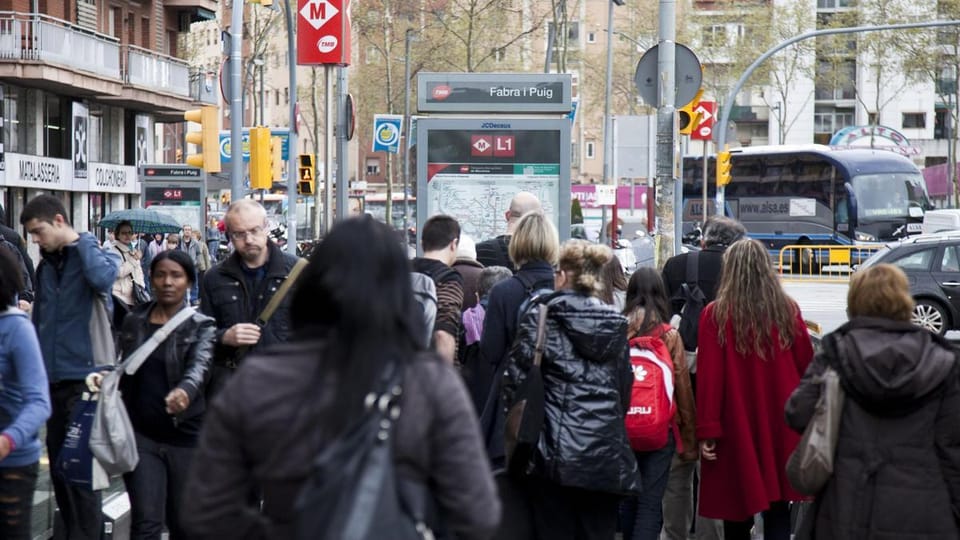
Barcelona’s metro has seen a clear change in passenger flows in the first quarter of the year, as the Rodalies crisis pushed many commuters onto alternative routes across the city.
Diagonal station in the Eixample has overtaken Catalunya as the network’s busiest stop. Diagonal recorded 4.5 million users, up by 200,000, while Catalunya, in the city centre, fell by 100,000 to 4.2 million.
Across the main metro and Rodalies interchanges in Barcelona, the three largest hubs lost 729,000 passengers. Those stations include Sagrera, Catalunya, Sants Estació and Passeig de Gràcia. At the same time, Fabra i Puig and Diagonal metro stations gained a combined 775,000 validations.
Sagrera and Sants Estació both saw steep falls. Each lost about 300,000 users. Sagrera dropped by 10 per cent, from 3.2 million to 2.9 million passengers. Sants Estació, in Sants-Montjuïc, fell by 11 per cent to 2.5 million users.
Fabra i Puig on Metro Line 1 had the biggest rise. Passenger numbers jumped by 35 per cent, adding 600,000 users to reach 2.3 million. The station, in Sant Andreu, links with several interurban bus routes and has become a key alternative for commuters affected by Rodalies disruption. Transport and community updates on Barna.News continue to track how these changes affect daily travel in Barcelona.
The sudden rise in demand at Fabra i Puig led to overcrowding, as the station was not built for such high volumes of interurban bus passengers. Transports Metropolitans de Barcelona (TMB) reinforced staff at the station to help manage passenger flow and reduce congestion on escalators and platforms. TMB also added more trains on Metro Lines 1 and 5 after Easter Week to cope with the higher demand. For official service information, see TMB.
Badalona-Pompeu Fabra on Metro Line 2 also saw a notable rise in usage. The station, which serves the nearby city of Badalona, increased by 20 per cent, gaining 200,000 users to reach 1.3 million passengers. Plaça Espanya, another major interchange, held steady at 3.9 million users and connects with the Llobregat-Anoia line of the Catalan Government Railways (FGC). The overall Barcelona Metro system rose by 3.2 per cent in the first quarter, from 121.9 million validations to 125.8 million, compared with the same period last year.
TMB described the growth as moderate. The broader trend for public transport use has been rising, but the Rodalies network, managed by the Generalitat de Catalunya, has faced repeated incidents and disruptions. For official rail updates, see Rodalies de Catalunya and Renfe. Barcelona’s metro remains a key part of daily travel for residents in the city and for people commuting in from surrounding areas.