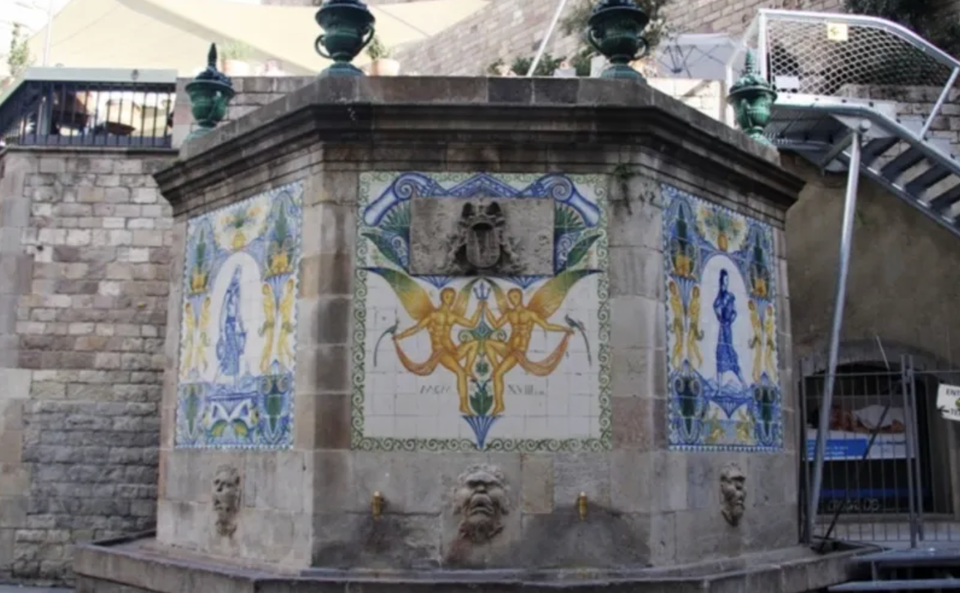
Barcelona's Gothic Quarter holds two of the city's oldest fountains, with one dating back to 1356. These historical water sources offer a glimpse into Barcelona's past and the evolution of urban life.
The Font de Santa Anna, constructed in 1356, stands at the beginning of Carrer Cucurulla. Originally known as the Font d'en Moranta, it later became the Font de Santa Anna. This emblematic fountain features five distinct sections. A later ornamental ceramic mosaic by Josep Aragay enhances its appearance.
Just a short distance away, the Font de Sant Just, built around 1367, is another ancient landmark. It sits in Plaça de Sant Just, at the corner of Carrers Lledó and Palma de Sant Just. This fountain faces the Basílica dels Sants Màrtirs Just i Pastor. Historians consider it a significant cultural asset, declared a local cultural interest.
Saint Just Fountain's History and Legend
Legend states the Font de Sant Just honours Joan Fiveller. He reportedly discovered a water spring while hunting in the Collserola mountain range. The fountain originally had three bronze spouts emerging directly from its stone wall. Three human heads flanked these spouts.
In 1831, the Gothic fountain underwent a significant reform. This renovation gave it a neoclassical style, shaping its current appearance. The city carried out the reform to address a ban on necropolises within the city limits. Until then, the fountain stood next to the parish cemetery of the church in the square. Workers restored the fountain while installing a new terracotta balustrade. Today, the three human heads remain, but only two spouts are present. The fountain also retains two shields, representing the king and the city, alongside reliefs of a falcon catching a partridge.
Other Historic Barcelona Fountains
Beyond these two ancient structures, Barcelona features other notable historical fountains. The Font de Portaferrissa, built in 1680, is located at the end of Carrer Portaferrissa. This street connects with Carrer Cucurulla. Ceramista Joan Baptista Guivernau decorated this fountain with distinctive tiles.
More recently, the Font del Pla de la Boqueria, from 1830, has drawn attention. Images recently circulated showing this neoclassical fountain in a degraded state. It features three taps above three mascarons. The monument was placed near a city wall gate that opened onto La Rambla. However, by its 1830 inauguration, it no longer served that defensive purpose.
These fountains collectively narrate the story of Barcelona's urban development. They show the evolution of public water access and the quality of life for residents over centuries. Preserving these historical water sources is vital for understanding the city's rich heritage.
Come and join our Barcelona English Speakers community on WhatsApp.
Originally published by Tot Barcelona. Read original article.