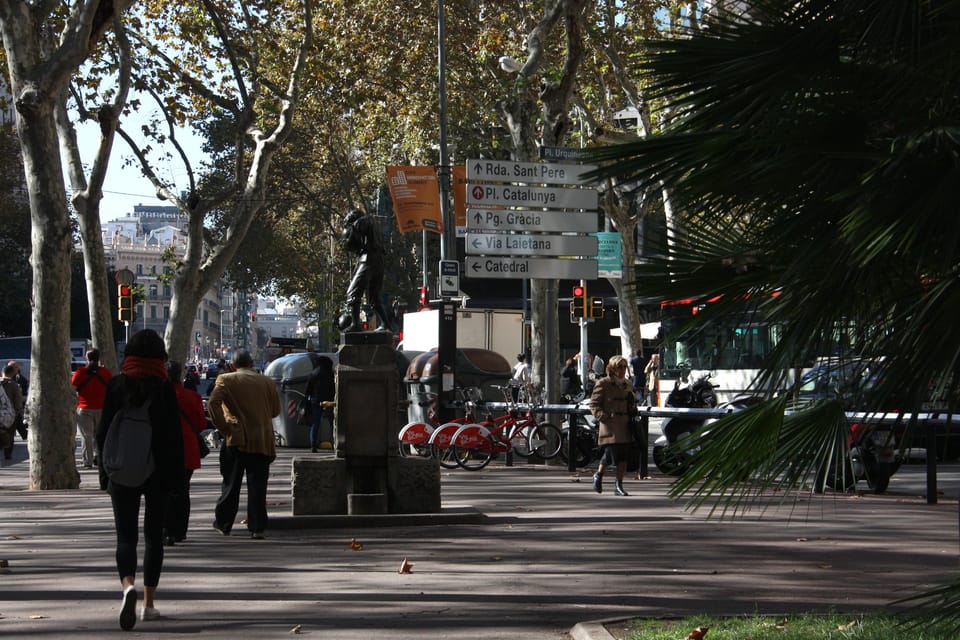
In Barcelona, Plaça d'Urquinaona is more than a busy crossing point. The square, between Ronda de Sant Pere and the start of Via Laietana, has carried several names over time, each tied to a different political moment in the city.
For two years, from 1937 to 1939, it was officially called Plaça de Francesc Ferrer i Guàrdia. The city council approved the change in late 1936 and made it official in January 1937. Joan Puig Elias, then president of the Unified Socialist Party of Catalonia's Central Executive Committee, inaugurated the new name. After the Civil War, the Francoist regime restored the name of Bishop Urquinaona.
Francesc Ferrer i Guàrdia was an educator and activist who founded the Escola Moderna in 1901 at Carrer de Bailèn 56. The Ajuntament de Barcelona's Democratic Memory page says his work was based on free thought, secularism, co-education and rationalism. He was later accused of instigating the Tragic Week in 1909, tried in a process marked by irregularities, and shot at Montjuïc Castle on 13 October 1909.
The square's main namesake was Bishop José María Urquinaona Bidot, Bishop of Barcelona from 1878 to 1883. Born in Cádiz in 1813, he became closely linked to Barcelona and Catalonia. He organised the millennium celebrations for Montserrat, helped secure Pope Leo XIII's proclamation of Our Lady of Montserrat as patron saint of Catalonia, laid the first stone of the Sagrada Família in 1882, and began work on the Conciliar Seminary of Barcelona in 1879.
According to the Nomenclàtor de Barcelona, the square was built in 1857 after the demolition of the Jonqueres and Sant Pere bastions. Its first name was Plaça Nova de Jonqueres. Later versions included Obispo Urquinaona, Urquinaona, Francisco Ferrer y Guardia and Ferrer y Guardia. It took its current Catalan form, Plaça d'Urquinaona, in 1982.
The square is also a major transport hub. Two metro lines run beneath it. The second branch of the Gran Metro de Barcelona opened on 19 December 1926, now part of the L4, with Urquinaona station built directly under the square. The original iron and glass entrance was demolished in 1972, but the spiral staircase still exists. TMB sometimes organises visits to it, along with other historic metro sites. The L1 station opened in 1932, and the access at Ronda de Sant Pere and Carrer de Bruc still keeps original iron railings and pinnacles.
There are no current proposals to rename Plaça d'Urquinaona after Ferrer i Guàrdia, according to the Ajuntament de Barcelona. No political party or citizen initiative has put forward a formal request. For more Barcelona history and city stories, see our Community and Sport pages.