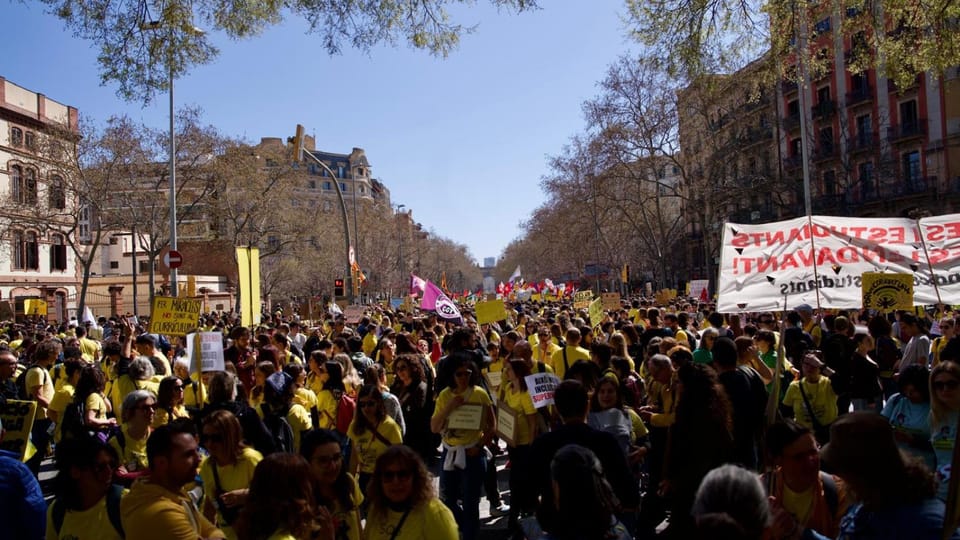
Municipal workers and teachers across Catalonia will stage a mass strike and demonstration in Barcelona on Tuesday, May 12. They are protesting against "blocked negotiations" with the Barcelona City Council and the Generalitat de Catalunya.
This joint action aims to increase pressure on both administrations. The strike involves staff from Barcelona's libraries, Citizen Service Offices (OAC), Social Services, feminism departments, and nurseries. Education professionals from across Catalonia also join the protest. La Intersindical, a union involved, stated that municipal workers will form one of three columns. These columns will converge in the city centre.
The demonstration follows similar protests in late March. At that time, a large teachers' march joined forces with striking doctors. This upcoming protest will see municipal workers start their march from Plaça del Fort Pienc at 09:30. They will unite with teachers at Plaça d'Urquinaona at 12:00. The combined group will then march to Plaça de Sant Jaume. This square houses both the Barcelona City Council and the Generalitat de Catalunya.
Uniting Against Administration
The CGT union detailed the other two columns of demonstrators. These will gather at Plaça d'Espanya and El Clot station. From these points, they will march to Plaça d'Urquinaona. This central square is a key meeting point for the entire mobilisation. Teachers from all over Catalonia will participate. Organisers aim to replicate the success of the March demonstration. Tens of thousands of educators then caused significant disruption in the Catalan capital.
Stalled Negotiations and Grievances
Both groups of striking workers face a shared "situation of blockage," according to the convening entities. They report no significant progress in negotiations with either the municipal or regional governments. The education strike stems from an agreement signed by the Generalitat with unions UGT and CCOO. Other unions claim this agreement makes staff conditions more precarious, both economically and professionally. The Generalitat's agenda involves implementing this already signed agreement.
Demands for Public Services
Locally, mobilised unions protest against a collective agreement. The Barcelona City Council signed this agreement with UGT, CCOO, and CSIF. The mobilised social side argues this new agreement degrades the "social shield" of the Catalan capital. Unions demand the Collboni government open dialogue spaces. They also call for staff reinforcement, improved conditions in nurseries, and an end to bureaucracy. Both institutions claim they are open to negotiation. However, no understanding has been reached to call off the strike.
Escalating Tensions
Aggravating factors exist in both disputes. Municipal unions claim the City Council is delaying an extraordinary plenary session. This delay, they say, is a legal strategy to merge it with the next ordinary plenary. This would dilute the opposition's original reason for calling the session. That reason was to hold the executive accountable for a conflict. This conflict has been "in the streets for 90 days." The education strike has also intensified. Recently, the CGT reported two Mossos d'Esquadra officers infiltrated an assembly. Unions have condemned this, and USTEC announced it would take legal action.
Impact on Residents
Beyond the large demonstrations, individual groups have started their own protests. Libraries have announced closures ahead of university entrance exams. Many school staff have also stated they will no longer organise extraordinary activities like excursions. This Tuesday's strike represents a new test of strength. Unions and workers will measure their resolve against the City Council and the Generalitat. The conflicts put the future of public education in Catalonia and public services in Barcelona at stake.
Sign up for our new entrepreneurs community Bizcelona, now accepting our second wave of applicants.
Originally published by Metrópoli Abierta - Urban Life. Read original article.