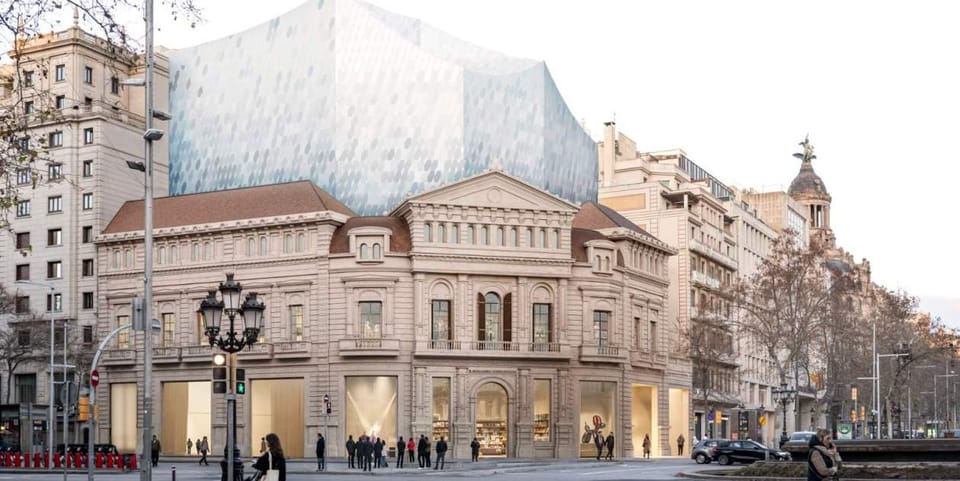
Barcelona's historic Palau Marcet, formerly the Cinema Comèdia, will transform into the new Carmen Thyssen Museum, set to open in 2028. Located at the prominent intersection of Gran Via de les Corts Catalanes and Passeig de Gràcia, this ambitious project will house Carmen Cervera's private collection of Catalan painting.
The Barcelona City Council has given its approval, paving the way for the building's complete restoration and the addition of a distinctive seven-storey volume. This new structure will feature curved lines and a neutral ceramic panel façade, designed to integrate with adjacent buildings.
A New Cultural Landmark for Barcelona
Juan Manuel Sevillano, director of Stoneweg - Places & Experiences, the cultural investment arm promoting the project, stated that previous controversies surrounding the plans are "overcome." He emphasised that the future Carmen Thyssen Museum will offer a "museum, academic, scientific, and educational programme, like all major museums." This programme will combine the permanent collection with a "new space for contemporaneity."
Santi Vila, representing the Cercle d’Infraestructures, highlighted the project as "a private initiative of public interest." The plans were recently presented at the Col·legi d’Enginyers de Camins, Canals i Ports, providing detailed insights beyond initial visualisations. Damià Calvet, a Junts per Barcelona councillor and former regional minister for Territory, also attended the presentation.
Architectural Vision and Urban Integration
The current Palau Marcet building, situated on the Llobregat-mountain chamfer, stands significantly lower than its surrounding structures. This disparity presented a key challenge for the architects, OUA / Casper Mueller Kneer Architects.
Oriol Serret and Àlex Gómez from OUA, along with Vicente Hernández from Casper Mueller Kneer Architects, clarified their approach. They aimed to "fill an urban void" created by the existing building, which they described as "distorted by extensions, its conversion into a theatre, and the incorporation of shops." The design seeks to resolve the building's "depressed situation" compared to the taller surrounding structures.
The approved design, supported by the City Council's chief engineer Oriol Altisench, involves recovering original elements in the façade-facing structure. It also includes a new volume of up to seven floors, defined by its curved lines and set back from the original façade. This new section will maintain the historic roofs and "dialogue with the Palau Marcet," according to the architects. They described the new volume as "light and with neutral chromaticism," achieved through a ceramic panel façade. This façade will "mediate between the adjacent buildings with curved lines," with its colouration changing according to sunlight intensity to "highlight" the historic building's colours.
Museum Facilities and Public Access
Pere Calvet, Dean of the Col·legi d’Enginyers, described the museum project as "exceptional." He asserted that the future cultural facility will "resolve a complicated corner" in the city. The Eixample district, where the museum will be located, is a central and densely populated area, home to over 260,000 residents. This development will significantly alter one of Barcelona's most iconic intersections, impacting both daily life and the city's cultural landscape.
Plans include an auditorium on the first basement level. The ground floor will be reserved for the entrance, a multi-purpose area, and commercial services related to the museum. The permanent exhibition, showcasing Baroness Thyssen's collection, will occupy the first and second floors, within the existing building volume. A restaurant will be located on the third floor, serving as a "pause space," and will not have direct street access. The subsequent two floors will serve for temporary exhibitions, as well as terrace and viewpoint areas and other services.
This project configures a design that seeks to become iconic through its forms, while avoiding a "heavy" volume. Its rounded shapes aim to prevent visual clash. By 2028, this historic chamfer in the heart of the Eixample will have a new identity, offering a major cultural attraction for residents and visitors alike.
Come and join our Barcelona English Speakers community on WhatsApp.
Originally published by El Nacional. Read original article.