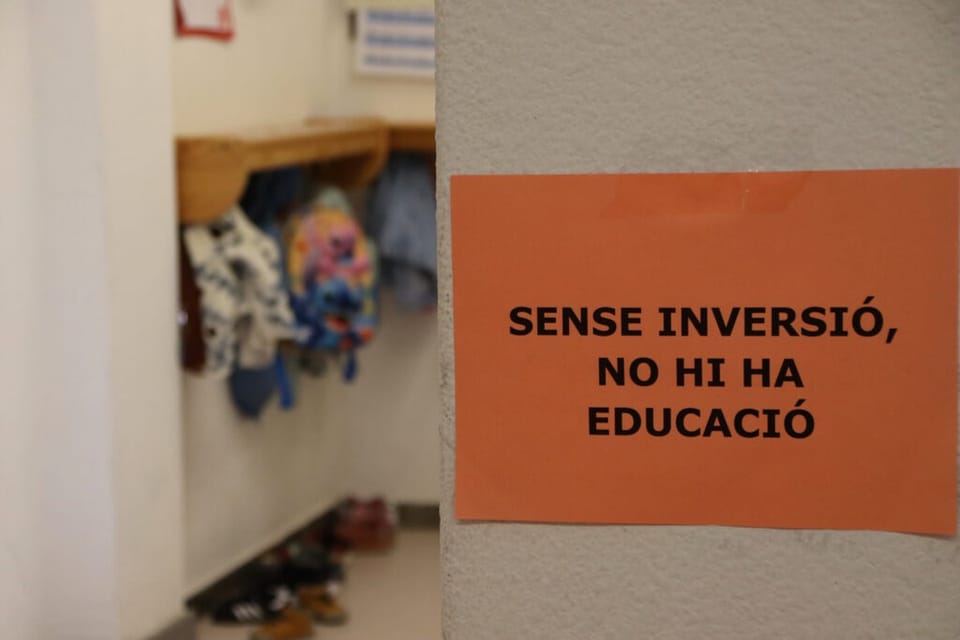
Early childhood educators in Barcelona and across Catalonia are striking today, demanding better working conditions and recognition for the 0-3 education stage. This historic action, involving both public and private nurseries, aims to address the critical situation in classrooms. Teachers feel invisible and undervalued, calling for their profession to receive equitable recognition compared to other educational stages.
This marks the first time early childhood educators in the Catalan Countries, which include Catalonia, Valencia, and the Balearic Islands, have united for a strike day. Several Spanish state unions and platforms organised the action. For the first time, both public and private nurseries, regardless of their management model, are participating. In Catalonia, the Plataforma 0-3, a coalition of various entities and unions, leads the protests.
Demands for Improved Conditions
Teachers share several common grievances and demands across the territories. They stress the need to reduce the number of students per classroom. Additionally, they want full recognition for educators in this stage and more resources to manage the increasing diversity and complexity in classrooms. They also advocate for a public nursery network for children under three years old, ensuring quality, non-fragmented education, according to Catalan education system. Furthermore, teachers request non-teaching time for administrative and pedagogical tasks.
Neus Rojas, from Dignitat pel 0-3, described the strike as historic and unprecedented. "We expect a thorough debate on the need to rethink 0-3 conditions," Rojas told VilaWeb. "Policies for this stage must change, with responsibility from both central and local governments, understanding that 0-3 is the foundation of education."
Alba Moreno, a teacher at Barcelona's Tramvia Blau municipal nursery and a member of Bressol BCN en Lluita, emphasised the broader impact. "This call is not just a labour protest; it is a collective call to defend children's rights and dignified education from the earliest years of life," Moreno stated. She highlighted that the 0-3 stage builds emotional, cognitive, and social foundations. "Despite all this, it remains one of the most precarious stages of the education system, with Europe's highest ratios, a lack of resources, job instability, and territorial inequalities," Moreno warned.
Precarious Working Environment
These demands stem from long-standing issues. The Intersindical Valenciana union insists on recognising teachers' work in this educational stage, clarifying it is not merely an assistance service or a reconciliation resource. The union noted the 0-3 stage has remained in an ambiguous regulatory margin. This is because it has been historically invisible and predominantly staffed by women, with approximately 97% of professionals being female. This extreme feminisation has contributed to precarity, a lack of institutional recognition, and the uncritical assumption that educational and care work can sustain itself with unmanageable ratios, low salaries, and scarce resources.
Helena Morillas, a teacher and member of Plataforma 0-3 in Catalonia, reported that the 0-3 stage is not treated as an educational stage in practice. This is evident when looking at the budgets and funding allocated to it. In Catalonia, a nursery teacher's salary varies depending on the agreement. There are five different management models because nurseries depend on municipal management, not the Generalitat. Professionals warn this means each nursery can employ workers under different agreements and conditions, leading to varying salaries. Georgina Rius, also from Plataforma 0-3, alerted that many "public" nurseries are only public in name. Internally, external management companies pay workers under agreements that set salaries below 1,200 euros monthly.
Europe's Highest Student-Teacher Ratios
Professionals also demand more resources for this educational stage. "We increasingly have more children with special educational needs, and we demand the Generalitat provide us with more resources," Moreno said. "They talk about inclusive education, but they do not give us the resources to apply it. These current conditions not only make it difficult for children to access quality educational care but also endanger their well-being and that of the teachers."
A teacher for children aged one to two years old is responsible for thirteen children. For children aged two to three, these figures rise to one teacher for every twenty children. These are the highest figures in Europe. The European Union average is one teacher for every five students of this age. "As long as they continue to see the 0-3 stage as a tool for reconciliation and not as an educational stage with its own identity, children will suffer systematic neglect due to excessive ratios," Rojas stated. She added, "Workers will continue to have the most precarious working conditions in the education system."
"In the 0-3 stage, the situation is flagrant: the number of children per room we work with doubles European recommendations," Rojas explained. She works with a group of thirteen children aged one to two. Rojas described the daily precarity to VilaWeb: "I cannot sit down all day. In fact, many times I cannot go out to drink water or go to the toilet."
Barcelona Protests and Future Action
Teachers are asking to change these figures and adapt them to European recommendations. They propose one teacher for every four children under one year old, one for every six children aged one to two, and one for every eight children aged two to three. In Barcelona, today's protests included a concentration at 11:45 at Jardinets de Gràcia, a prominent public space in the Gràcia district. Another gathering took place at 17:30 in front of the Spanish government sub-delegation. Across Catalonia, minimum services are in place at all centres, with 33% of staff and 50% of dining room monitors, reception staff, extracurricular activity staff, and special educational needs support staff.
Looking ahead, another strike day is scheduled for Wednesday, 20th, this time exclusively in Catalonia. This will involve a joint mobilisation in Barcelona. This continued action shows the determination of early childhood educators to achieve significant reforms and secure a more dignified future for both themselves and the children they teach.
Sign up for our new entrepreneurs community Bizcelona, now accepting our second wave of applicants.
Originally published by VilaWeb Feed. Read original article.