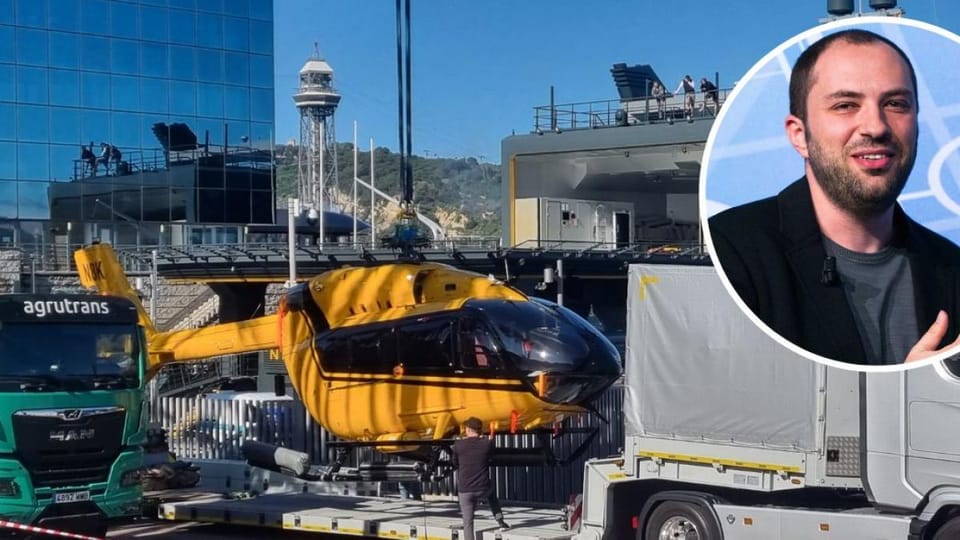
A massive crane carefully lifted a multi-million euro Airbus H145 VIP helicopter from its support catamaran, Nebula, at Barcelona's Marina Port Vell this morning. WhatsApp co-founder Jan Koum owns the aircraft. Workers transferred the luxury aircraft to a specialised transport lorry. This marked a discreet departure from the city's prominent superyacht hub.
The 68-metre Nebula, a Spanish-built support vessel, moored in Barcelona several weeks ago. It assists a larger yacht logistically. The Nebula carries auxiliary boats, diving equipment, and expedition gear. Unusually for its class, the Nebula features a hangar for two aircraft. This hangar recently held Koum's yellow twin-engine helicopter.
The lifting operation occurred near the Barceloneta restaurant and the port's control tower. A long-armed crane positioned itself at the Nebula's stern. Two heavy lorries waited on land. Workers carefully hoisted the helicopter onto a low-loader truck. Its blades were already removed. An aerospace transport company provided the truck. The operation concluded without incident, according to La Vanguardia.
Jan Koum's Luxury Fleet
Marina Port Vell maintains strict client privacy. This is standard practice in the luxury yacht sector. However, the superyacht community widely knows who owns the Nebula and its primary vessel, the Moonrise. Jan Koum co-founded WhatsApp in 2009 with Brian Acton. Both vessels belong to him.
Koum, born in Kyiv in 1976, emigrated to the United States as a young man. He worked at Yahoo before creating WhatsApp. Facebook, now Meta, initially rejected Koum and Acton as potential employees. Ironically, Meta later acquired WhatsApp in 2014 for approximately 19 billion US dollars.
Koum and Acton briefly became reluctant partners with Mark Zuckerberg. They left Meta due to disagreements over privacy values. Acton later invested 50 million US dollars in Signal, an encrypted messaging application. Many saw this move as a clear statement on his commitment to privacy.
Barcelona's Growing Superyacht Hub
Barcelona has established itself as a key port for large luxury yachts in the western Mediterranean. The city offers advanced infrastructure, technical services, and discretion. Superyacht owners value these qualities. These vessels often use Barcelona as a base. They also use locations like Monaco or Palma.
The main yacht, the Moonrise, measures almost 99 metres. This length symbolically separates large superyachts from others. The Dutch shipyard Feadship built it. They delivered it in 2020. It accommodates sixteen guests with a crew of thirty-two. The Moonrise features a deck swimming pool and a certified helipad. French interior designer Rémi Tessier designed its lounges.
The Luxury Yacht Market
The Moonrise recently entered the market. Its asking price is 325 million euros. Koum has commissioned a new, even larger Moonrise. It will measure 101 metres. This new vessel will also come from Feadship. It will include integrated Starlink satellite systems, a gym, massage room, hair salon, and a private cinema. It will also feature propeller design improvements. These will reduce underwater noise.
The helicopter's departure highlights the routine nature of high-value logistics within the luxury maritime industry. Workers in this sector are accustomed to these complex manoeuvres. Marina Port Vell and the MB92 shipyards in the industrial port area operate with a similar understanding. Everyone knows these enormous vessels are present. However, their owners' identities remain private.
Koum considers the current Moonrise "too small." It already has a helipad and a support vessel hangar. This illustrates the extreme scale of luxury in this market. The operation this morning was logistically impressive. It proceeded with professional indifference from those involved. Onlookers showed quiet surprise. This event shows the unique duality of Barcelona's waterfront. The working port and luxury leisure coexist there.
Sign up for our new entrepreneurs community Bizcelona, now accepting our second wave of applicants.
Originally published by La Vanguardia Catalonia. Read original article.