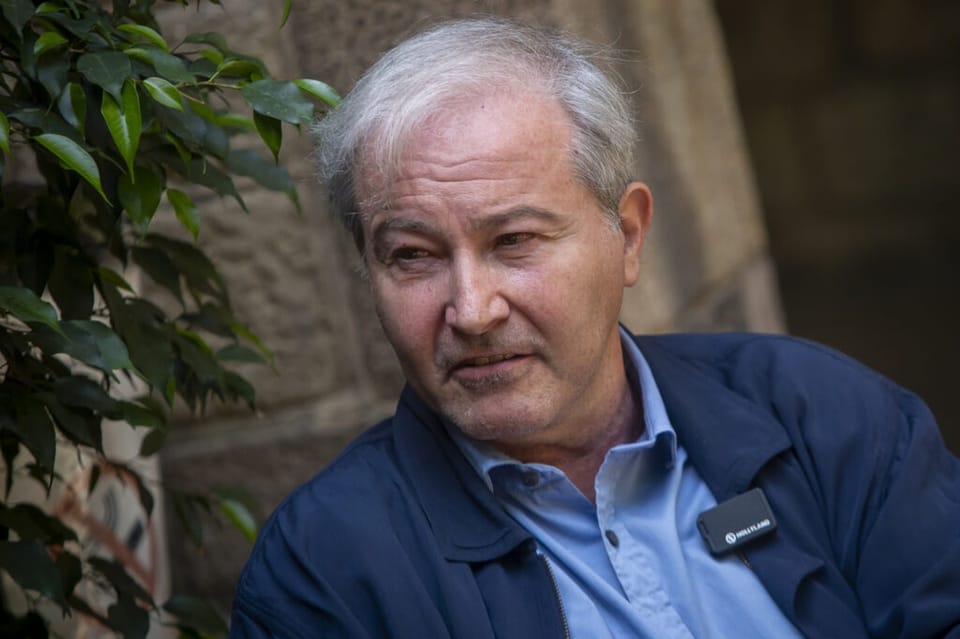
Barcelona-born writer Josep Maria Argemí recently challenged prevailing trends in Catalan literature, advocating for imagination and style over authorial trauma. During an interview at the Marès Museum garden, Argemí discussed his unique literary philosophy following the publication of his latest novel, El naixement de Venus.
Argemí, born in Barcelona in 1965, is a philologist and lawyer from the city's textile bourgeoisie. He has published five volumes of short stories and four novels over a three-decade career. For five years, he has published consistently with Lleonard Muntaner, an imprint led by Maria Muntaner.
"I am aware that I have few readers, but they are good ones and I have had them for years," Argemí stated. He explained that his readers seek more than fleeting entertainment. They look for literature understood as style, where language plays a central role in the text.
Championing Literary Ambition and Style
Argemí expressed absolute literary ambition. He does not compare his work to recent Sant Jordi bestsellers. Instead, he looks to authors like Borges, Bioy Casares, and Pere Calders. He also draws inspiration from Mercè Rodoreda's Viatges i flors, which impressed him at 16 years old.
His ambition aligns with that of Joseph Conrad and Joaquim Ruyra. It focuses on constructing a distinct style and maintaining tension in the text's structure. Argemí believes the text itself, not a "pretext," should be critical.
Argemí criticised what he sees as a major flaw in current Catalan literature. He believes many authors publish books with a "pretext of personal vindication." "The author is more important than the work," he observed.
Critiquing Autofiction and Authorial Trauma
While the author is important for creating the text, Argemí argues the author should not overshadow the work. He considers it ideal for the text to conceal the author, allowing the work to speak for itself.
Argemí noted a trend where much literature explains the author's trauma to reach readers. He referred to this as autofiction, acknowledging that good autofiction exists. He cited Annie Ernaux and Patrick Modiano as excellent examples.
These authors do not produce "tearful autofiction" where trauma is the central theme. Modiano, for instance, seeks happiness in memory and ephemeral hopes, which he revives in his texts. Argemí warned that literature directly manifesting authorial trauma often results in books resembling therapy sessions. Readers effectively pay for these sessions, he suggested.
The Power of Imagination and the Soul
Argemí strongly champions imagination as the essence of literature. He pointed to foundational Western texts like The Odyssey, The Iliad, and the Bible. These works represent an "explosion of imagination," he said.
He believes this effort is harder today than a century or two ago. There is a general public distrust of fiction that builds imagination. People often reduce imagination to "youth literature." Adults, he argued, accept literature only if it deals with explicitly realistic and traumatic themes. He described this as "almost journalistic, if not pamphleteering" literature.
For Argemí, imagination involves projecting oneself towards the idea of the soul. He sees the soul, a concept he feels is often absent today, as essential to imagination. Literature must recover the soul in its texts. This means incorporating a human, divine, and even eternal sense.
Musicality and the Writing Process
He also stressed the importance of musicality in literature. "The best virtue of a writer is to have a good musical ear," Argemí said. Prose should be fluid and musical, possessing an internal rhythm that readers do not consciously notice. This, he concluded, is the craft of writing.
Argemí does not create detailed structures or outlines for his work. He keeps the entire structure in his mind. He starts from an idea, an intuition, or even a single word, often inspired by previous readings. His literature builds heavily on earlier works.
He contrasts his "European vision" of assimilating tradition with Hemingway's "very American vision" of experiencing grand adventures. Argemí writes a first version by hand on recycled paper with a pencil. He then transfers it to a computer, producing two or three more versions. The final text often differs significantly from the initial draft.
El naixement de Venus and Beyond Genre
His latest novel, El naixement de Venus, is a choral work featuring many characters and Mallorcan lineages. It grew from his earlier novel, Les nimfes sota el sol, published by AdiA in 2018. That book explored scenes from the youth of women in a partly invented, partly real aristocratic Mallorcan family.
Argemí retained a desire to continue with some characters. His maternal family is Mallorcan, providing a cultural reference. El naixement de Venus depicts a family in decline. Argemí invents a curious, possibly false descendant, the result of an Oliver family member's extramarital affairs. This descendant's appearance creates great anticipation among several characters. Argemí includes references to his own historical lineage, the Munar de la Font, ennobled by King Martin the Humane in 1401.
Argemí considers the concept of genre "unproductive" and "uninteresting." He believes only texts exist, which can be well-written or poorly written. He cited science fiction authors like Karel Čapek, Isaac Asimov, Ray Bradbury, and Arthur C. Clarke as great writers.
He argues that genre labels serve commercial interests for booksellers. El naixement de Venus does not contain science fiction. Argemí allows his literary ambition to extend beyond that genre. It is an initially realistic novel that delves into romantic fiction, infused with a sarcastic tone. He draws inspiration from Llorenç Villalonga and his lesser-known brother, Miguel Villalonga, whose novel Miss Giacomini influenced El naixement de Venus's initial idea.
Josep Maria Argemí continues to carve a distinctive path in Catalan literature. His steadfast commitment to imagination, style, and the inherent value of the text offers a counterpoint to prevailing trends. This perspective invites readers and writers to reconsider the fundamental purpose and potential of literary creation.
Come and join our Barcelona English Speakers community on WhatsApp.
Originally published by VilaWeb Feed. Read original article.