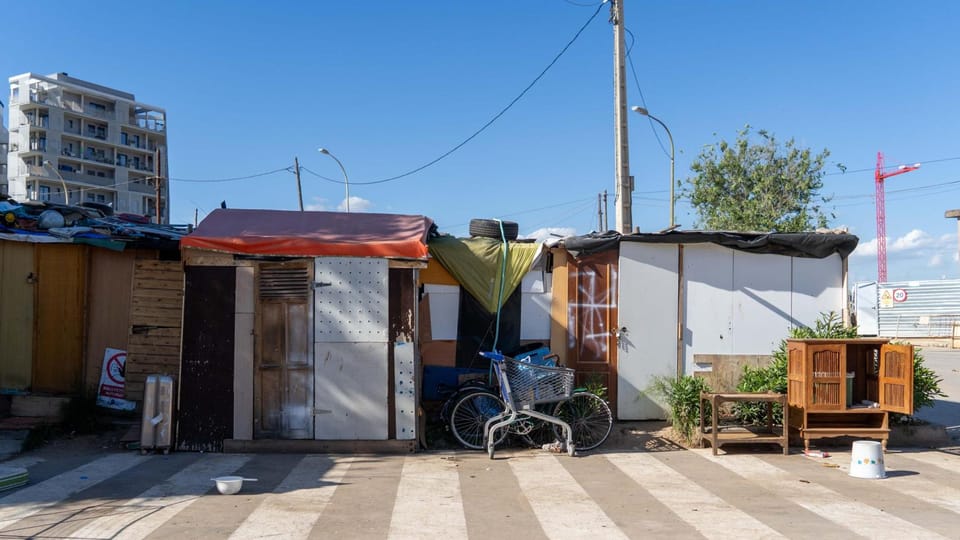
Dozens of families, including children and elderly residents, live in an expanding shantytown in Barcelona's La Sagrera district. This informal settlement exists just metres from one of Europe's largest urban development projects. The area is set to become a modern urban centre with new homes and infrastructure.
The shantytown, hidden among dirt tracks and railway scars in Sant Andreu, consists of improvised shacks made from scrap materials. These include mud, metal sheets, wood, and smoke. This forms a striking contrast to the future vision of La Sagrera, which Barcelona's Mayor Jaume Collboni presents as a symbol of growth.
Residents here face daily uncertainty. An unnamed woman, cooking over a portable stove, shared her feelings. "I know that one day this will disappear," she said. "But I do not know when. And I prefer not to think much about that because I do not know what I will do afterwards."
Life in the Informal Settlement
The settlement has its own internal structure. Romanian families primarily live in the inner part, forming an irregular circle of connected structures. These shacks create small improvised corridors and a central space for daily life. People of Moroccan origin occupy more dispersed constructions on the outer edges of the open ground.
Residents build their homes from found materials. These include pallets, advertising tarpaulins, salvaged doors, and damp wood pieces. Some shacks contain sofas or televisions, illegally connected to electricity. Others are merely a mattress protected from the rain. The environment feels provisional, yet deeply established. The unnamed woman added, "Here whole families live. There are children, there are elderly people... we live as best we can."
Recent Eviction and Official Response
Just weeks ago, authorities cleared another large settlement near the Pont del Treball Digne in La Sagrera. The eviction started before 08:00. The Guardia Urbana, Mossos d'Esquadra, Bombers (firefighters), municipal technicians, and teams from the Centre d'Urgències i Emergències Socials de Barcelona (CUESB) entered the Adif railway land. They cleared the settlement where 200 to 300 people lived.
Officials justified the action due to a serious risk following a recent fire. Marta Villanueva, Councillor for Sant Andreu, stated, "The action was taken to protect people's lives. And we want to remind you that linking up with social services is voluntary." Sebastià Massagué, Head of Barcelona Fire Department, explained that a fire in one of the 40 shacks, involving appliances, butane gas, and open fires, prompted the immediate eviction.
Waiting for the Next Clearance
In the currently inhabited shantytown, the atmosphere remains calm, but a sense of waiting persists. "Everyone knows that we will be next," the Romanian woman said, removing her pot from the fire. She showed no alarm or anger. "I am not afraid," she added. Daily life continues under its own rules. Many men leave in the mornings to collect scrap metal or seek casual work. Some women cook outside while watching their children.
Improvised washing lines stretch between shacks. Refrigerators connect to precarious electrical installations. Small common areas exist where several families sit together. The air carries a mix of damp earth, smoke, burnt plastic, and hot food. Dogs act as constant alarms, briefly disrupting the settlement's balance when a stranger enters. The woman admitted, "I do not see any solution." She then fell silent.
Community Concerns and Future Uncertainty
The La Sagrera Neighbourhood Association criticised the Ajuntament (City Council) after the last eviction. They stated that the council did not offer enough housing alternatives. The association reported that many people ended up in an even more precarious situation. Local residents have also complained for years about dirt, insecurity, and institutional neglect in these areas.
This situation highlights a stark contradiction. La Sagrera symbolises Barcelona's urban future, yet it coexists with extreme poverty. The unnamed woman finished cooking. She looked around at the shacks built close together, at children playing among metal scraps, and at the railway tracks. "We know this will end," she said. She does not know when the eviction will arrive. She also does not know where she will go afterwards. Perhaps that is why she prefers not to think about it too much. While Barcelona imagines a green, modern, and connected La Sagrera filled with new homes, dozens of people continue to live among portable stoves, mud, and scrap metal, waiting for the day someone tells them they have two hours to leave.
Come and join our Barcelona English Speakers community on WhatsApp.
Originally published by Metrópoli Abierta - Urban Life. Read original article.