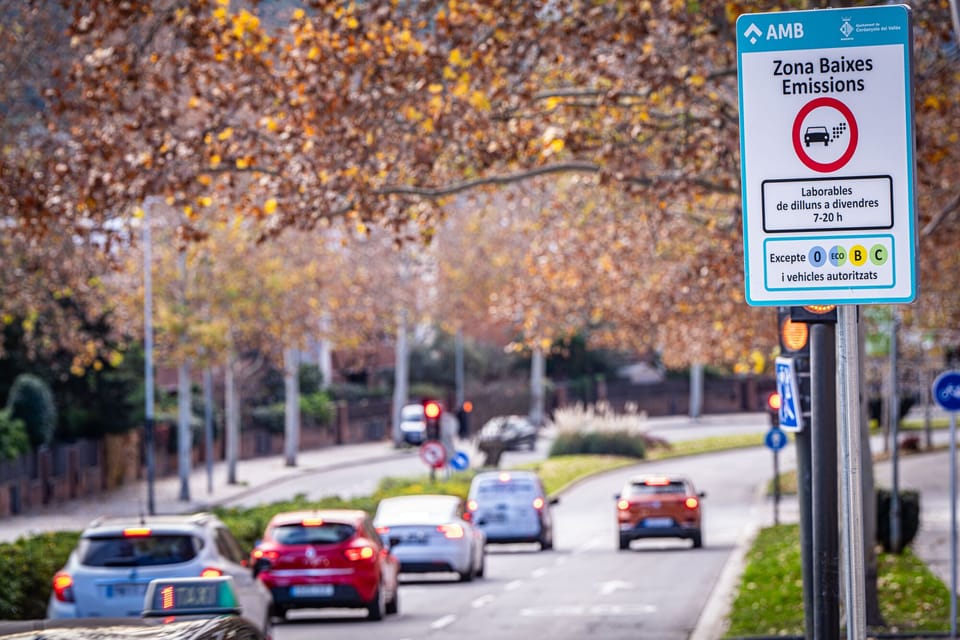
Four cities in the Baix Llobregat area will introduce Low Emission Zones (ZBE) in 2026. However, most councils plan to delay fining local residents for several years. This expansion affects Sant Vicenç dels Horts, Molins de Rei, Sant Feliu de Llobregat, and Sant Just Desvern.
Sant Vicenç dels Horts and Sant Feliu de Llobregat have already approved initial ordinances. Sant Vicenç will not fine registered residents until 2030. Sant Feliu will delay fines until 2028. This means cars without environmental labels can enter ZBEs in these areas without penalty.
Molins de Rei municipal sources state the local government supports a fine moratorium. They expect an ordinance approval before summer. Sant Just Desvern City Council, however, currently has no moratorium project planned. They anticipate approving their ordinance by summer, covering the entire municipal area with a ZBE.
Miguel Comino Haro, Mayor of Sant Vicenç dels Horts, explained the decision. He said, "We have approved a moratorium because poor air quality is not the fault of Sant Vicenç residents. Its origin lies in the infrastructures that cross us, like the A-2 and B-23, with nearby industrial estates."
Local Concerns Drive Delays
The mayor also cited "a lack of responses" from the bus service. He mentioned the "complex economic situation" in the municipality as reasons for the delay. This approach follows the model of Cerdanyola del Vallès. That metropolitan municipality first introduced moratoria in the Barcelona area with the Barcelona Metropolitan Area (AMB) approval. Castelldefels and Santa Coloma de Gramenet have since adopted similar measures.
These four cities in the Baix Llobregat area are home to approximately 124,000 residents. The main argument for postponing fines centres on public transport deficiencies. These services often cannot replace restricted private vehicles. This is particularly true in towns where the AMB has not yet taken over bus concessions. Additionally, with municipal elections a year away, mayors are hesitant to activate an unpopular measure.
Government Pressure and Air Quality
These new ZBEs in cities with 20,000 to 50,000 residents are already a year behind schedule. A Catalan decree required restrictions "before 1 January 2026". City councils are now accelerating implementation. This is because the Spanish government links state aid for public transport to ZBE activation. The AMB, for example, receives approximately 52 million euros in such aid.
An annex from the Catalan government's Directorate General for Climate Change and Environmental Quality also drives the measure. This document, issued late last year, details municipalities with poor air quality. These areas exceeded legal pollution values between 2020 and 2024. Sant Vicenç, Molins de Rei, Sant Feliu, and Sant Just appear on this list. However, 24 other towns, despite being legally obliged to implement ZBEs, are exempt this year. They did not breach pollution limits.
Coordinated Approach Needed
Mayor Comino reiterated his support for air quality measures. He noted, "I am a firm defender of measures to improve air quality; in the area of the Barcelona ring roads, it has worked very well." However, he stressed the need for coordinated implementation. "Our moratorium also responds to being surrounded by cities without ZBEs, such as Torrelles de Llobregat or Pallejà. That discontinuity would not make much sense," the mayor added.
Future Vehicle Restrictions
ZBE implementation timelines in Catalonia closely link to restrictions on different environmental labels. Until now, vehicle bans only applied to cars without an environmental label. The next significant policy change for Catalonia will occur in January 2028. Catalan regulations then plan to activate ZBEs for vehicles with a 'B' (yellow) label. The AMB has included this 2028 forecast in its new urban mobility roadmap for 2030.
Officials expect Barcelona city to initiate the 'yellow label' restrictions after the 2027 municipal elections. This mirrors the original ZBE Rondas, which included Barcelona, L'Hospitalet, Cornellà, Esplugues de Llobregat, and Sant Adrià de Besòs. Restricting 'yellow label' vehicles is a sensitive issue for councils. It affects a large segment of vehicles in cities with older car fleets. Data from the Directorate General of Traffic (DGT) shows that vehicles without labels and 'B' label cars constitute over half the fleet in major cities. These include Barcelona, L'Hospitalet, Terrassa, Badalona, Sabadell, and Mataró.
Come and join our Barcelona English Speakers community on WhatsApp.
Originally published by El Periódico Barcelona. Read original article.