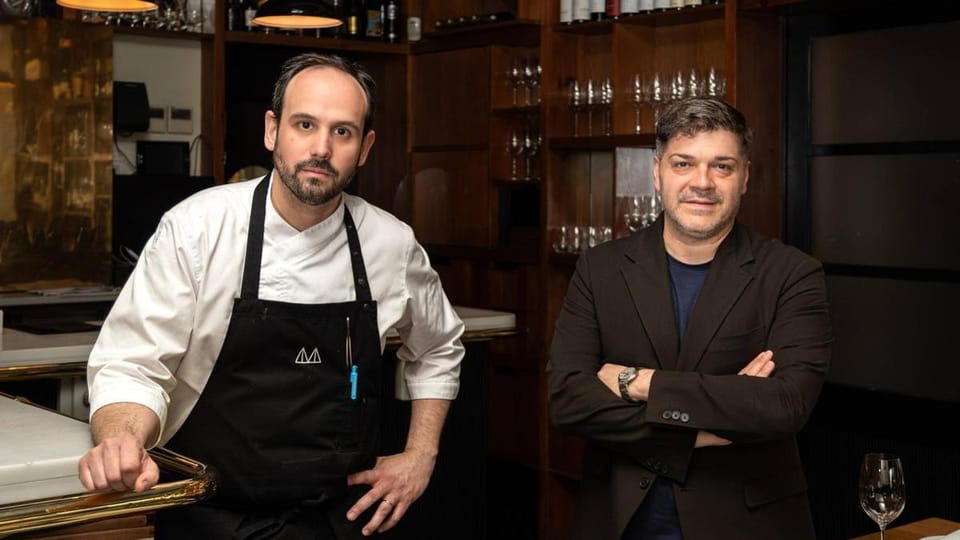
Barcelona's Mont Bar has earned two Michelin stars. The restaurant operates from a compact 30-square-metre dining room. This achievement marks a significant moment in the city's culinary scene, highlighting an innovative approach to high-end gastronomy within a remarkably small footprint.
The establishment, located in central Barcelona, started in 2013 with humble aspirations. Its name, 'Mont Bar', reflects these initial modest goals. Founder Iván Castro is originally from Vall d’Aran. He named the restaurant partly after his hometown. The name also signified its initial simple concept. Castro recalled the early days when he hoped people would visit "to snack before or after going to the cinema". Today, the clientele has shifted dramatically. It now attracts international diners, such as a couple recently visiting from Dubai. This marks a clear departure from its original local focus.
The Visionary Team Behind Mont Bar
Fran Agudo, who joined Mont Bar as head chef in October 2020, drives the restaurant's culinary vision. Agudo previously served as head chef at the renowned Tickets restaurant and also spent time at El Celler de Can Roca. He describes his cooking philosophy as "a free kitchen, without barriers, where technique is invisible". Agudo, born in Andújar, Jaén, and raised in Lloret, credits his self-taught chef father, Bernardino, for inspiring his passion for cooking. Iván Castro, the founder, manages the front of house and operations, seeing himself as the "worker" to Agudo's "artist". Kasaundra Williams, Castro's partner, serves as the Operations Director, ensuring the restaurant runs smoothly.
Overcoming Space Constraints
The restaurant's compact 20-square-metre kitchen presents unique operational challenges for the team of 12 people working inside. However, Agudo maintains that space does not limit their creativity. "If you think about limitations, you do nothing. We have forbidden it," Agudo stated. He added, "We work on the spot, 'à la minute'". This commitment allows the team to produce complex, precisely resolved dishes despite the tight quarters. Plating often requires skilled hands and tweezers for intricate details.
A Shift from Traditional Fine Dining
Mont Bar serves 39 diners across three daily shifts, with 13 guests per service. This is a stark contrast to the 130 people they served daily before receiving their first Michelin star. The restaurant offers both two tasting menus and an à la carte option, a complex operational model for such a small venue. Iván Castro believes their success stems from a public weariness of traditional formality. "We get tired of everything, also of tablecloths and 'fine dining'," Castro explained. "We adapt to the client, to what they want. Do they want à la carte, do they want a menu? They are not looking for comfort in a traditional sense. They are looking for this." This "this" includes a mix of low and high tables, bar seating, custom-designed crockery, and quality napkins, creating a relaxed yet refined atmosphere.
Signature Dishes and Consistent Presence
The menu features intricate dishes such as the enduring tuna belly with pine nuts, a tribute to their past, alongside new creations. Other notable items include mushroom crisp, dry meringue with sea urchins, puffed bread filled with dashi foam, and a chicken skin and squid bikini. Diners can also enjoy turbot with beurre blanc and caviar, guinea fowl and red prawn surf and turf, and a version of the Montblanc tart. Iván Castro and Fran Agudo maintain a constant presence in the restaurant, a factor Castro considers critical to their quality. "Consistency is being here every day, every day, every hour," Castro affirmed, highlighting their hands-on approach to maintaining high standards.
Broader Impact on Gastronomy
Mont Bar's dual Michelin stars, awarded in 2026, within its modest setting, challenge the Michelin Guide's historical tendency to favour larger, more predictable establishments. This recognition aligns more with the guide's flexibility seen in Asia, where efficient, smaller venues, including market stalls, receive accolades. The restaurant's success suggests a broader shift in what constitutes high-end dining, moving away from stiff formality towards a more adaptable, client-focused experience. This approach offers a fresh perspective on fine dining in Barcelona and beyond, proving that exceptional culinary experiences do not require vast spaces or rigid traditions.
Come and join our Barcelona English Speakers community on WhatsApp.
Originally published by El Periódico Barcelona. Read original article.