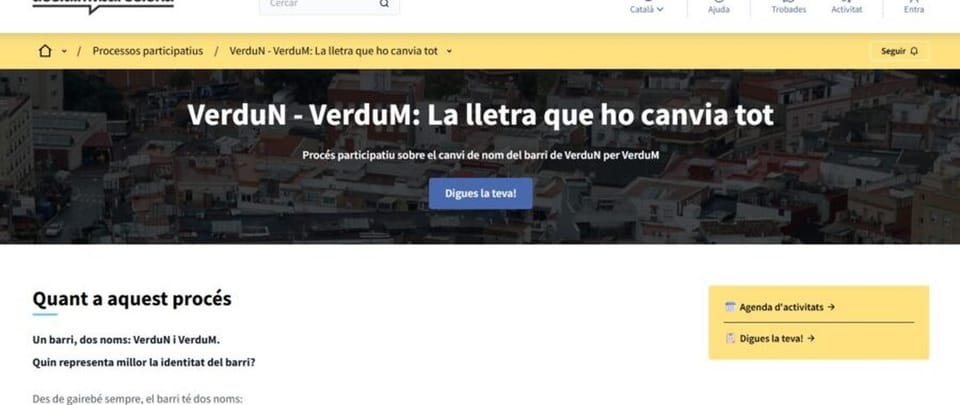
Barcelona's Nou Barris district has launched a participatory process for residents of the Verdun neighbourhood to decide its official name. From 8 May to 19 June, locals can vote on whether the area should be called "Verdun" or "Verdum". This initiative aims to strengthen local identity and historical awareness within the community.
The process, titled "Verdun/Verdum, the letter that changes everything", includes guided walks and information points across the neighbourhood. It also features an online survey on the municipal participation website, decidim.barcelona. Residents aged over 14 and registered in the Nou Barris district can participate in this important decision.
Xavier Marcé, the Nou Barris District Councillor, stated, "We have decided to open this participatory process because we want the residents themselves to define their neighbourhood's identity." He added, "For years, an informal debate has existed about whether the name should be written with an 'N' or with an 'M', and now we are giving it a formal, transparent, and open space."
Community Support for the Name Debate
The initiative has strong support from deeply rooted local organisations. These include the Associació de Veïns i Veïnes del Verdum, which has promoted this debate for years and conducted an informal consultation in 2023. The Centre d’Estudis Populars i Arxiu Històric de Roquetes also backs the effort, helping to ensure broad community engagement.
The current Verdun neighbourhood was incorporated into the municipality of Sant Andreu de Palomar in the 18th century. After the War of the Spanish Succession, it was a forested area that gradually transformed into farmland with the first constructions. Barcelona annexed Sant Andreu in 1897, and urbanisation of the zone began soon after.
In 1919, the Ajuntament de Barcelona approved the name "Passeig de Verdun". This commemorated the Battle of Verdun in France during the First World War. More than 6,000 Catalan volunteers served in the French army during that conflict. The neighbourhood as it is known today did not exist at that time, but the name marked the area.
The Emergence of "Verdum"
The 1920s saw the first documented use of "Verdum" in land sale advertisements for the area. This period also marked the founding of the Centre Cultural Els Propis, an important local institution. Additionally, "verdum" is the Catalan word for greenfinch (Chloris chloris). An ornithological association in the neighbourhood used this name in the 1930s, further embedding the alternative spelling locally.
Following the Spanish Civil War, extreme poverty led the Franco regime to change some street names. The city also started building hundreds of homes to house squatters from other parts of Barcelona. In this context of rapid population growth, without basic schools or sanitation infrastructure, the Ajuntament began to officialise the name "Verdun". This distinguished the area from nearby neighbourhoods like Les Roquetes and La Prosperitat.
Residents campaigned for years to bring basic services to the neighbourhood. In 1984, the Verdun neighbourhood officially became part of the Nou Barris district. This historical background provides important context for the current debate, highlighting the evolution of the area's identity.
How Residents Can Participate
The online survey runs until 19 June. To participate, individuals must enter an official document number. This confirms their registration in the Nou Barris district and ensures single voting. The system maintains anonymity, recording no personal data from participants. Information points will also have facilitators present to help with digital participation for anyone interested.
Councillor Marcé emphasised the government's desire to "recognise this concern and turn it into an opportunity for dialogue and cohesion." He added that the goal is to "listen to the neighbourhood's opinion with all official guarantees and with a rigorous process." This also serves to help residents learn about the history and origin of both name forms, fostering a deeper connection to their home.
After 19 June, officials will prepare a report detailing participation data and support for each name option. It will also include residents' feedback, proposals, and arguments. The Ajuntament's participation regulations state that the council must explain its next steps within 60 days of receiving this report. This process aims to reinforce community cohesion and belonging, placing residents' voices at the centre of their neighbourhood's future.
Sign up for our new entrepreneurs community Bizcelona, now accepting our second wave of applicants.
Originally published by Barcelona City Council Press Room. Read original article.