

Barcelona has proposed the historic Ramon Llull residence Barcelona as the headquarters for Spain’s future State Public Health Agency. This architectural jewel within the Escola Industrial houses a striking modernist chapel on its upper floor. Currently closed to the public, the building remains one of the city’s hidden treasures. This proposal highlights Barcelona’s rich architectural history. Indeed, this focus is timely, considering Barcelona’s designation as World Capital of Architecture in 2026.
City officials have formally put the building forward as a candidate. The site is centrally located in the Eixample district. However, its primary asset is its historical and artistic significance. Joan Rubió Bellver, a disciple of Antoni Gaudí, remodelled the residence in the 1920s. He transformed an old textile factory into a space for students.
Your browser does not support the video tag.
Home » Ramon Llull Residence: Barcelona’s Proposed State Public Health Agency HQ
The Ramon Llull residence Barcelona: A hidden masterpiece
The building’s defining feature is a deconsecrated chapel on the top floor. This placement breaks with traditional religious architecture of the era. Rubió Bellver, who also designed the famous neo-Gothic bridge on Carrer del Bisbe, created a space filled with distinct textures, colours, and shapes. These elements reflect the transition from Modernisme to Noucentisme.
The chapel sits directly above former student dormitories. For decades, students living in the residence could access the space for worship. Today, few pedestrians realise this significant work of Catalan architecture exists beneath the roof.
Secular saints and industrial history at the Ramon Llull residence
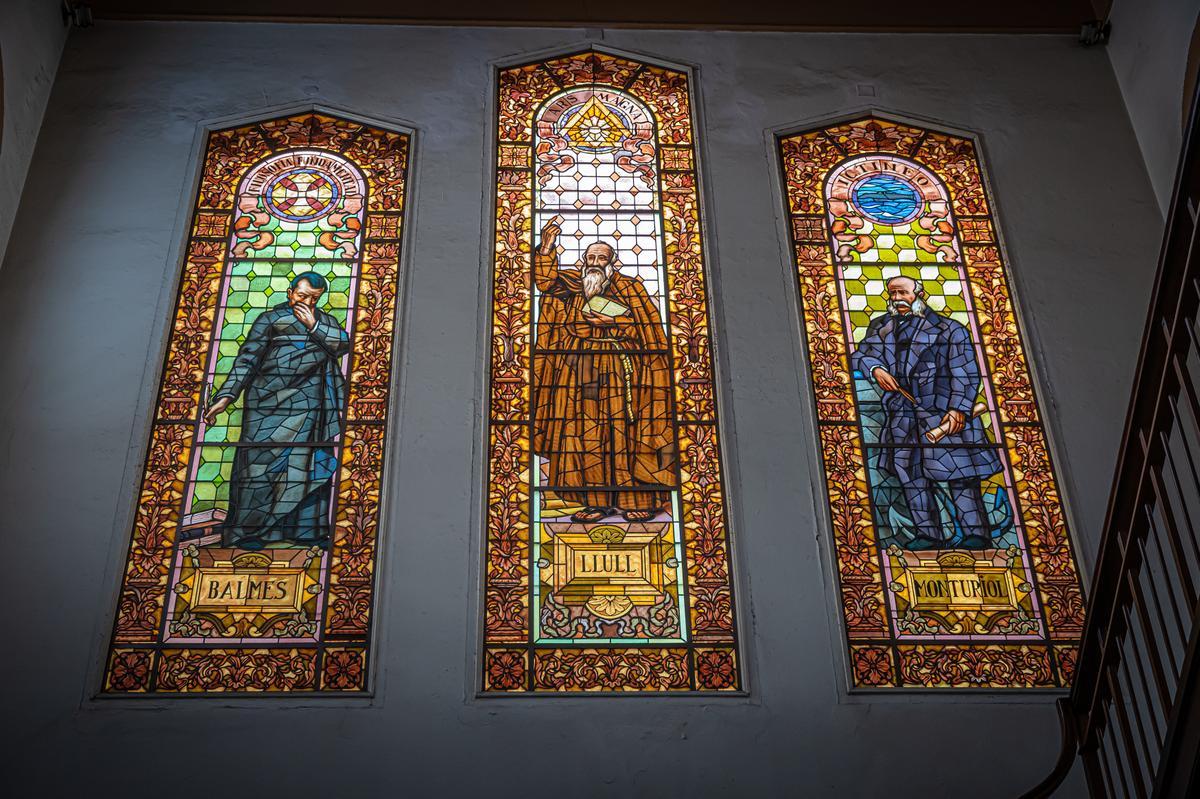
The interior design reflects the building’s academic and industrial roots. Large stained-glass windows on the main staircase illuminate the ascent. While they appear to depict saints, the figures are actually secular Catalan icons. These include philosopher Jaume Balmes, polymath Ramon Llull, and engineer Narcís Monturiol.
The inclusion of Monturiol, inventor of the Ictineo submarine, aligns with the site’s history. The complex began as the Batlló family textile factory. The Mancomunitat de Catalunya later converted it into the Escola Industrial. Rubió Bellver arrived in 1925 to convert the agricultural school into the student residence. He designed grand corridors and staircases originally intended for a Catalan Ministry of Agriculture. However, this ministry never materialised due to the Primo de Rivera dictatorship.
Alternative plans for the Ramon Llull residence Barcelona
If the State Public Health Agency is not established in Barcelona, local authorities have a backup plan. The Diputació de Barcelona intends to renovate the building into a modern residence for researchers. Under this proposal, the historic chapel would become a multi-purpose hall for conferences and study.
This potential renovation aims to update the facilities for 21st-century use. It will also preserve the heritage elements. The building, including its famous false bridge nearby, will mark its centenary in 2028. According to reports in El Periódico, the final decision will determine public access. Therefore, this architectural rarity may open through a state institution or an academic facility.
Apply to join our community of Entrepreneurs, Senior Executives and Founders at Bizcelona .
