

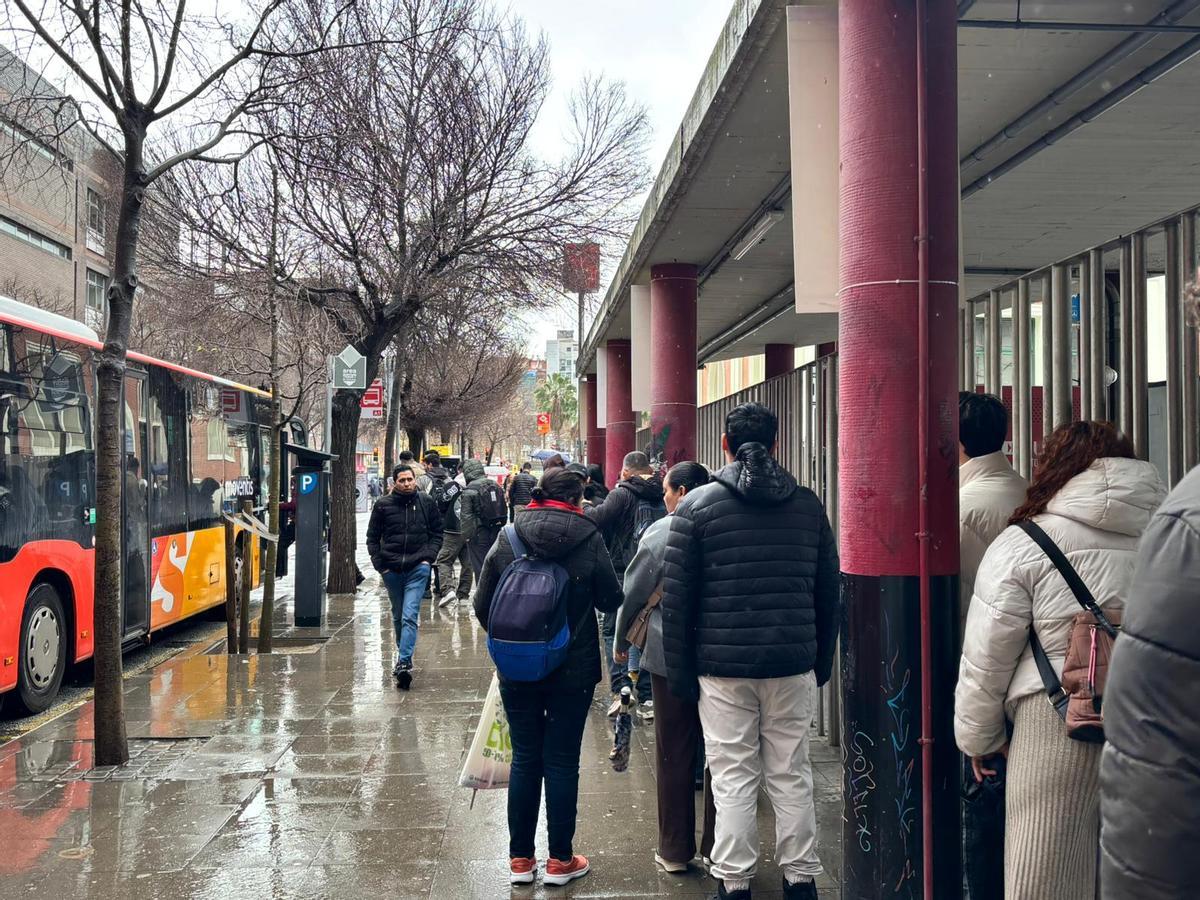
The Rodalies collapse has caused a second consecutive day of severe travel disruption in Barcelona. Consequently, thousands of passengers were forced onto an overwhelmed bus network on Thursday. Meanwhile, rain and cold weather compounded the misery at Fabra i Puig station. Travellers reported kilometre-long queues and widespread confusion regarding alternative transport options. Therefore, the widespread disruption stems from an ongoing dispute. Indeed, Rodalies train drivers are refusing to resume services without a written safety guarantee from the network operator.
While bus frequencies have reportedly increased compared to Wednesday, the sheer volume of displaced train passengers has left many unable to board vehicles. In addition, users at the station described the situation as chaotic. Safety limits on bus capacity left hundreds waiting on pavements for extended periods.
Your browser does not support the video tag.
Home » Rodalies Collapse: Barcelona Bus Chaos Enters Second Day
Rodalies Collapse Causes ‘Horrible Logistics’ and Delayed Journeys
For residents in the metropolitan area, the Rodalies collapse has turned routine commutes into multi-hour ordeals. Adrián, a resident of Montcada i Reixac, reported that his usual one-hour journey took two and a half hours on Thursday morning. He described watching at least six or seven buses pass him by because they were already full. The shift to alternative transport has affected the entire city. For example, reports show that traffic on Barcelona’s ring roads surged by up to 11% as people turned to private vehicles.
“The logistics have been horrible,” Adrián told reporters. He explained that buses do not originate in his municipality. Therefore, they arrive at Montcada already at maximum capacity. Drivers have been strictly enforcing passenger limits for safety reasons. This forces commuters to rely on luck to find a free seat.
Rodalies Collapse Leaves Commuters ‘Helpless’
The Rodalies collapse has had significant personal consequences for those relying on public transport. Irene, a student who travels between Passeig de Gràcia and Sant Celoni, missed an exam on Wednesday due to the delays. On Thursday, she was forced to ask friends for a car ride to Granollers just to attempt to catch a bus. Her hometown lacks a direct bus connection to Barcelona. The problem became so widespread that the University of Barcelona suspended exams due to the Rodalies disruption. The university acknowledged the severe impact on students.
Paola, a regular user of the R2 line, expressed frustration at what she perceived as a failure to deliver promised support. Despite leaving home two hours early, she found herself stuck in queues stretching across the platform. According to a report by El Periódico, Paola disputed claims of reinforced services. She noted that buses were arriving at their standard half-hour intervals rather than the promised 15-minute frequency. “We are helpless,” she said.
Confusion Persists Despite Operational Changes
Municipal sources indicated that an operation involving informants and security agents had been deployed to manage the crowds. Staff were observed at Fabra i Puig attempting to direct passengers. However, many travellers criticised the quality of the information provided.
Commuters travelling to Barberà del Vallès and Granollers reported being told to wait in the same queue. This created friction and uncertainty. However, by the afternoon peak at 2:00 p.m., some improvements were visible. The busiest lines, particularly those serving Granollers and Sabadell, were maintaining a frequency of approximately 20 minutes. Therefore, some passengers could board more quickly than on the previous day.
Join Barcelona English Speakers WhatsApp Community .
