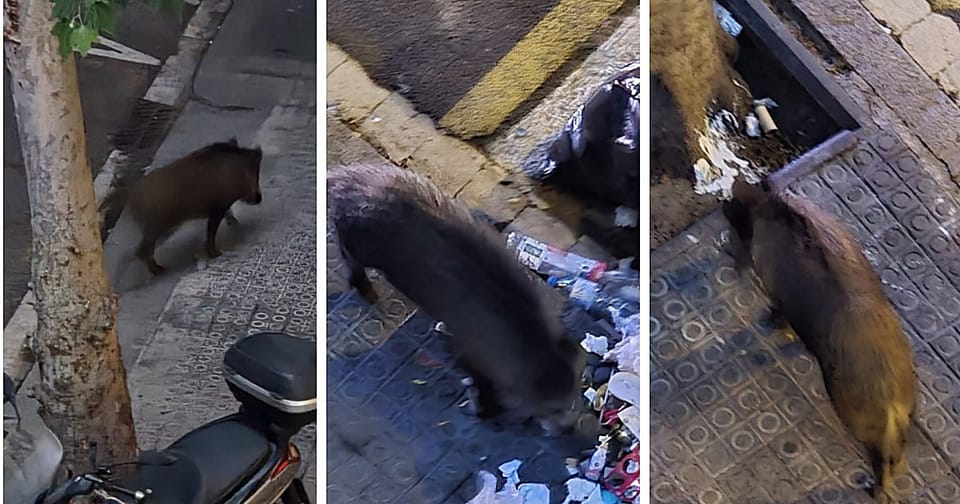
A wild boar ventured deeper into Barcelona than ever recorded, crossing Gran Via in the early hours of 4 May before Forest Agents euthanised it in the Eixample district. This incident highlights the ongoing challenge of urban wildlife management and public health concerns related to African Swine Fever.
Unprecedented Urban Penetration
Residents of Carrer Casanova 31, located between Gran Via and Sepúlveda, photographed the boar rummaging through rubbish at approximately 03:00. The Urban Guard and Forest Agents confirmed this sighting. This marks the first known instance of a wild boar reaching so far into the city from its natural habitat in Collserola Natural Park. The animal traversed the Sarrià and Eixample districts towards the sea, almost reaching the Raval.
Forest Agents received an initial alert about a wild boar near Plaça del Gall and Avinguda de Roma. A Special Animal Capture Group patrol from the Forest Agents responded quickly. They assessed the situation and euthanised the animal at Carrer Casanova 56, between Diputació and Consell de Cent. This action followed established African Swine Fever (ASF) protocols. Officials aimed to prevent risks to road safety and public security.
Public Safety and Disease Prevention
A second Forest Agents patrol then removed the animal. They collected biological samples to test for the ASF virus, adhering strictly to biosecurity measures. Forest Agents warn that wild boar presence in urban areas is increasing. These animals often find easy food sources in city streets, drawing them further into residential zones.
The Eixample district, home to over 260,000 residents, faces particular challenges with waste management. Residents of Carrer Casanova 31 have repeatedly reported issues with containers outside their building. They describe these bins as a constant source of dirt, rats, and now wild boars. "It's the last straw. We haven't stopped reporting that these containers are badly located," residents stated, expressing their frustration.
Resident Frustrations with Waste Management
These residents have suffered for weeks from a person systematically scattering rubbish from the containers. Additionally, employees from a nearby supermarket reportedly overfill these specific bins with leftover food. This causes them to overflow while other local bins often remain empty. "Rubbish on the ground, smells, cockroaches, rats... and now, a wild boar, it's unbearable," residents of Carrer Casanova 31 complained, highlighting the worsening conditions.
This incident occurred ten days before the Generalitat's Department of Agriculture announced new ASF findings. The department detected 14 new positive ASF cases in wild boars during the previous week. These cases were found across high and low-risk zones within Catalonia. During the same period, authorities captured 346 wild boars in these areas as part of ongoing culling efforts.
Ongoing African Swine Fever Efforts
Councillor Òscar Ordeig spoke after a meeting of the Wild Boar Table. He detailed that authorities have captured and analysed 5,277 wild boars in risk zones in total. Ordeig stated these figures "enter within the normality of carrying out this sanitary emptying and at the same time carrying out this tracking to empty this entire area." He asked the public to allow technicians to work without interference.
Ordeig addressed questions about easing mobility restrictions in affected zones. He said, "We are working as quickly as possible to be able to de-escalate as quickly as possible." He also requested prudence, understanding, and apologised to citizens whose routines are disrupted by these measures. Ordeig urged collaboration and empathy from the public during this critical period.
He confirmed officials are studying ways to make mobility more flexible in the risk zone. This requires approval from technical and scientific experts. Ordeig warned that "the consequences could be very negative" if they take steps backwards in managing the disease. He specified that the ASF "zero zone" now has "practically no animals," estimating around 20 remaining wild boars. The subsequent four zones contain approximately 230 wild boars. Determining numbers in denser forested areas proves more difficult, according to Ordeig.
Sign up for our new entrepreneurs community Bizcelona, now accepting our second wave of applicants.
Originally published by ABC Cataluña. Read original article.