

The Zona Franca homeless settlement is home to Chahine, a 25-year-old Algerian law graduate. He has lived on Carrer número 2 for two months. After leaving North Africa for stability, he arrived in Barcelona hoping to find work. He wants to bring his wife and young daughter to join him in Europe.
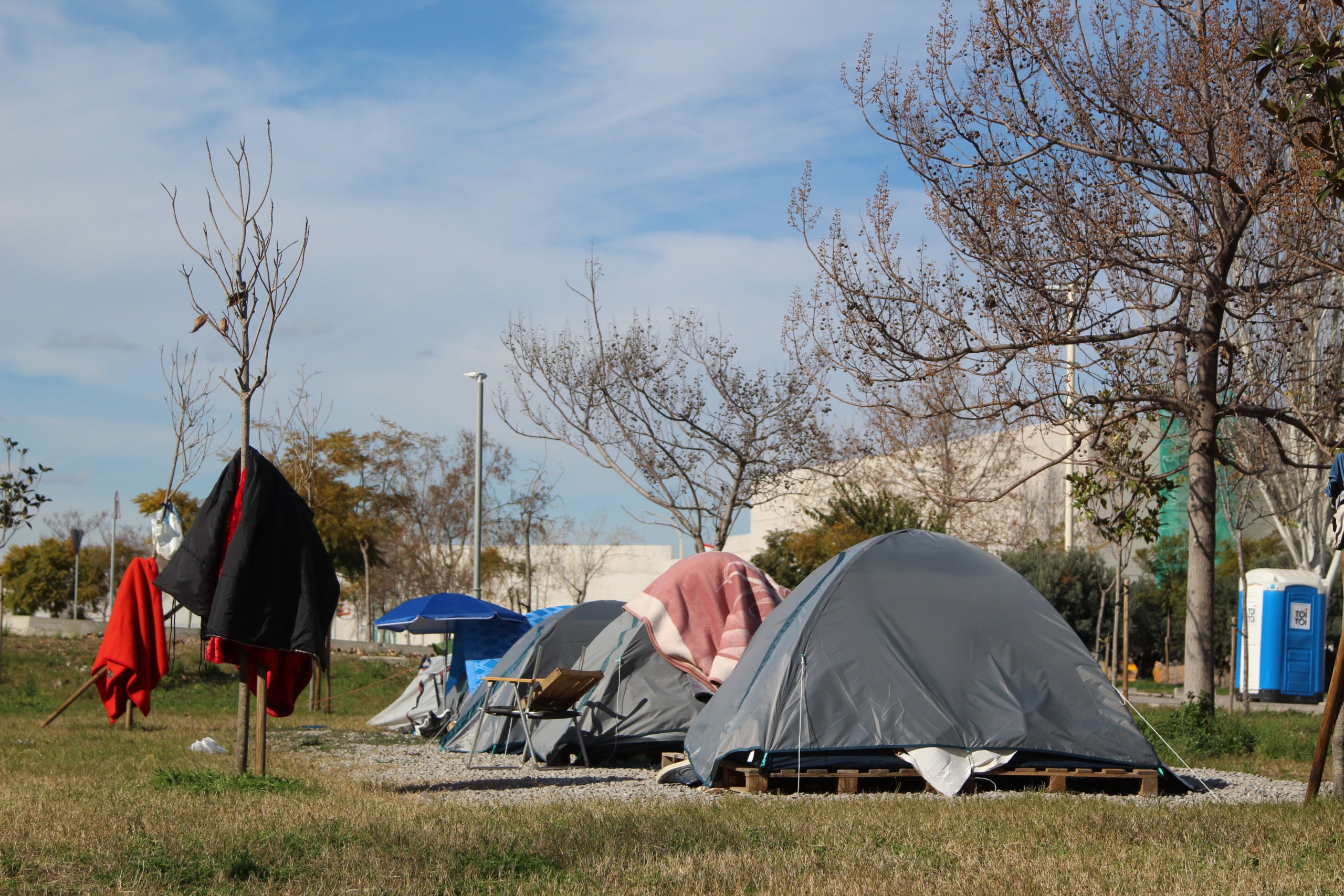
Instead, he shelters from the cold and rain in a small camping tent. The tent is barely large enough for a mattress, a blanket, and a suitcase. He shares a rectangular patch of flowerbed with three compatriots. This forms one of the many clusters in the Zona Franca homeless settlement.
Your browser does not support the video tag.
Home » Zona Franca Homeless Settlement: Inside Barcelona’s Migrant Encampment
“It is very difficult to prosper. If you don’t have papers, you don’t have a job. I just want to work to help my family,” Chahine told local news outlet Tot Barcelona. Like many others in this sprawling encampment, he finds himself trapped in a cycle of bureaucratic limbo.
Zona Franca Homeless Settlement: “In Plaça de Catalunya, We Are a Nuisance”
The Zona Franca homeless settlement spans approximately 400 metres between two roundabouts in the industrial estate. It has grown significantly. What began as a cluster of eight tents has expanded to nearly 200. Despite the difficult conditions, residents describe the location as a strategic retreat from the city centre. Police pressure is intense there.
“We cannot go to a shelter or rent. Where do you want us to go? Plaça de Catalunya? Here we are not a nuisance, we are quiet,” said Oualid, another young Algerian who has lived in the camp for a year. “I just ask people to put themselves in my place. We have nowhere to go. Here, at least, they don’t steal your things while you are out trying to make a living.”
The demographic of the settlement is strikingly diverse. Flags from across the globe-including Palestine, Colombia, and the Dominican Republic-fly beside tents. Residents report that many among them hold higher education degrees from their home countries. However, they cannot validate them in Spain. Chahine often acts as an interpreter for his neighbours. Many of them speak multiple languages.
Zona Franca Homeless Settlement: Precarious Conditions and Public Health Concerns
Life in the Zona Franca homeless settlement is dictated by access to the nearby Centre de Primera Acollida (First Reception Centre) on Carrer 60. The centre provides food and clothing. However, shower access is restricted to once a week.
“Before, I showered every day, but here I have to go five days without doing it. It’s not easy,” Chahine admitted. While residents say they strive to keep their areas clean, the accumulation of waste has attracted rats. This raises concerns about sanitation and public health.
Luis, a Peruvian national with a degree in business administration, has lived in the camp for two years. He is currently waiting for his municipal registration (empadronament) to be finalised. This is a crucial step toward regularisation.
“I have a degree… but here, without a work permit, I can’t work in that. In these three years, I have worked in construction and doing manual labour. They have always paid me a pittance or ended up scamming me,” Luis explained. He fears that eviction may come before he can secure his legal status.
Zona Franca Homeless Settlement: Political Pressure to Evict
The visibility of the camp has drawn political attention. The municipal group of the People’s Party (PP) has formally requested that the executive government of Mayor Jaume Collboni evict the settlement at Carrer número 2. The party argues that the camp is “growing without control”. It also says the camp creates coexistence issues with workers in the industrial estate.
“Barcelona cannot allow illegal settlements to be perpetuated in different points of the city that affect those who barely survive there, especially minors, and the neighbours,” the PP stated recently.
However, for residents like Luis, the prospect of eviction without an alternative housing solution brings back memories of similar actions in Badalona. There, settlements were cleared with little resolution for the inhabitants. The need for alternative housing highlights the ongoing challenges of increasing the public housing stock in the city. “If you don’t want them to take your things, it’s better to leave before,” he noted. He acknowledged the precarious tenure of their makeshift homes.
For now, the residents of the Zona Franca homeless settlement remain in a holding pattern. They pin their hopes on government regularisation programmes to reintegrate into society. “We cannot get out of this reality without that,” Chahine concluded. “I just want to work.”
Join Barcelona English Speakers WhatsApp Community .
