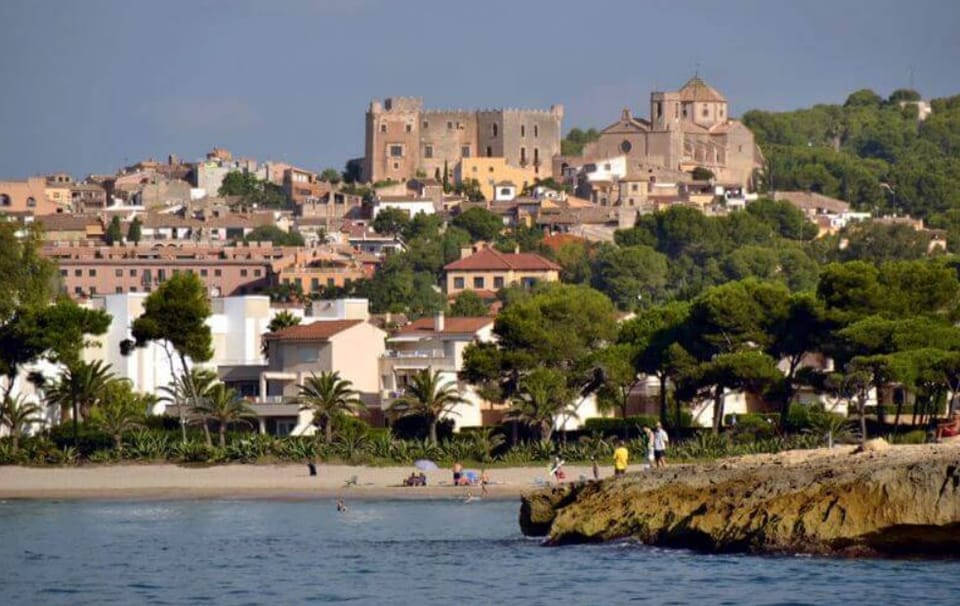
Altafulla, in Tarragona and about 70 kilometres from Barcelona, makes an easy day trip for readers in the city looking for a mix of medieval streets and Roman history. The town has around 5,800 residents and is best known for its walled old quarter, the Vila Closa, and the nearby Els Munts Roman Villa.
The Vila Closa is Altafulla’s historic centre. Visitors can walk its sloping stone streets, see old gateways, central squares, the Church of Sant Martí, and the remains of the old wall. The Catalan Government declared the ensemble a Cultural Asset of National Interest in 1998. Although many of the houses visible today date from the 18th century, records trace the area’s origins to the second half of the 11th century.
Above the old quarter stands Altafulla Castle. The building still looks like a fortress, even though much of its current form comes from later work, especially in the 17th century. It remains privately owned, but since 2019 visitors have been able to join guided tours by booking in advance.
Just outside the old town is the Els Munts Roman Villa, part of the UNESCO World Heritage archaeological site of Tarraco. According to the Tarragona National Archaeological Museum, a large and luxurious villa was built here in the early 2nd century AD for the elite of Tarraco, the provincial capital of Roman Hispania.
At Els Munts, visitors can see remains of mosaics, wall paintings, residential areas and thermal baths. The site gives a clear picture of how Roman elites lived by the Mediterranean, close to one of Roman Spain’s major centres of power. For more Barcelona-area day trip ideas, see our Community coverage and Sport updates.
Getting there from Barcelona is straightforward. Driving takes about an hour, depending on traffic, via the AP-7 or C-32 towards Tarragona, then on to Altafulla. The train is also a practical option, with Altafulla-Tamarit station linked to Barcelona Sants and journey times of roughly an hour, depending on the service. From the station, visitors can walk towards the beach area and then continue to the old town.
Originally published by ABC Cataluña. Read the original article. For official background on the Roman site, see the Tarragona National Archaeological Museum and UNESCO’s Tarraco listing.