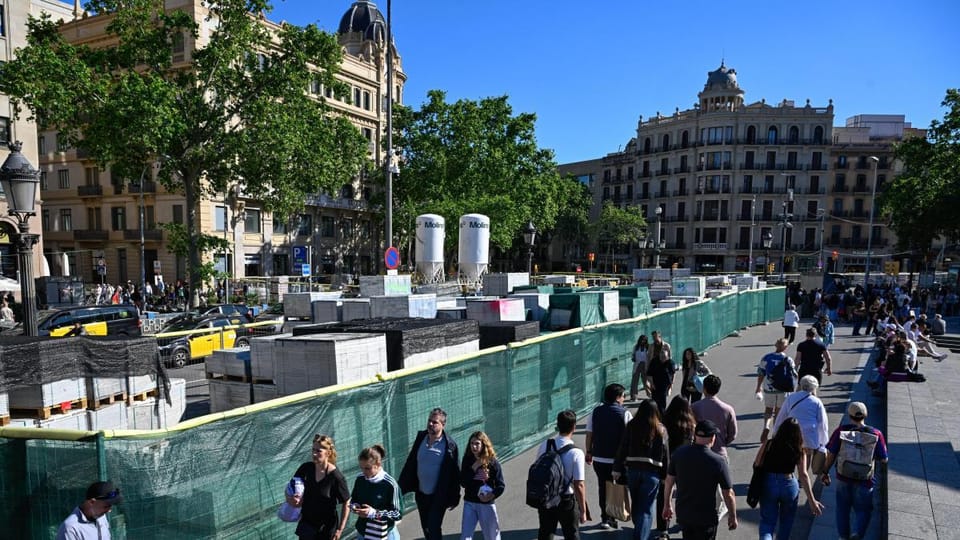
Barcelona currently manages 293 public works projects across the city, with the city government pushing to complete many before the 2027 municipal elections. This extensive effort aims to minimise disruption for residents and visitors.
The total number of ongoing projects has decreased from 330 last summer, a figure reported by La Vanguardia. This reduction reflects the final stages of several major improvement works. The city government attributes the downward trend to the acceleration of key projects.
Laia Bonet, Deputy Mayor for Urban Planning, confirmed the city's approach. She stated, "We are lowering the curve of the large transformation works of the city that we have underway." Bonet added that the municipal works committee seeks to balance "the municipal government's determined commitment to continue improving the city and building the necessary infrastructure, always making it compatible with daily life and the right to mobility for all citizens."
Key Projects Nearing Completion
Several significant projects have recently finished, easing congestion in vital areas. The works on Via Laietana, a major artery connecting the city centre to the port, concluded last year. Additionally, the Túnel de la Rovira, crucial for traffic flow around the city, reopened in both directions in March.
More completions are expected soon. This summer, works on Carrer Balmes, between Plaça Molina and Ronda General Mitre, will end. This project involves widening pavements and removing a downhill lane for private vehicles, prioritising pedestrians. In autumn, the Meridiana avenue project, extending from Felip II to Fabra i Puig, will also conclude. This transforms the former urban motorway into a more pleasant space with reformed pavements and a central cycle lane from Glòries.
By the end of 2026, the Vila i Vilà collector in Poble Sec, a neighbourhood at the foot of Montjuïc, will finish. This crucial underground infrastructure will prevent flooding in the lower Paral·lel area during heavy rain. The project also includes associated street improvements. The city's "Endreça" plan also encompasses smaller lighting projects across all districts, which are completed in a few weeks.
Accelerating Major City Transformations
The remodelling of La Rambla, Barcelona's iconic central promenade, is now expected to finish by early 2027. This represents a significant acceleration, three years ahead of the original schedule. One of the first decisions made by the Jaume Collboni government was to instruct the municipal company Barcelona d'Infraestructures Municipals S.A. (Bimsa) to fast-track the project phases. This ensures the transformation of the emblematic promenade is complete before residents head to the polls.
Works in the Glòries area, a major transport hub and urban park, will also conclude by spring 2027. These include constructing a collector on Carrer Badajoz and the definitive reurbanisation of public space on Gran Via following the opening of the Glòries tunnel. Additionally, the project involves the controversial duplication and construction of a new tram route via Ciutat de Granada, which will consolidate all tram lines on the Diagonal.
Regional Government Projects and Long-Term Impact
Beyond municipal works, projects executed by the Generalitat de Catalunya also cause significant disruption across Barcelona. These include major infrastructure developments, such as the ongoing construction of the L9 Metro extension. This line will serve future stations at Manuel Girona, Mandri, and Ronda del Guinardó.
Furthermore, the extension of the L8 Ferrocarrils de la Generalitat (FGC) line from Plaça Espanya to Gràcia creates several important disruption points. For instance, Carrer Urgell is currently closed between Francesc Macià and Buenos Aires, and near Hospital Clínic on Carrer Rosselló, for L8 station construction. Officials aim for a partial reopening of traffic in these areas before 2027. Work on an emergency exit for the L8 on Carrer Muntaner will take longer.
A large tunnelling machine will start work in the Plaça Espanya and Gran Via area this summer. This project will affect traffic on Gran Via, a main entry artery into Barcelona, until the end of the decade. It will maintain fewer lanes and significantly alter the normal flow in Plaça Espanya and surrounding streets.
Future Outlook for Barcelona's Infrastructure
One major project extending beyond the next municipal elections is the covering of the Ronda de Dalt. This section, between Avinguda Vallcarca and the Vall d’Hebron institute, will finish in late 2027. Work progresses slowly, primarily at night and during summer, to minimise traffic impact on this vital city ring road. Cutting this road completely would severely restrict traffic in Barcelona.
These extensive works represent a continuous effort to modernise Barcelona's infrastructure. They aim to improve public spaces, transport networks, and the city's resilience against environmental challenges like heavy rainfall. The city government's push to complete projects before the elections highlights a focus on reducing daily inconvenience for residents.
Come and join our Barcelona English Speakers community on WhatsApp.
Originally published by La Vanguardia Barcelona. Read original article.