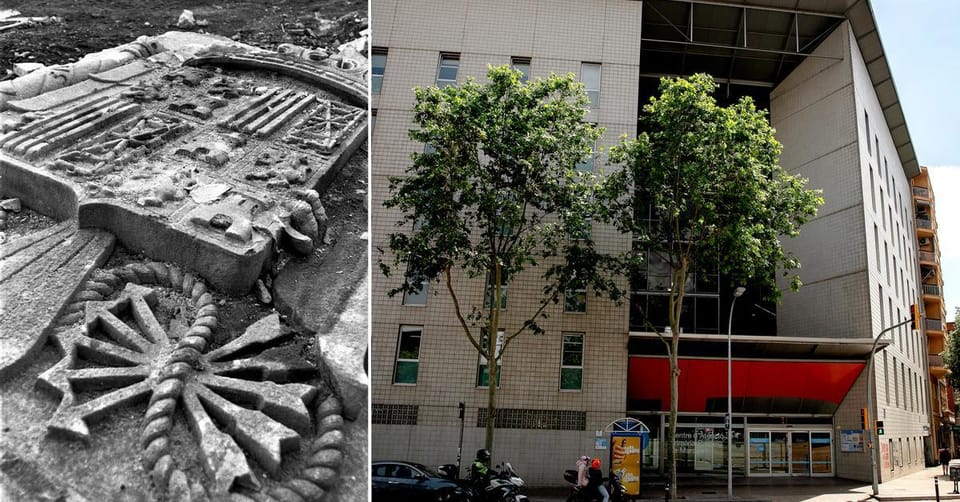
The current Passeig de Maragall Primary Care Centre (CAP) in Barcelona's Sant Martí district still appears registered under the name of Falange Española Tradicionalista y de las Juntas de Ofensiva Nacional Sindicalista (FET y de las JONS), a Francoist syndicate. This situation persists more than 50 years after the death of General Francisco Franco.
Historian Neus Moran uncovered this fact during her research into the expropriation of healthcare assets by the Francoist regime. Her work documents how the Spanish state protected this sanitary heritage before transferring powers to regional governments. "It is a shocking case," Moran stated, who received the Premi Ciutat de Barcelona 2025 for her research, "L'espoli general" (The General Expropriation).
State Ownership of Healthcare Assets
Most major public hospitals under the Institut Català de la Salut (ICS) and historic primary care centres are assigned to the Generalitat de Catalunya. However, a paradox exists: in many cases, the Generalitat does not hold ownership. Instead, the assets belong to the Tresorería General de la Seguridad Social (TGSS), the General Treasury of Social Security.
This arrangement forces the Generalitat to cover all maintenance, renovation, and investment costs for facilities it does not own. Essentially, the Generalitat manages these centres but does not possess the underlying property. This situation also restricts the Generalitat's control over the future use of these buildings.
Restricted Future Use and Community Impact
If a centre becomes disused, such as the former Sant Elies CAP in Barcelona, the Generalitat cannot decide its future. The TGSS retains the final say, potentially blocking any alternative use for the local community. This impacts urban planning and the ability to adapt public spaces to neighbourhood needs. The TGSS, established in September 1978, inherited a diverse legacy from the defunct Instituto Nacional de Previsión (INP) and the Obra Sindical 18 de Julio, the health branch of the Francoist regime's vertical syndicate.
Much of this inherited property originated from confiscations during the dictatorship. These actions affected workers' movements, associations, institutions, and private individuals. The Hospital Vall d'Hebron, for example, was originally named Residencia Sanitaria Francisco Franco, built by the INP.
The History of Clínica Ginecós
The site of the current Passeig de Maragall CAP was once Clínica Ginecós, founded in 1923 as a limited company. A group of doctors and industrialist Josep Lafitte established the centre, specialising in gynaecology and obstetrics. It was located on Carrer de la Garrotxa, now Passeig de Maragall, and featured modern facilities for its time, including 60 rooms and advanced operating theatres.
King Alfonso XIII inaugurated the centre in 1927. It thrived amidst a boom in private healthcare and demographic growth. Historian Alfons Zarzoso, who specialises in medicine, explained the context. "Catalan society at that time could access these clinics," Zarzoso said. "There had been a demographic leap, and surgery had made giant strides."
Forced Transfer to Falangist Control
Despite its apparent solvency, Clínica Ginecós faced forced liquidation and transfer to Falangist hands in 1942. The Falange often absorbed entities burdened by debt or mortgage pressure. They also occupied board positions to force transfers to FET y de las JONS. "During the early years of the dictatorship, the Falange held significant power," explained Joan Maria Thomàs, Professor of Contemporary History at Universitat Rovira i Virgili. "They controlled social affairs, housing, and healthcare."
Thomàs, a specialist in Francoism, Falangism, and fascism, noted that the Falange's influence waned from the 1950s onwards. Technocrats and Opus Dei gained prominence. The former Clínica Ginecós became Clínica Victoria, integrated into the Obra Sindical 18 de Julio. This operation, formalised in November 1942, included a donation of surgical material and 10,000 pesetas to the new institution. "This is truly disconcerting," Moran added.
Persistent Anomalies and Unresolved Ownership
The Clínica Victoria became part of the Seguro Obligatorio de Enfermedad (Compulsory Sickness Insurance). It had 140 beds and treated surgical specialities, chronic patients, and retirees. A 1963 hospital catalogue listed Clínica Victoria as property of the Obra Sindical 18 de Julio. Lack of investment during the Franco regime led to its degradation. The building was eventually demolished in February 1989.
The new Passeig de Maragall CAP opened on the same site on 8 November 1997. However, property registry data, confirmed by ARA newspaper, still lists the "Delegación Nacional de Sindicatos de la F.E.T. y de las J.O.N.S." as the owner. "In principle, this cannot be, because the historical Falange disappeared in April 1977," Thomàs stated. "It is an administrative negligence, a case of neglect."
Broader Implications for Barcelona's Public Assets
The Passeig de Maragall CAP is one of 110 properties Moran studied. Her research documents the origin of healthcare assets managed by the Generalitat since the 1981 transfer of powers, yet still under state ownership. Moran's investigation faced persistent administrative opacity. Tracing the documentary trail remains complex.
Moran found that 50% of buildings listed under Francoist organisations were formally registered between 1975 and 1978. This mass registration, just before competency transfers, secured ownership for the state via the TGSS. It prevented assets from returning to the Generalitat or original owners. An urban planning report from 1995, during the new CAP's development, already highlighted the issue. It noted the plot remained in the name of the Delegación Nacional de Sindicatos.
Other Barcelona CAPs also show similar ownership complexities. The Sant Andreu CAP, for instance, sits on land ceded by the Ajuntament de Barcelona to the INP between 1958 and 1961. The Sant Martí de Provençals CAP is on land acquired in 1958 and registered to the INP in 1967. These ongoing discrepancies affect public asset management and local community development across Barcelona and Catalonia.
Sign up for our new entrepreneurs community Bizcelona, now accepting our second wave of applicants.
Originally published by Ara Cat. Read original article.