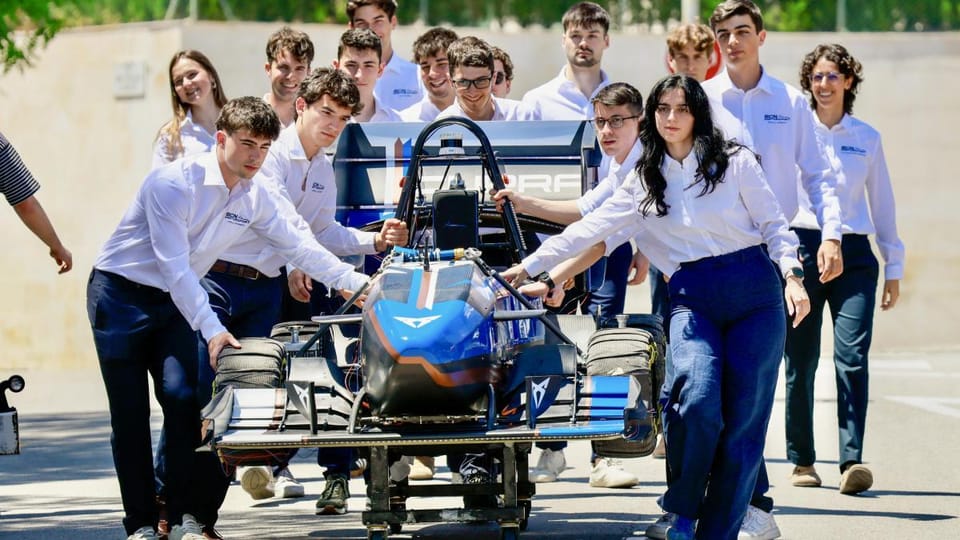
Barcelona university students are turning classrooms and workshops into race car labs for the international Formula Student competition. Across Catalonia, 386 students from eight teams are taking part, with the region holding Spain’s largest presence in the contest.
At the Escola Tècnica Superior d'Enginyeria Industrial de Barcelona (Etseib), part of the Universitat Politècnica de Catalunya (UPC), students have converted ground-floor classrooms into working racing spaces. Professors oversee weekly meetings, but the design and manufacturing work is led by the students themselves. The BCN eMotorsport team, made up of 54 Industrial and Telecommunications Engineering students, is one of Catalonia’s main entries.
Catalonia also ranks among the top regions worldwide for Formula Student participation, according to Etseib. The competition brings together about 20 teams in Spain, and the Catalan presence is comparable with major motor engineering regions such as Bavaria in Germany. That profile has also helped attract international students to Barcelona, including Sabrina Faieta, 24, who moved from Italy to study a Master’s in Automotive Engineering at the UPC.
Faieta was later elected team leader. She said the best part of the competition is seeing a year’s work come together and speaking with students from other teams. She also sees it as a route into motor sport, including Formula 1. Some former students have gone on to work with professional racing teams, including Ferrari.
Professor Vicente Medina, a project coordinator, said the students put in a huge amount of work. They are meant to spend four hours a day on the car, but many do more and cut back on academic subjects to keep up. Medina said he sometimes finds students sleeping on the workshop floor in the morning.
The BCN eMotorsport team’s Cat18X electric car weighs 200 kilograms without the driver and measures 2 metres long, 1.35 metres wide and more than a metre high. Catalan teams compete in both traditional driving and driverless autonomous categories, with telecommunications students configuring the LISAR sensor for the autonomous system. International judges check every car for safety before each event.
Medina said he would like to see universities build almost 100% of the car’s components in-house in future. For now, Formula Student remains a practical training ground for Barcelona and Catalan engineering students, and a clear route into motor sport and wider industry. For more local education coverage, see our Community and Sport pages.
Originally published by La Vanguardia Catalonia. Read original article.