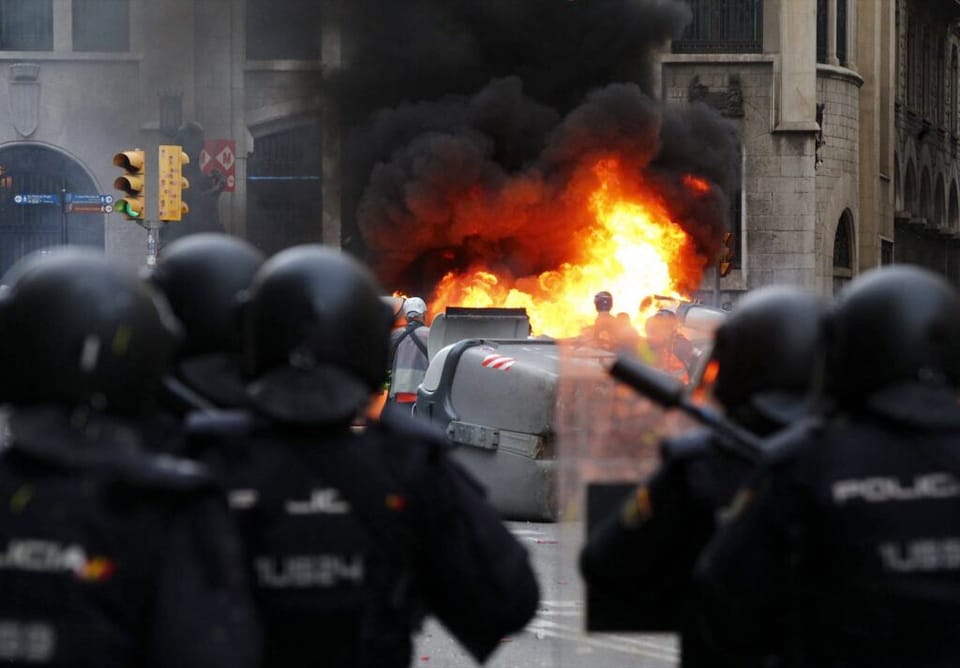
The case of Roger Garcia, who sustained a severe cranial injury during the October 2019 protests in Barcelona, has now reached the Spanish National Court. Human rights organisation Irídia is pursuing legal action to establish responsibility for the police projectile that caused his permanent injuries.
Five Years of Institutional Deadlock
Irídia initiated the administrative contentious appeal after more than five years of institutional deadlock. Both the Catalan government, known as the Generalitat, and the Spanish state have avoided assuming responsibility for the incident. According to Irídia, the appeal aims to force a resolution determining the origin of the shot. This will clarify who must bear the consequences of Garcia's severe injuries. The human rights organisation Irídia has consistently advocated for victims of police violence.
Incident During 2019 Protests
The incident occurred on the afternoon of 16 October 2019. Garcia was at a concentration near the junction of Passeig de Sant Joan and Carrer de Diputació in Barcelona's Eixample district. This central area is home to over 260,000 residents. The mobilisation had initially been peaceful. However, the situation escalated when some demonstrators moved fences and threw objects at police forces. These officers were stationed outside the Sagrat Cor Institute. The protests followed the Spanish Supreme Court's verdict against Catalan independence leaders, sparking widespread demonstrations across Catalonia.
Officers from the Mossos d'Esquadra's Mobile Brigade and the Spanish National Police's Intervention Units fired foam projectiles and rubber bullets. They did so indiscriminately and without prior warning, according to the source material. One of these projectiles struck Garcia in the head. An expert report confirms the object was a kinetic energy projectile. This is consistent with those used by police during the operation. Garcia suffered a severe traumatic brain injury with permanent sequelae. He also faces potential psychological affections as a result of the impact.
Seeking Accountability and Reparation
Despite compelling evidence, the case has been stalled for years due to a blame game. Both the Generalitat and the state have rejected claims for patrimonial responsibility. They mutually attribute the police action that caused the injury. Irídia denounces this situation, stating it has left the victim without effective reparation. The organisation views the judicial route as the only way to guarantee Garcia's rights.
The appeal seeks not only compensation but also to challenge a dynamic of impunity. Irídia warns this dynamic could have serious consequences for public safety and trust in police forces. This case could set a significant precedent for defining responsibilities in joint security force operations. It highlights the ongoing legal and political complexities stemming from the 2019 protests against the 'procés' verdict.
The Spanish National Court will now consider the administrative contentious appeal. Its decision could provide clarity on police accountability and victim reparation in similar future incidents across Catalonia. This landmark case could influence how joint police operations are handled moving forward.
Sign up for our new entrepreneurs community Bizcelona, now accepting our second wave of applicants.
Originally published by VilaWeb Feed. Read original article.