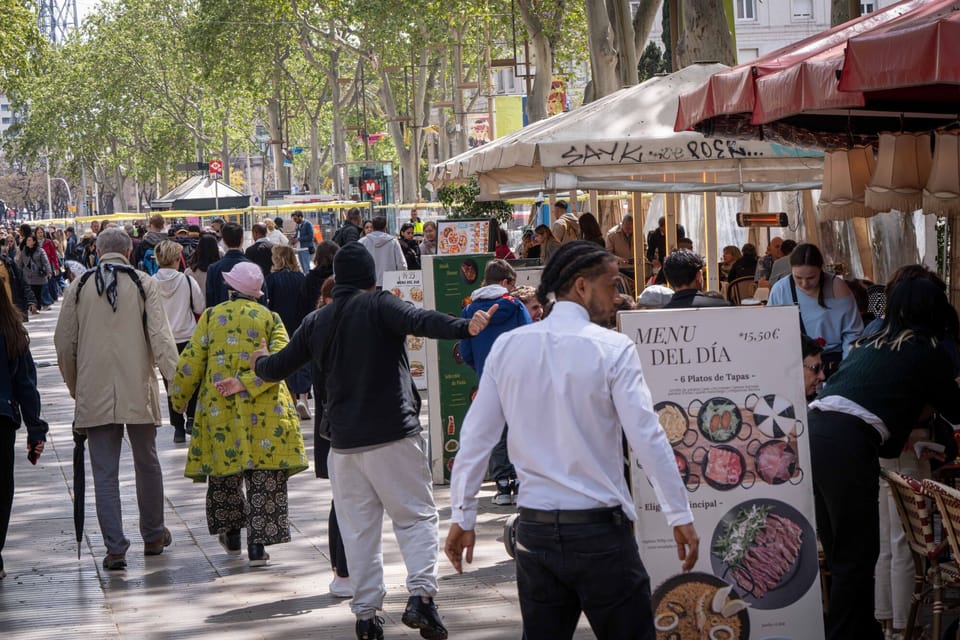
Barcelona is closing in on 7,000 terrace licences, with 6,899 active in 2025, a 6.1% rise since 2022. The figures keep the city at the centre of a debate over how much public space should be set aside for bars and restaurants.
Between 2022 and 2025, the Ajuntament de Barcelona granted 1,192 new terrace licences and rejected 1,117 applications. The growth has split opinion between the hospitality sector and neighbourhood groups.
Roger Pallarols, director of the Gremi de Restauració de Barcelona, said terraces are part of the city’s identity and important for restaurant trade. Ana Menéndez, vice-president of the Federació d'Associacions Veïnals de Barcelona (FAVB), argued that terraces are taking up too much public space and said the city should move towards less of it.
Sants-Montjuïc saw the biggest rise in new licences, with 235 granted between 2022 and 2025. Sant Martí received 200, and the Eixample 196. The Eixample also had more than 400 applications refused in that period, while Ciutat Vella rejected more than 200 and granted 58.
The Eixample still has the most terraces overall, with 2,296 licences, about one-third of Barcelona’s total. Sant Martí has 1,096, Sants-Montjuïc 678, Ciutat Vella 568, Sant Andreu 467, Sarrià-Sant Gervasi 466, Nou Barris 423, Les Corts 382, Horta 279 and Gràcia 244. The city average is four terraces per 1,000 residents, but the Eixample stands at 8.3 per 1,000.
Terrace enforcement remains busy. The council opened 2,400 sanction files in 2025, close to 2,432 in 2024 and below 3,549 in 2022. From 2022 to 2025, authorities opened 11,033 files in total, mainly for unauthorised elements, too much occupation of public space, reduced pavement width and operating without a licence.
In 2025, the Eixample led with 967 sanction files, followed by Ciutat Vella with 539 and Sant Martí with 320. Pallarols criticised the level of inspection, while Menéndez said the current rules still allow excessive use of public space and do not deal well with repeat offenders. The city’s current ordinance remains in place, and deputy mayor Raquel Gil says the issue cannot be solved through positions that are too far apart.