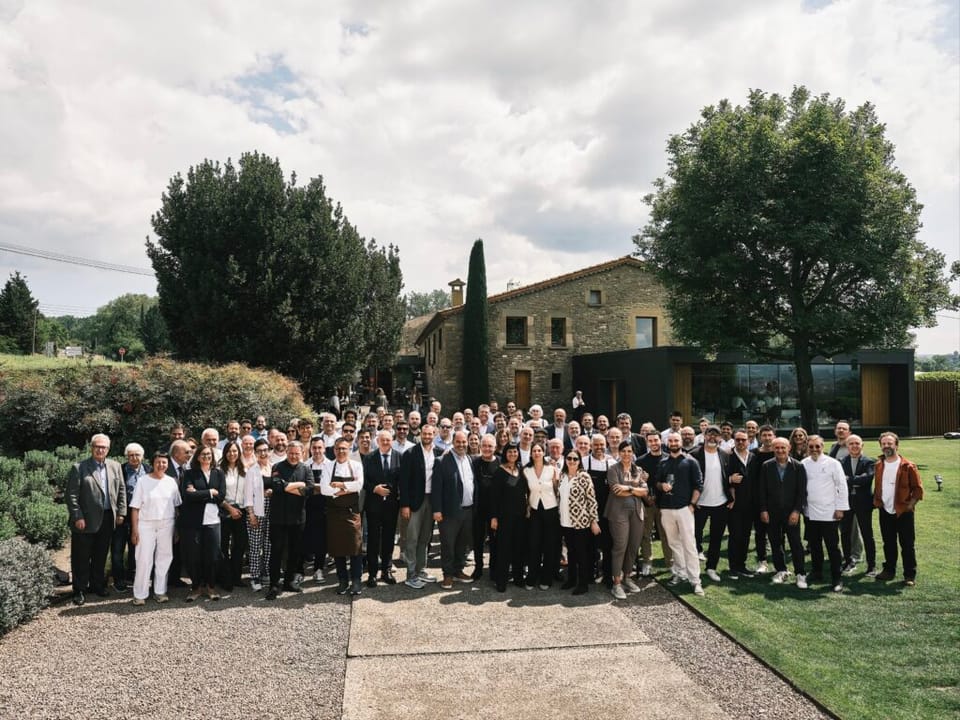
Catalan cuisine witnessed a historic reconciliation this Monday. Renowned chef Ferran Adrià publicly embraced the family of the late Santi Santamaria, 15 years after his passing. This emotional homage in Tona, a town in central Catalonia, effectively closed a decades-old rift that had divided the region's culinary community.
The event, organised by Santamaria's son Pau, alongside his sister Regina and mother Àngels Serra, brought together a "big family" of Catalan chefs. They gathered at Can Jubany for a special lunch, followed by a presentation at the new Font Gastronòmic facilities in Tona. Font Gastronòmic, led by Pau Santamaria, distributes organic vegetables and fresh produce, continuing his father's legacy.
The afternoon presentation marked the day's main event. Here, Ferran Adrià directly addressed the long-standing conflict. He recalled his friendship with Santamaria, which began in 1984. Their relationship later soured due to opposing culinary philosophies. Santamaria championed product-focused, traditional cooking. Adrià, however, pioneered "techno-emotional" or molecular cuisine at El Bulli. This public disagreement created deep divisions within the culinary world. Journalists and colleagues often fuelled the differences, causing widespread resentment.
A Decades-Old Culinary Divide
Santi Santamaria, the first Catalan chef to earn three Michelin stars, never hid his strong gastronomic views. He defended his clear principles in conferences, articles, and books. His controversial 2008 book, La cocina al desnudo (Cuisine Laid Bare), criticised the risks of technified cooking. This book intensified the clash with Adrià and amplified Santamaria's feelings of misunderstanding and isolation.
Santamaria wrote about his experiences. He stated, "I have not had the unanimity of my press friends, and within the profession, when I received the third star, I was largely unknown." He added, "In fact, El Racó de Can Fabes appeared with low scores in many Spanish guides, and the fact that my international activities have always been aimed at promoting Catalan cuisine, within a framework of full equality with other European cuisines, has aroused strong suspicions."
Uniting the Culinary Community
Ferran Adrià spoke emotionally at the Tona event. He declared, "The most important thing today is that we are once again a big family." Adrià had previously avoided discussing the feud for years. However, he recently hinted at a possible reconciliation in an interview with VilaWeb. He has since spoken more openly about their past friendship.
On Monday, Adrià went further, recalling their shared history from the 1980s until their relationship broke down. This breakdown caused pain and a sense of estrangement for both chefs. Adrià firmly urged against reopening old wounds. He stated, "Whoever wants to throw this rubbish that does not exist, let them eat it."
Santamaria's Enduring Influence
Xavier Pellicer, Santi Santamaria's former right-hand man, observed weeks ago that Adrià's current culinary discourse is not so different from Santamaria's. Today, the revaluation of product-based cooking and the focus on rethinking Catalan cuisine are widely shared values. The defence of local producers also remains a strong teaching within the profession.
This Monday's event demonstrated the profession's unity and strength. It closed a long period where internal divisions prevented the synthesis of two powerful and diverse traditions. These traditions were represented by Santamaria and Adrià. Moving forward, Adrià will write the prologue for a new book. This volume, edited by Jon Sarabia, will honour Santamaria's memory and capture this renewed spirit of brotherhood in Catalan cuisine.
Time Heals Old Wounds
In his book, La cuina de Santi Santamaria. El gust de la diversitat (Santi Santamaria's Cuisine: The Taste of Diversity), published 25 years ago, Santamaria reflected on a chef's legacy. He wrote, "Of a chef, good memories of their cooking remain, some recipes if they are lucky enough to publish a book, and little else." He continued, "Cuisine is ephemeral, it disappears when the chef does not interpret it and varies as recipes pass from one chef to another. Chefs have time against them."
This Monday's event showed that time did not work against Santamaria's legacy. Instead, it allowed for a turning point in a conflict that his premature death in 2011, at 53 years old, prevented from closing sooner. The reconciliation proves that time can indeed heal old misunderstandings and resentments from a brilliant, yet controversial, era of Catalan cuisine.
Sign up for our new entrepreneurs community Bizcelona, now accepting our second wave of applicants.
Originally published by VilaWeb Feed. Read original article.