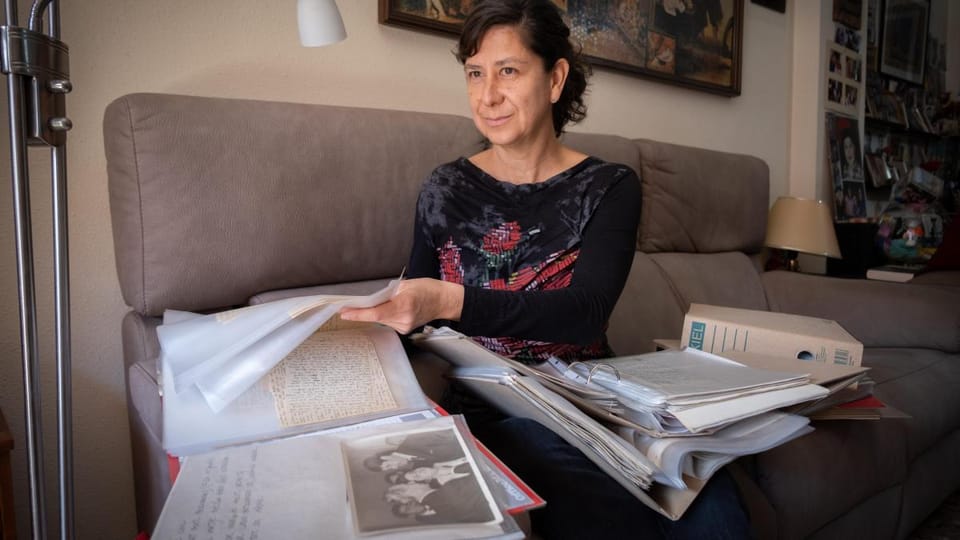
A significant collection of approximately 1,000 personal and political documents from exiled Catalan Republican Marian Font i Orobitg has arrived at the Arxiu Nacional de Catalunya this week. His granddaughter, Diana López Font, travelled from Mexico to donate the archive. It offers new insights into the Catalan government in exile and the Spanish Civil War.
Marian Font's Legacy Returns
Ms López Font personally transported the documents from Mexico, bringing them as carry-on luggage due to their irreplaceable value. "I cannot lose it," she stated, explaining her decision at the airport counter. She added, "I do not know how to get rid of all this, but it must be this way; everyone must have access." The collection includes letters, military cards, reports, studies, postcards, poems, and photographs. These documents analyse political, economic, cultural, and migratory situations of the period.
The archive contains numerous notes and reports signed by Josep Tarradellas, some marked "confidential." One text from post-war Barcelona denounces that 37% of the population had been born outside Catalonia. Another notable document is a letter from Eugene Black of the International Bank for Reconstruction and Development to Mariano Navarro, Franco's finance minister. This letter analyses Francoist economic policy. In a 1961 letter to journalist Màrius Calvet, Tarradellas expressed his frustrations. He had criticised the tactics of the exile community during his trips to Mexico. He warned of the dangers of ignoring political realities within Catalonia. However, he only encountered "displeasure."
A Life in Exile Documented
Marian Font i Orobitg was an Esquerra Republicana de Catalunya (ERC) militant in the 1930s. He served as a commissar for the Macià-Companys Column during the Spanish Civil War. Font went into exile in Mexico in 1939. He died there in 1977. His wife, Isabel Fernández Bernús, preserved all his papers after his death. The collection then passed to their daughter Montserrat. Finally, it reached granddaughter Diana. Ms López Font discovered the Memorial Democràtic exhibition in Barcelona's Raval district a few years ago. This exhibition focused on another exile in Mexico. Ms López Font realised her grandfather's story was similar. She contacted the Arxiu Nacional de Catalunya, which valued the material remotely. The Arxiu Nacional requested she send it in December.
Font's exile began from the Barcarès concentration camp in southern France. The United Kingdom and the Netherlands rejected his application. Mexico, under President Lázaro Cárdenas, finally granted permission for his family to enter. They reunited on a French pier before sailing. Mexico imposed three conditions for entry: have a trade, not settle in Mexico City, and avoid politics. Font, a qualified mercantile expert, presented himself as a carpenter. He and his family settled on the periphery of Mexico City. They faced severe hardship. Eventually, they bought a two-storey house. Font then established a glass and furniture business with another Catalan. This venture proved "ruinous," according to Ms López Font.
Preserving Republican History
Despite the condition to avoid politics, Font became the treasurer for ERC in Mexico. Josep Vall, executive president of the Fundació Irla, values Font's methodical nature. He states this helped Font preserve many papers, reports, and letters from Josep Tarradellas. Before his exile, Font was a grassroots ERC militant. He played a significant role as commissar of the Macià-Companys Column. This column integrated ERC militants on the southern Aragon front. Font's own curriculum, found in the legacy, details his involvement in the 1931 municipal elections. These elections led to the proclamation of the Republic. He also helped seize Barcelona's Post and Telegraph building in April 1931.
Font trained as a mercantile expert. He started working for Compañía Telefónica in 1926. In 1930, he joined a furniture manufacturing company. He left voluntarily in 1931. He then joined the "bureaucratic staff" created in Catalonia after the Republic's proclamation. He worked in the Presidency, Parliament, and Labour and Social Welfare departments. In 1933, he became secretary of Cornellà council. He held this position until 6 October 1934. Officials removed him following the October Events.
Uncovering War Experiences
After the events of 19 July 1936, Font helped organise the Macià-Companys volunteer column. This column fought fascism on the Aragon fronts. He served as War Commissar. When the force became militarised, he became a captain in the Quartermaster Corps. He later served as secretary of the Quartermaster Headquarters of the XI Army Corps. Font participated in all war actions involving his unit. These included battles at Sierra de Alcubierre, Vivel del Río, Belchite, and the Ebro. He also taught accounting at an officer training school in Pons.
Historian Gonzalo Berger, an expert in the Civil War and anti-Francoist militias, confirms the column's deployment. It was in Vivel del Río Martín, Teruel, from September 1936. They faced severe attacks in February 1937. They had to retreat to Martín del Río. In March 1938, the Francoist army broke through this front. Republican units had orders to resist. However, Francoist forces captured and executed their commanders there. Berger notes a mass grave in the area, analysed by ground-penetrating radar. It may contain around 30 bodies. Authorities will excavate this grave next summer. Font had already left the area by then. These 30 executed individuals were almost certainly his comrades.
Marian Font died of a heart attack in 1977. This occurred shortly after Spain reinstated the monarchy, following the Franco regime. Diana López Font believes this contributed to his death. "I always say he died because of that," she explains. "He was very republican, and suddenly democracy was returning, but also the monarchy, and he could not bear that price." The archive's availability will allow historians and the public to access these records. It contributes to understanding the broader narrative of the Catalan exile and the Spanish Civil War. Diana López Font concludes, "All this suffering is that of many. It is the story of many. Things that must never be repeated."
Come and join our Barcelona English Speakers community on WhatsApp.
Originally published by La Vanguardia Catalonia. Read original article.