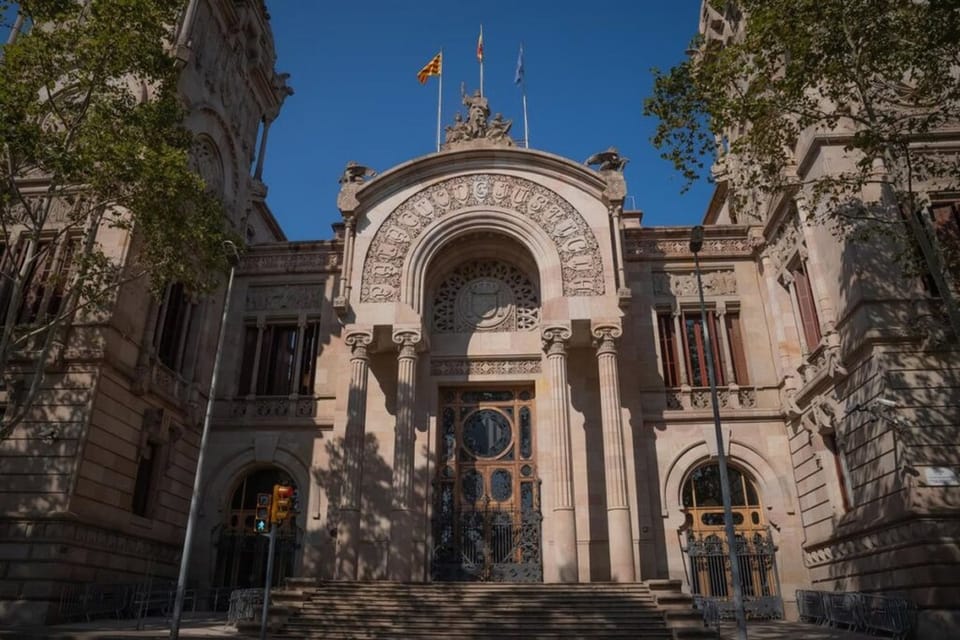
Only 6.5% of court judgments in Catalonia were issued in Catalan during 2024, a significant drop that has alarmed the Il·lustre Col·legi de l’Advocacia de Barcelona (ICAB). This decline extends to legal demands, with just 5.7% filed in the region's co-official language this year.
The Departament de Justícia provided these figures. They form part of a study by Òmnium Cultural, requested by the ICAB. The ICAB's Language Commission started a series called "Dialogues on Catalan in Law" on 12 May. This initiative aims to generate discussion about the use of Catalan in the legal field.
Alexander Salvador, a lawyer and deputy responsible for the ICAB's Catalan Language Commission, described the data as "very little encouraging". He highlighted that the use of Catalan in justice continues to fall. Judicial notifications requested in Catalan also show a sharp decrease. Only 7.4% of these requests were made in Catalan in 2024. This figure stood at 14.7% just three years ago. The presence of Catalan in this area has nearly halved in a short period.
Obstacles to Catalan in Courts
The study points to several obstacles. Spanish legislation often defaults to Castilian, making the use of Catalan conditional on a judge's decision. This contradicts the Statute of Autonomy, which establishes Catalan as the region's own and official language. The report also highlights a lack of linguistic competence among both judges and administrative staff. It mentions "certain attitudes" that discourage and hinder the use of Catalan, both spoken and written.
Furthermore, the availability of legal training in Catalan decreases as lawyers progress in their careers. The study concludes that "resources, consolidated legislation, and jurisprudence in Catalan are lacking, which limits writing and oral use." This situation affects legal professionals across Catalonia, including the many international residents who interact with the justice system.
Declining Legal Education in Catalan
Alexander Salvador called the situation in law degrees and master's programmes "totally desolating". This is particularly true in private universities. He suggests ensuring Catalan materials are available for students. Using the language from the start helps naturalise professional habits.
The problem continues after graduation. Catalonia has a limited tradition of public examinations for legal roles. Many civil servants arrive from other Spanish territories with little or no knowledge of Catalan. This creates further barriers to its use in courts.
Fear and Prejudice Among Legal Users
The report finds that many citizens and lawyers avoid using Catalan in the justice system. They do so out of fear and prejudice, even if Catalan is their usual language outside legal settings. "Bad experiences and non-compliance when choosing Catalan reinforce the idea that it is not an operational language for the world of law," the study states. This feeds its marginal use.
The Statute of Autonomy guarantees the right to use Catalan without discrimination, increased costs, or delays. However, the Spanish Justice Administration does not require Catalan for job placements. It only considers it a merit.
Legislative Gaps and Future Outlook
The law regulating popular juries, in force since 1995, does not require knowledge of Catalan for jury service in a community with its own language. However, the new Organic Law on the Right to Defence, approved in late 2024, explicitly recognises the right to use any official language in judicial communications. This applies to procedures before bodies with jurisdiction across Spain.
Despite this new law, Alexander Salvador believes the situation needs more social and institutional awareness. This will help reverse the decline in Catalan language use within the legal world. The ongoing "Dialogues on Catalan in Law" aim to address these challenges.
Come and join our Barcelona English Speakers community on WhatsApp.
Originally published by VilaWeb Feed. Read original article.