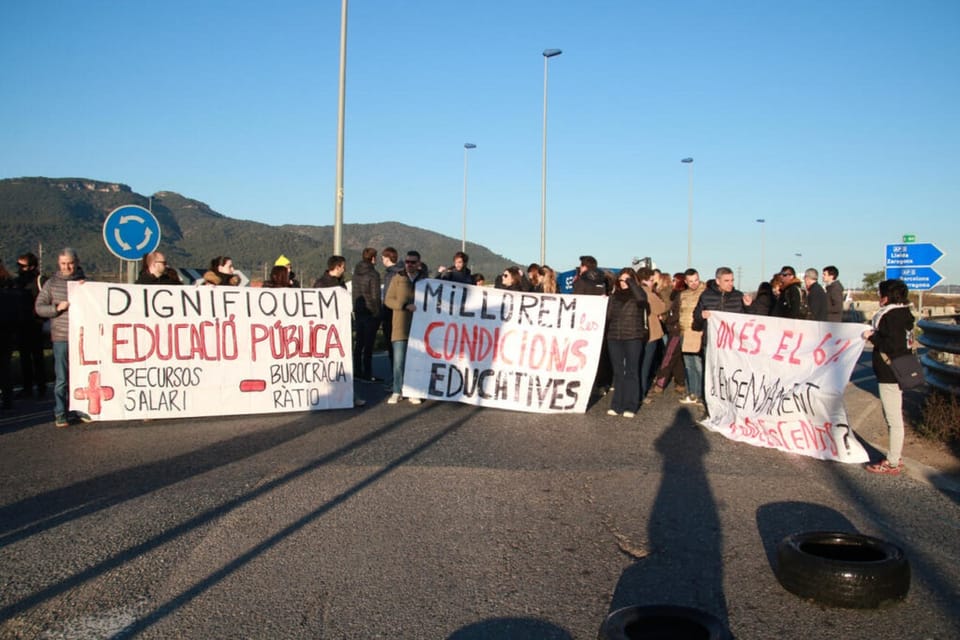
Catalan police, the Mossos d'Esquadra, identified or reported 76 teachers across Catalonia during recent strikes in February and March. Interior Minister Núria Parlon revealed these figures in a parliamentary response to a request from the CUP political party. This information has added to the widespread discomfort within the teaching community.
Police Surveillance During Teacher Strikes
Between 11 February and 20 March, the Catalan government conducted territorial police surveillance of teacher protests. This surveillance led to the identification or reporting of 76 educators throughout the region. Notably, the parliamentary document highlights an absence of violent acts by the demonstrators during these protests. However, the police actions still drew strong criticism.
The document details police operations in numerous municipalities. These include Barcelona, Badalona, Granollers, Mataró, Sabadell, Santa Coloma de Gramenet, Martorell, Molins de Rei, Cornellà, and Esplugues within the Barcelona Metropolitan Region. Outside the metropolitan area, actions occurred in Moià, Tarragona, Montblanc, El Vendrell, Girona, Tordera, Palafolls, Tàrrega, Lleida, El Pont de Suert, Terres de l’Ebre, and Vilafranca. In the Barcelona Metropolitan Region alone, the Interior Department admitted identifying 27 individuals and reporting another 10. These reports were for participating in or organising demonstrations not communicated in advance.
Additionally, police reported two teachers under Organic Law 4/2015, known as the Citizens' Security Law or "Gag Law". These reports were for allegedly throwing firecrackers at police officers or for graffiti. This law allows authorities to restrict public circulation or presence if there are signs of public safety disruption. It also permits the preventive seizure of items that could be used for illegal actions.
USTEC Denounces Police Actions
The leading teachers' union, USTEC, strongly condemned the police actions. "Everything points to a systematic violation of union rights by the government," USTEC stated in a press release. They added that the government "has focused repressive measures on union organisation and collective protest." The union's statement continued, "In the context of the complaint regarding Mossos' infiltration into teacher assemblies, this report confirms what we already warned: we are not facing an isolated incident, but a pattern of political and police persecution against mobilised teachers."
This revelation follows an earlier scandal involving the infiltration of two Mossos agents into a teachers' assembly at a Barcelona institute. The union views the newly released data as further proof of a broader strategy. They argue these actions aim to suppress dissent within the education sector. The extensive list of municipalities where teachers faced identification or reports shows the wide reach of these police operations across Catalonia.
Demands for Accountability and Negotiation
USTEC demands immediate explanations from the President of the Generalitat, Salvador Illa. The union also calls for an end to any surveillance or infiltration practices against teacher assemblies. Furthermore, they insist on the withdrawal of all repressive measures against mobilised teachers. USTEC urges President Illa to start negotiations without delay to address the teachers' concerns.
Interior Minister Núria Parlon's document admits no specific criteria exist for Mossos d'Esquadra to allow or deny road closures. The General Directorate states that assessing situations where closures are not permitted follows current state regulations. Specifically, it refers to Article 17 of Organic Law 4/2015. This article empowers security forces to restrict public movement in cases of public safety alteration or reasonable suspicion of such. Only one police action during the strikes, a road closure on the C-58 in Sant Quirze del Vallès, detected "serious public disorder."
Come and join our Barcelona English Speakers community on WhatsApp.
Originally published by VilaWeb Feed. Read original article.