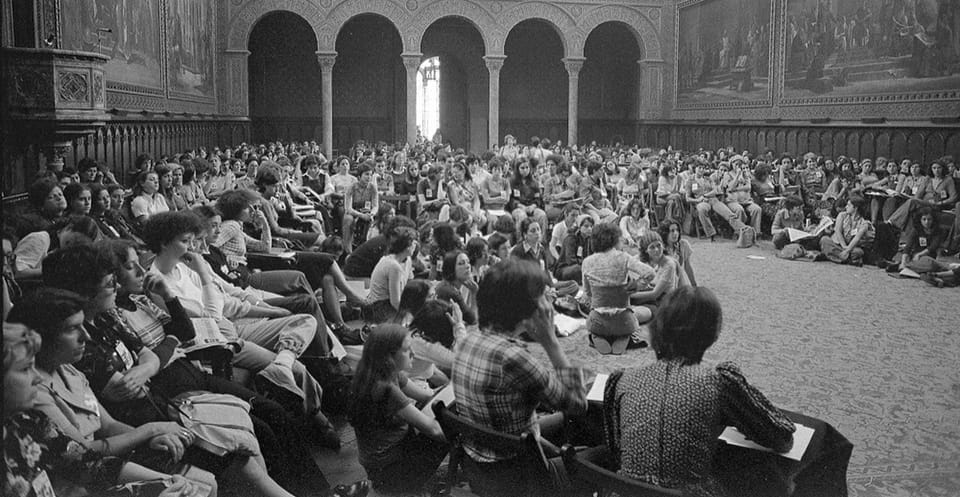
Barcelona is marking 50 years since the First Catalan Women’s Conference, held at the Paranymph of the University of Barcelona between 27 and 30 May 1976. More than 4,000 women attended, far above the 300 organisers had expected, in a gathering that helped launch contemporary feminism in Catalonia after the Francoist dictatorship.
Anna Mercadé, one of the organisers and now a consultant on equality and female leadership, said the conference was the result of three years of clandestine work. Speaking to Infobarris, she said, “It was not a mushroom”, a way of stressing that the turnout came from sustained mobilisation at a time when democratic rights and freedom of assembly did not exist.
The conference challenged the Francoist model for women, promoted by the Sección Femenina of the Falange. That model pushed women towards submission to their husbands, domestic work, motherhood and obedience, while limiting female employment and tying women’s legal and economic position to marriage.
Women from different backgrounds, including workers, housewives and students, took part. Organisers such as Anna Mercadé, Anna Balletbò, Dolors Calvet and Anna Maria Vela helped shape a shared manifesto, which Mercadé later described as a rare moment of complete unity. That consensus fed into later gains, including the decriminalisation of female adultery and the approval of divorce.
Mercadé, founder and honorary president of the Observatory for Women, Business and Economy at the Barcelona Chamber of Commerce, says the fight is not over. She points to the wage gap, care-related precarity, labour segregation and the glass ceiling, and argues that equality laws still need proper resources and real enforcement. She also said: “We have been achieving very important laws, but in practice there are still things to achieve, such as free nurseries for everyone.”
To mark the anniversary, La Model prison in Barcelona is hosting an exhibition on the conference and its legacy. The show places the 1976 gathering in the wider history of feminism in Catalonia and underlines the point Mercadé keeps making: rights are not guaranteed by law alone, and public policy still matters. For more on local civic coverage, see our Community and Sport pages.
Originally published by betevé. Read original article.