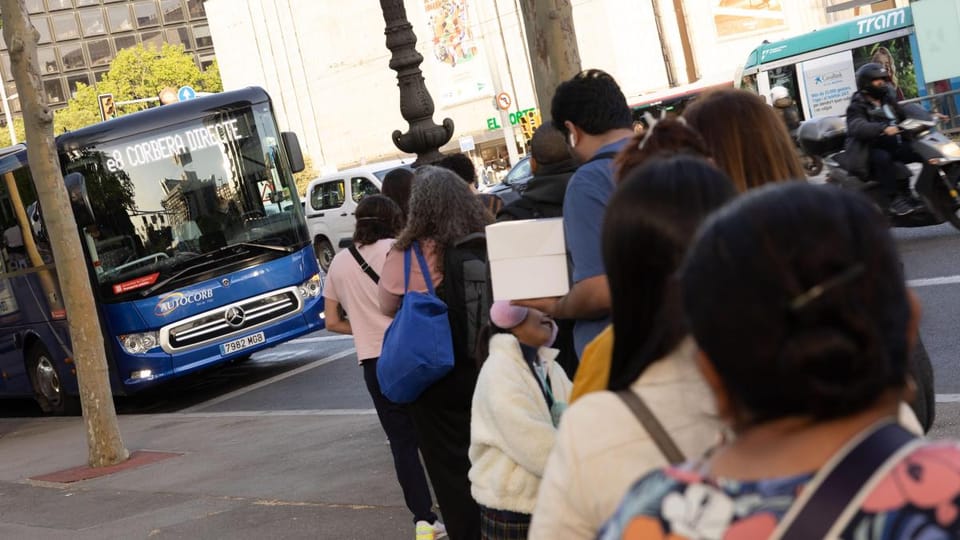
The Association for the Promotion of Public Transport (PTP) has identified over 40 intercity bus stops on Barcelona's Diagonal Avenue that could immediately double their capacity without requiring major construction work. This simple change would significantly improve conditions for thousands of daily commuters who rely on these vital routes.
Currently, most of these stops only allow one bus to operate at a time, leading to long queues of passengers and buses. Jordi Porta, a board member of the PTP, stated, "Waiting times could improve significantly tomorrow just by painting the signal and installing stop posts to speed up passenger boarding." PTP experts analysed 43 stops between Francesc Macià and the start of the B-23 motorway. They found that only the Maria Cristina stop currently permits two vehicles to operate simultaneously. This represents a considerable operational inefficiency.
This inefficiency particularly affects passengers leaving Barcelona and those arriving during peak hours. They often stand in bus aisles while waiting for the vehicle to reach the designated stop. The surge in users of express, intercity, and metropolitan bus lines has increased both pavement crowds and road congestion. Bus operators have reinforced services, leading to more coaches on the road. This creates significant queues on Diagonal Avenue, sometimes causing dangerous overtaking manoeuvres where buses occupy both traffic lanes in addition to their dedicated bus lanes.
Urgent Need for Stop Upgrades
Barcelona's intercity bus stops have historically suffered from neglect. Many stops offer only a small shelter, leaving passengers exposed to rain or intense summer heat. This is a common complaint among the city's commuters and visitors. Municipal data shows some of these stops handle over 20,000 people daily. This volume exceeds that of some Rodalies de Catalunya regional train or Metro stations. The PTP describes the current situation as "incomprehensible inefficiency," highlighting the poor service quality for such high demand.
Reconfiguring Existing Space
The PTP suggests reconfiguring existing space at key locations along Diagonal Avenue. For example, near Zona Universitària, a major interchange area for metro and bus services, four shelters exist. However, two of these are almost unused. Meanwhile, a single overcrowded shelter serves numerous lines, struggling to display all route information. This creates confusion and further delays for passengers. Porta explained, "A reformulation of the existing space with those same three shelters would allow six buses to stop simultaneously where only one stops now." He believes this six-point stop model should also apply at Maria Cristina and Francesc Macià, which are areas with the highest demand for intercity bus services.
City Council and Government Plans
The Catalan government plans to build long-term intermodal stations at strategic points like Plaça d'Espanya and Diagonal Avenue. These would offer more integrated transport solutions. Meanwhile, the Barcelona City Council recently promised a medium-term improvement plan for stops. This plan, scheduled for next year, responds to the massive increase in users following recent disruptions to Rodalies de Catalunya services. These disruptions forced many commuters to switch to bus transport. The City Council intends to invest €12 million in around 20 stops. However, these improvements do not plan with the urgency that users and the PTP demand. Municipal sources confirm they continuously monitor the situation to develop new improvement proposals.
Improving Commuter Experience
The Association for the Promotion of Public Transport urges authorities to "aerate" the stops. This means spreading out the stopping points to reduce congestion. They also call for dignifying waiting areas with seating, shade, and real-time service information. These short-term changes would significantly enhance the daily commute for thousands of residents and visitors. They would also address the immediate safety and comfort concerns at these vital transport hubs, making public transport a more attractive option. Such improvements are critical for a city aiming to promote sustainable mobility.
Come and join our Barcelona English Speakers community on WhatsApp.
Originally published by La Vanguardia Barcelona. Read original article.