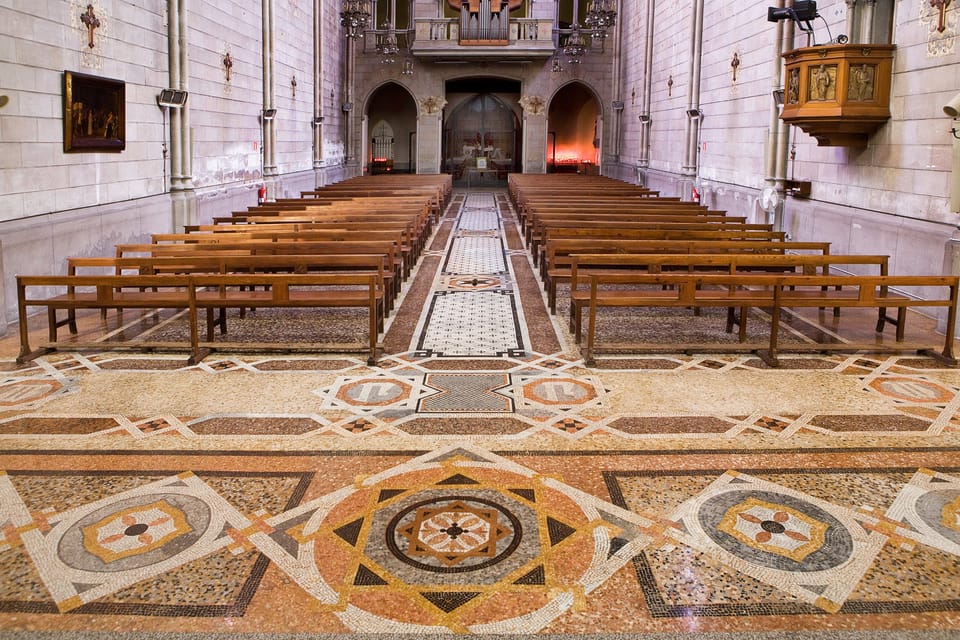
Barcelona's Junts municipal group will propose declaring Antoni Gaudí's mosaic at Sant Pacià church a Cultural Asset of National Interest. This initiative aims to protect the deteriorating artwork in the Sant Andreu de Palomar neighbourhood. The proposal will go before the Sant Andreu district plenary on 13 May.
Councillor Xavier de la Cruz signed the Junts initiative. It urges the Catalan government's Department of Culture to "start the process for declaring the mosaic designed by Antoni Gaudí i Cornet, located in the former chapel of the Nuns of Jesus and Mary, now the Sant Pacià parish, a Cultural Asset of National Interest." The text also stresses the need for urgent actions. These actions would ensure the mosaic's conservation, restoration, and effective protection. Junts highlighted the progressive loss of pieces and a real risk of total or partial deterioration. This damage stems from inadequate maintenance of the historically, artistically, and symbolically valuable heritage element.
Deterioration Concerns and Future Plans
Junts believes a rigorous study of the deterioration causes is necessary. They also call for a rehabilitation plan. The independentist party sees the upcoming 2026 centenary of Gaudí's death as an opportune moment. Barcelona will also be the World Capital of Architecture that year. It will host the World Congress of the International Union of Architects. These events provide a strong platform to highlight the mosaic's importance.
Gaudí's Early Work in Sant Andreu
People recognise Antoni Gaudí for iconic buildings like the Sagrada Família, Casa Batlló, and La Pedrera. He also designed spaces such as Park Güell. Early in his career, Sant Andreu architect Joan Torras i Guardiola commissioned Gaudí. Torras i Guardiola designed the Sant Pacià church. Gaudí created the mosaic's design. Marblist Lluís Pelegrin then executed the mosaic itself. The church finished construction in 1881.
Mosaic Design and Historical Impact
The mosaic comprises small ceramic pieces called tesserae. It features streets and borders that display various geometric designs. The letters J and M, representing Jesus and Mary, appear repeatedly. Latin letters Alpha and Omega, signifying the beginning and end of the Apocalypse, also appear. Councillor De la Cruz recalled the church's past as the chapel of the Nuns of Jesus and Mary convent. This convent gives its name to the street where the church stands. Beyond the main mosaic, Gaudí also designed the main altar's mosaic, the monstrance, lighting fixtures, and the nuns' choir.
A Century of Challenges and Restoration
Sant Pacià church has endured significant historical events. During Barcelona's Tragic Week in 1909, assailants looted, assaulted, and burned the parish. The mosaic suffered extensive damage. In 1918, owners rented the convent and church remains as a grain warehouse. This use further increased the degradation. The Archbishopric of Barcelona bought the old chapel in 1923. It then became the Sant Pacià parish. During the Civil War in 1936, a revolutionary committee in Sant Andreu confiscated the church. They repurposed it as social dining halls, known as Menjadors Durruti. Lluís Bru restored Gaudí's mosaic in 1988.
The upcoming vote on 13 May will determine the immediate future of this proposal. If approved, the district will formally urge the Catalan government to initiate the BCIN declaration process. This move could provide crucial protection for a significant piece of Barcelona's architectural heritage. It would ensure future generations can appreciate Gaudí's early work.
Sign up for our new entrepreneurs community Bizcelona, now accepting our second wave of applicants.
Originally published by Tot Barcelona. Read original article.