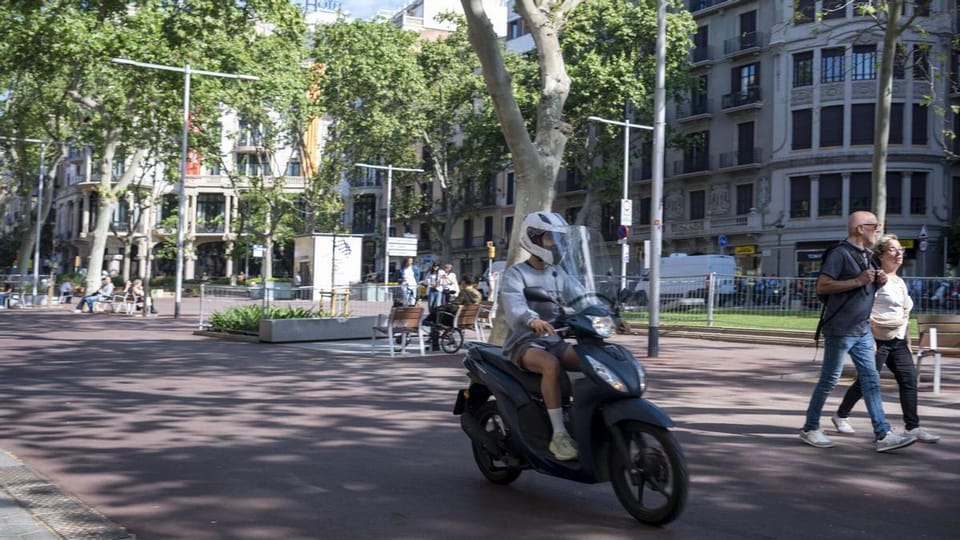
Motorcyclists are routinely ignoring traffic regulations and illegally driving through the recently reurbanised Jardinets del Passeig de Gràcia, a prominent pedestrian zone in Barcelona's Eixample district. This persistent violation, observed daily since the area's transformation less than a year ago, poses a significant safety risk to pedestrians, including children.
The Jardinets, officially known as Salvador Espriu Gardens, underwent a successful reurbanisation project. This transformed them into a popular public space. However, many motorcyclists use the pedestrian area as a shortcut towards Diagonal Avenue, often accessing it from Carrer de Sèneca. Clear "no entry" signs, a white circle with a red border, are prominently displayed at the entrance, indicating that motor vehicles are prohibited, El Periódico Barcelona reported.
These drivers often proceed at speeds incompatible with a pedestrian zone. Children play there, and people stroll without expecting traffic. The issue is particularly concerning given the area's high footfall. It attracts both residents and tourists to one of Barcelona's most iconic boulevards.
Persistent Violations and Public Safety Concerns
The disregard for traffic signs extends beyond simple inconvenience; it creates dangerous situations. El Periódico Barcelona observed a father pulling his young child away from an approaching motorbike that did not reduce speed. Later, an elderly man confronted a motorcyclist, who reportedly remained unfazed and continued through the pedestrian zone towards Diagonal Avenue. This daily occurrence highlights a serious public safety issue in a space designed for leisure and relaxation.
A History of Changing Traffic Rules
Before its recent reurbanisation, the Jardinets del Passeig de Gràcia allowed cars and motorbikes to circulate in a "sea-bound" direction. This historical context might explain the current behaviour, as some habits persist despite the new pedestrian-only designation. The current situation is comparable to motorbikes driving through the middle of Plaça de Catalunya or the central promenade of Rambla de Catalunya, areas where such traffic is unthinkable.
Barcelona's Struggle with Traffic Habits
Barcelona has faced similar challenges with ingrained traffic habits elsewhere in the city. For instance, the "green axes" in the Eixample district, home to approximately 260,000 residents, frequently see loading and unloading vehicles operating outside designated hours. This pattern suggests a broader issue where established customs often override official signage and regulations. The Ajuntament de Barcelona recently launched a campaign in the Sants district to remove motorbikes from pavements following numerous resident complaints, yet no similar organised protest has emerged regarding the Jardinets.
The Art of Ignored Signs
The phenomenon of ignored traffic signs is not new to Barcelona. In 2013, Italian artist Clet Abraham visited the city, placing removable stickers on traffic signs in areas like El Born, Gràcia, and Poblenou. His art aimed to draw attention to how little notice people pay to these everyday symbols. El Periódico Barcelona noted that only the most observant residents appreciated his work, underscoring the city's tendency to overlook signage. This historical observation reinforces the idea that habits quickly take root and become difficult to change, even with clear new regulations.
The ongoing illegal use of the Jardinets del Passeig de Gràcia by motorcyclists presents a clear challenge to Barcelona's urban planning efforts and pedestrian safety. As the city continues to prioritise pedestrian zones and green spaces, ensuring compliance with traffic regulations in these reurbanised areas remains crucial for the safety and enjoyment of all residents and visitors.
Come and join our Barcelona English Speakers community on WhatsApp.
Originally published by El Periódico Barcelona. Read original article.