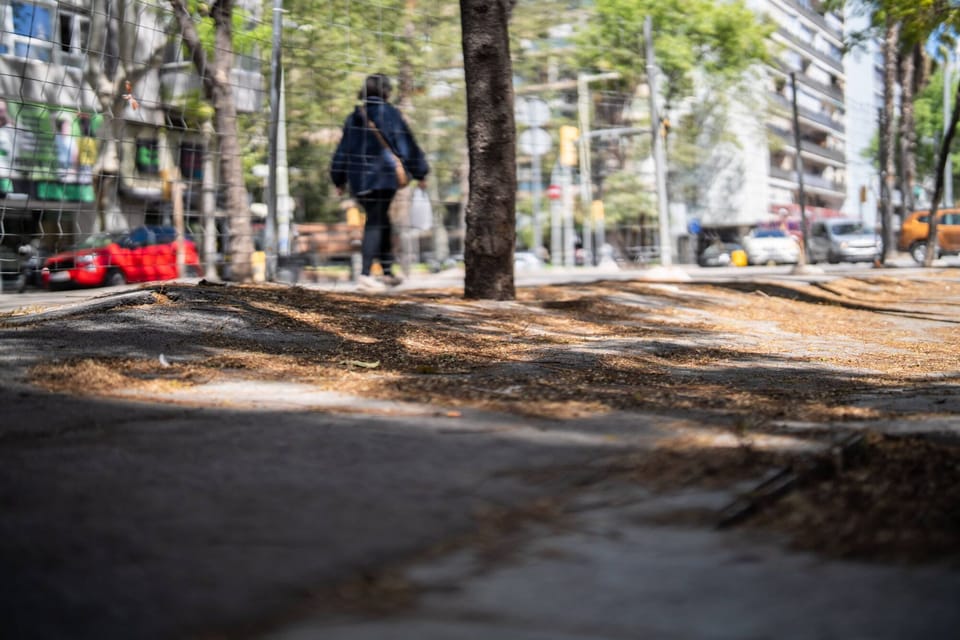
Barcelona City Council will invest €1.27 million to address severe cracks and subsidence on Rambla Guipúscoa. This major repair project in the Sant Martí district will begin in October and conclude in March 2027. The extensive damage poses a significant safety risk to pedestrians and cyclists.
Elongated cracks fracture and deform parts of the Rambla Guipúscoa pavement. These fissures and indentations in the central promenade have created height differences of up to 40 centimetres. The affected area stretches between Carrer Maresme and Rambla Prim. A wide breach also appears in the carriageway.
The threat of pedestrians tripping on the buckling ground has led authorities to fence off a corner with benches and trees. A maintenance brigade first warned of the severe subsidence in 2023. The City Council now faces a substantial bill to fix the damage.
Traffic and Bus Route Changes
The repair work will cover 126.6 metres of the road and 4,200 square metres in total. The initial phase requires excavating between the carriageway and part of the promenade. This will necessitate a complete closure of the sea-facing side's traffic lanes.
This interruption will continue for resurfacing the lane. The plan ensures sufficient width for pedestrians. It also provides alternative routes for vehicles travelling towards Besòs. Traffic in this direction "will be affected throughout the entire execution of the work," the reform's report anticipates.
Additionally, the report warns that bus lines H10, 33, and N8, which use that carriageway, "must modify their route." However, the City Council assures residents that access to garages will not change. At least one traffic lane will remain open in both directions on Rambla Guipúscoa.
Underlying Causes of Structural Failure
The City Council attributes the damage to the effects of a past drought. It also cites the ground's inability to absorb water flowing beneath the surface. This point coincides with the course of an ancient stream.
The combination of these factors triggered an underground collapse. This occurred in the retaining walls between the surface and the Metro Line 4 tracks, which run directly below. "The Metro tunnel caused water retention from higher parts of the city," explained Joan Carles Altamirano, Director of Public Space for Sant Martí, at the recent La Verneda i la Pau neighbourhood council meeting.
Mr Altamirano added, "Combined with the drought, the subsoil became very dry. Subsequent sporadic rains then washed away earth, leaving a void in this space." He revealed the subsoil became "totally empty of earth." "It eventually sank due to the weight of the trees, benches, and urban infrastructure," he specified.
Long-Term Solutions and Future Prevention
The project identifies a "structural failure of the pavement" and "widespread subsidence of the area." This affects the section between the two Metro tunnel walls. The defect has tilted the ground on part of the Rambla and the adjacent cycle lane.
"These steps create a risk of falls for pedestrians," the report warns. It also highlights a "road safety hazard for cyclists and vehicular traffic." The diagnosis states that "a conventional repair was not sufficient." Indeed, "this problem has been occurring for quite a few years," the report affirms.
Previous attempts to repair the pavement on the Rambla have proven ineffective. The new plan involves "excavating the entire area between the Metro infrastructure walls." It aims to "structurally reinforce the pavement to prevent further subsidence."
The works will include "repaving the entire street section, on both the sea-facing and mountain-facing sides." Tasks involve replacing the carriageway and promenade pavement in the remediated section. The asphalt will be strengthened to better withstand heavy vehicle traffic.
Mr Altamirano acknowledged "quite a few cracks" in the traffic lane. However, he stated these are due to expansion from "different settlements between one area and another," not the subsidence. He confirmed a georadar diagnosis detected no further voids. Soundings will occur during the reform to prevent "any possible ground failure."
Sign up for our new entrepreneurs community Bizcelona, now accepting our second wave of applicants.
Originally published by El Periódico Barcelona. Read original article.