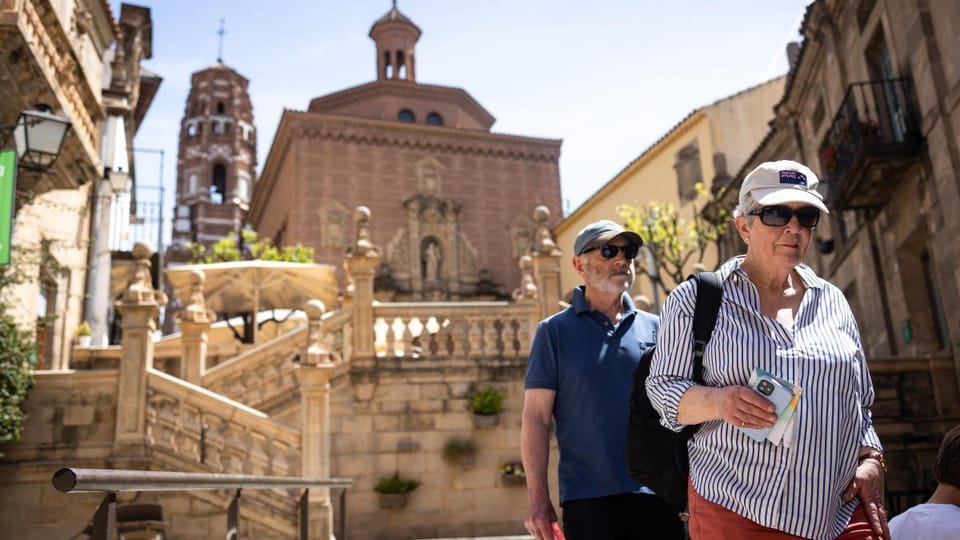
Barcelona's Poble Espanyol, a distinctive architectural complex on Montjuïc hill, is approaching its centenary, nearly 100 years after its creation as a temporary attraction for the 1929 International Exposition. The site's management is now highlighting its unique identity, which blends tourism, cultural programming, artisanal crafts, and gastronomy within a protected architectural setting.
A Landmark's Enduring Value
City officials initially conceived Poble Espanyol as a temporary structure. However, it proved so popular that the Barcelona City Council decided against its demolition. Anton Vidal, the director since 2013, states, "Poble Espanyol has added value to the city and has evolved with Barcelona." The complex has navigated various challenges throughout its history, including a significant financial crisis in the mid-1990s. At that time, the concessionaire company, which manages the municipally owned site, filed for insolvency with debts totalling approximately 2,000 million pesetas (12 million euros).
This crisis prompted a reorientation of the site's offerings. It shifted away from excessive nightlife towards a greater focus on craftsmanship and cultural activities. The Fran Daurel Museum of contemporary art opened in 2001, marking a key step in this new direction. In December 2002, an agreement between the City Council and the managers, Pemsa Leisure, extended the concession for another 20 years, until 2036. Vidal notes, "Before, they rented out spaces for events without a quality standard that we now apply." He reports that 85% of the commercial units are currently occupied. "We usually have a rotation of eight to ten units. We are not interested in offering just anything, and we would like more artisans to join us," Vidal adds.
Preserving Architectural Heritage
The agreement with the City Council included a commitment to invest 7.8 million euros in maintenance and improvements between 2003 and 2024. The company reports that this investment ultimately reached 9.5 million euros. Each year, they schedule rehabilitation and improvement works for the protected buildings. These projects require approval from the heritage department. Looking ahead to the centenary, the "Horizon 2029" project is underway. Sandra Moliner, a professor at the Vallès School of Architecture (ETSAV-UPC), leads this initiative.
With an initial budget of 36,000 euros, a team of architects is digitalising all 117 facades. These facades replicate constructions from nearly every Spanish region. Another initiative led by Moliner is the "Mapping Spain" programme, which started two years ago. This programme recreates the journeys undertaken by architects Ramón Reventós and Francesc Folguera, draughtsman Xavier Nogués, and painter Miquel Utrillo between 1927 and 1928. They travelled to gather information and inspiration before designing Poble Espanyol. Moliner completed her doctoral thesis on this foundational journey.
The Visionaries' Original Journey
Moliner insists, "We must end the idea that Poble Espanyol is a place without interest. You may like it or not, but it has value. It was not an original idea; other universal expositions already undertook projects of this type, but Poble Espanyol is the only one that has not been demolished." She explains that the four original creators started their journey intending to create something ephemeral. However, they became more enthusiastic. "They documented the buildings, colour palettes, decorative elements, and materials very well. The four understood each other perfectly," Moliner states.
Their first journey, lasting a month and a half, took them across northern Spain to Galicia and back through the centre. They sought models in situ and were amazed by popular architecture. They then made a second month-long journey through Catalonia and Aragon. Later, during a site visit by King Alfonso XIII and Prime Minister Primo de Rivera to Montjuïc, officials made them include Andalusian architecture. This led to a final fifteen-day journey. The team then fitted the 117 buildings into four zones: north, south, centre, and Mediterranean. This created an integrated and balanced enclosure featuring essential village elements like the main square, the City Hall, and the church.
A Hub for Culture and Commerce
Today, 97 years later, few spaces combine as many uses. Poble Espanyol hosts concerts, a Puppet Festival celebrating its 25th anniversary, archaeological treasure hunts, and a Scent Route with different essences designed for each zone. The final scene of the film Perfume was also shot here. The complex is open every day of the year, from 10:00 to midnight, and later during concerts, events, or when its three nightclubs are open. Last year, it welcomed over 1.6 million visitors. Local residents accounted for 60% of visitors, with tourists making up the remaining 40%. More than 230,000 people attended concerts and corporate events.
Some businesses within Poble Espanyol boast long histories and loyal customers. Among the classics, Carmen's Flamenco Show remains. It opened as the Lantern Courtyard in 1929, managed by the family of flamenco dancer Carmen Amaya. Another veteran is The Prades Fountain restaurant, open since 1969 and now run by the third generation, Marc and Pere Chías. Their parents, Pere and Rosa, met at Poble Espanyol because their respective fathers already worked there. Marc and Pere state, "Word-of-mouth has worked very well for us." They focused on quality, and customers return, with 75% of their clientele being local. Encarna Fernández, another long-time artisan, still comes to her shop every morning. She started embroidering tablecloths at Poble Espanyol in 1951, at the age of 18. "Before, we sold much more. Besides visitors, I had regular customers from Barcelona and some who came specifically from outside," she recalls. A further fifteen artisans now work at the site, creating and selling their pieces.
Looking Towards the Centenary
As Poble Espanyol approaches its 100th anniversary, its director, Anton Vidal, confirms plans for a significant celebration. "It would make no sense for us not to participate in the commemoration of the 1929 Exposition's centenary," he says. "Additionally, we will prepare our own programme to celebrate it." This commitment ensures that the unique architectural village will continue to evolve while honouring its rich history and cultural significance for Barcelona and its visitors.
Come and join our Barcelona English Speakers community on WhatsApp.
Originally published by La Vanguardia Barcelona. Read original article.