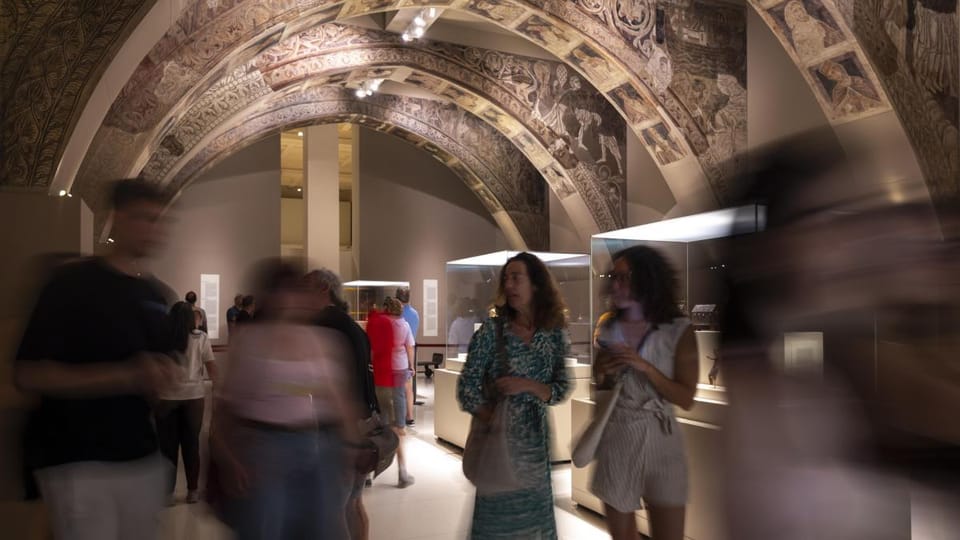
A Huesca judge has ordered the National Art Museum of Catalonia (MNAC) in Barcelona to return the fragile Sijena mural paintings. The artworks must go to their original monastery in Aragon by May 2027. This decision concludes a decade-long legal battle.
MNAC's legal team is preparing an appeal against the order. They have five days to challenge the ruling. However, Judge Rocío Pilar Vargas stated in her written order that the decision "will be carried out" regardless.
Legal Battle Culminates
The judge's provision, setting a deadline for the transfer, forms part of the enforcement process. This follows a Supreme Court ruling from May 2025. The Supreme Court mandated the return of the paintings, which MNAC has held and exhibited since the 1960s.
The Supreme Court's non-appealable judgment argued that the Catalan museum "did not possess the paintings as owner". It stated officials removed the paintings and they entered the museum via "deposit". This ruling ended a legal dispute spanning over a decade.
MNAC Director Pepe Serra has repeatedly stated the museum accepts the Supreme Court's ruling. However, he emphasises the challenge lies in fulfilling it without risking severe damage to the artworks. Mr Serra told La Vanguardia in December, "It is an engineering operation that has never been done in the world." He added, "I do not think anyone would appear."
MNAC's Preservation Concerns
The museum insists it lacks the technical capacity to move the Romanesque murals safely. They warn that attempting the transfer without damage would be impossible. This would constitute a failure to preserve an Asset of Cultural Interest.
Numerous technical and scientific reports advise against moving the ancient paintings due to their extreme fragility. The judge, however, has disregarded these warnings. She specified that MNAC must "fully assume" the dismantling and transfer costs.
Responsibility for the Transfer
The judge also assigns responsibility to "whoever physically carries out the execution". She advises that all work proceeds with "maximum prudence, caution, and diligence". Unlike medical professionals, art restorers do not have a recognised right to conscientious objection.
This means they cannot refuse to comply with a legal duty. They cannot cite concerns that manipulation could damage or ruin the fragile Sijena mural paintings. If MNAC's technicians do not perform the operation, an external company must.
The judge permits the Government of Aragon to execute the sentence "under its responsibility". This would occur if MNAC fails to meet the established deadlines. However, Barcelona Culture Councillor Xavier Marcé views this possibility as remote.
Councillor Marcé stated yesterday before the Culture Commission, "I do not think they would dare." He cited the significant risk this poses to the artworks. MNAC's alternative plan involves tendering the work to a specialised company.
Government Bodies Remain Divided
This company would then be responsible for the removal, packaging, and transport. MNAC Director Pepe Serra expressed scepticism about finding such a firm. He highlighted the unique engineering challenge involved.
The Institute of Cultural Heritage of Spain (IPCE) remains silent on the matter. MNAC has repeatedly requested a technical opinion from the IPCE. The IPCE recently advised against moving Picasso's Guernica to Bilbao.
The judge considers it inappropriate to consult the IPCE currently. She views it as a biased body, being part of the Ministry of Culture and a patron of MNAC. However, she leaves open the possibility of future consultation.
As the May 2027 deadline approaches, the National Art Museum of Catalonia faces a complex challenge. They must balance legal compliance with the preservation of invaluable cultural heritage. The outcome will significantly impact Barcelona's cultural landscape.
Sign up for our new entrepreneurs community Bizcelona, now accepting our second wave of applicants.
Originally published by La Vanguardia Catalonia. Read original article.