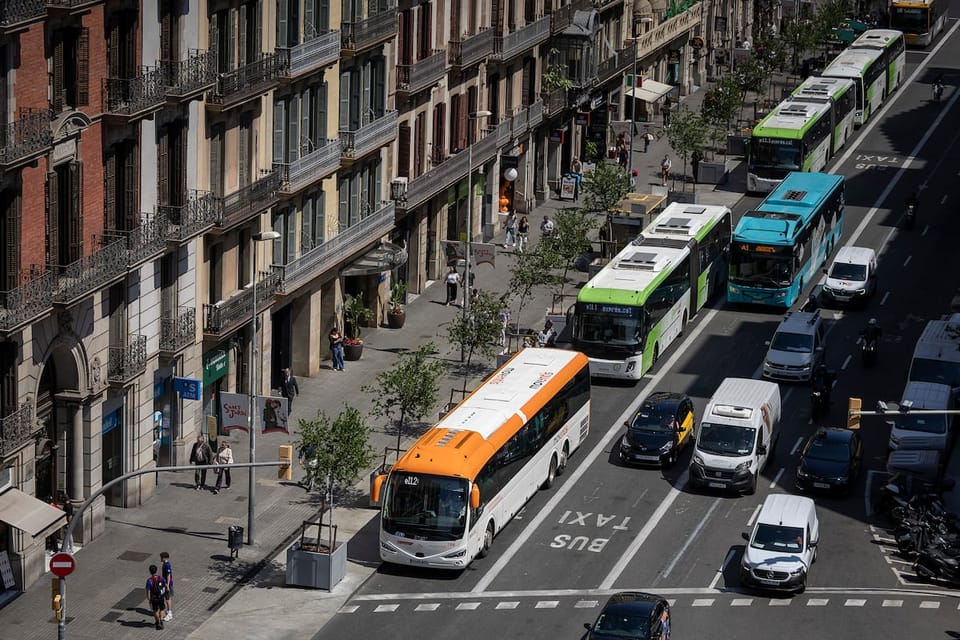
Barcelona City Council plans to drastically reduce the number of intercity buses operating in the city centre. This initiative aims to alleviate congestion, noise, and pollution, particularly in areas like Ronda de la Universitat, which has long functioned as an informal bus station.
First Deputy Mayor Laia Bonet announced the executive's plan to create new intercity coach stations at Plaça d'Espanya, La Sagrera, and Diagonal. Bonet stated this would "drastically" reduce bus numbers in central Barcelona. However, the announcement, made during a period of significant disruption to the Rodalies commuter rail service, has been met with concern from the transport sector and scepticism from residents.
Transport Operators Voice Concerns
The Federation of Catalan Passenger Road Transport Businesses (Fecav) expressed strong opposition to the council's proposal. A Fecav spokesperson told El País that such statements confirm administrations view buses as "second-class transport". They argued that preventing buses from reaching the "last mile" is discriminatory, unlike other transport methods such as the metro or train. "If I have to take two different forms of transport to reach the centre, it reduces efficiency and directly sends users to private transport," the spokesperson stated.
This sentiment highlights a broader concern within the industry about equitable access and the potential for increased reliance on private vehicles if public transport connections become less convenient. The current Rodalies crisis has already seen a significant shift, with 270,000 people entering and leaving Barcelona by bus daily. Before the crisis, there were 6,000 daily bus expeditions; now, this number has risen to 7,000, according to Laia Bonet. Bonet acknowledged the bus is more reliable than the train, but the existing infrastructure, with around 50 bus bays, significantly affects public space.
Residents' Long-Standing Frustrations
Residents of central areas, particularly Ronda de la Universitat, have long endured the impact of concentrated bus traffic. José Luis Bou, who has lived at number 35 Ronda de la Universitat for decades, described his street as an "open-air bus station" for over 25 years. More than 50 bus stops line the 350 metres of pavement, serving school, tourist, and intercity buses, especially those travelling to and from the Baix Llobregat and Maresme regions.
Bou lamented the constant noise and pollutant emissions. "It's not just the vehicles, the pollution, and the noise," he explained. "It's the queues of people in the middle of the street. Buses pass every ten minutes, and users leave tree pits full of cigarette butts and beer cans." He also noted that the proliferation of intercity coaches has attracted more tourist buses to the area. Marius Armengou, a co-founder of the SOS Ronda Universitat collective, monitors the street's mobility daily. "With the Rodalies crisis, we are even worse off," Armengou said. "There are intercity buses constantly. What we have today in Ronda de la Universitat is a covert station with dozens of urban drop-off points. A real nightmare that has lasted too long."
Political Reactions and Future Outlook
Elisenda Alamany, the ERC leader and Barcelona mayoral candidate, responded to Bonet's interview on social media. She argued that while public transport does not function correctly, a responsibility she attributed to the PSC at all levels, only tourist buses should face limitations, not those used by commuters. Genís Domínguez of the Eixample Respira platform, which advocates for city air quality, expressed surprise at the plan. "We are surprised that they move the Sants bus station to Plaça d'Espanya and at the same time say they promote intermodality," Domínguez stated. He acknowledged resident concerns about bus concentrations in areas like Ronda de la Universitat and near the Sagrada Família, which generate noise and pollution.
Both the City Council and the Barcelona Metropolitan Area support intercity buses but aim to keep them out of the city centre. However, residents of Ronda de la Universitat remain unconvinced, having heard similar promises many times before. The debate continues as Barcelona seeks to balance efficient public transport with improved urban living conditions.
Sign up for our new entrepreneurs community Bizcelona, now accepting our second wave of applicants.
Originally published by El País Barcelona. Read original article.