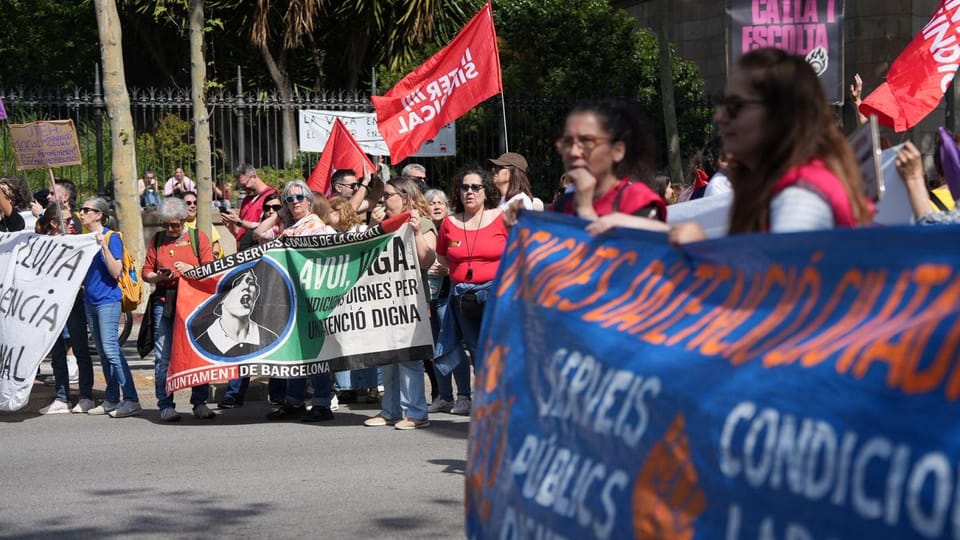
Around 1,000 Barcelona municipal workers recently protested, demanding Mayor Jaume Collboni renegotiate their new collective agreement. Employees from vital public services marched through central Barcelona, culminating in a rally at Plaça de Sant Jaume, where they met with opposition councillors.
The protest involved staff from Citizen Service Offices (OAC), Social Services, municipal nurseries, feminism departments, direct care services, and libraries. Unions CGT, Intersindical, and Àbacos led the demonstration. They rejected the collective agreement previously approved by the City Council with the backing of UGT, CCOO, and CSIF unions.
Intersindical representatives told Metrópoli that they urged opposition parties to push for an extraordinary plenary session. This session would compel the municipal government to explain "why there have been no meetings with the protesting unions."
City Centre Marches Disrupt Traffic
The demonstration began with two separate columns of workers. Nursery school staff started their march from Plaça d'Espanya, first gathering in front of the Institut Municipal d'Educació de Barcelona (IMEB). Meanwhile, Social Services and OAC employees convened outside the Institut Municipal de Serveis Socials (IMSS) on Carrer de València, proceeding down Passeig de Gràcia.
Both groups converged at Plaça de la Universitat, opposite the central faculty of the University of Barcelona. There, they joined members of the Barcelona Libraries collective. The combined march then continued to Plaça de Sant Jaume, home to Barcelona City Hall, where all participants gathered to read a manifesto.
The marches caused significant traffic disruptions. Roads affected included Carrer de València, Gran Via, Passeig de Gràcia, and Carrer de Pelai. These temporary closures impacted commuters and city traffic during the protest.
Opposition Parties Back Workers' Demands
At Plaça de Sant Jaume, councillors from Barcelona en Comú, Junts, and ERC met with the demonstrators. ERC councillor Jordi Coronas confirmed the meeting. He also expressed his party's concern for the effective functioning of municipal public services. Coronas added that this directly relates "to the working conditions of the staff."
Coronas stated, "From ERC, we are open to talk. We need to see if we can agree on a concrete proposal that we can support." He noted that 11 councillors are required to convene an extraordinary plenary session. The combined votes of ERC and Barcelona en Comú, or either party with Junts, or Junts alone, could reach this number.
Junts councillor Arnau Vives also confirmed the reception of the protesters. He explained that "at Junts per Barcelona, we did not vote in favour of the agreement because it did not generate unanimity and because it left many loose ends" with groups now on strike. Vives criticised the City Council, stating, "As the main opposition group, we must ensure that Collboni and his partners act and resolve these pending issues."
Concerns Over Resources and Conditions
Vives highlighted a perceived lack of resources for municipal services. He pointed out that despite the City Council having a record budget and a surplus of over 50 million euros, "the attention and conditions of the workers in these services have not improved." He confirmed Junts is in discussions with ERC and Barcelona en Comú to force an extraordinary plenary session. This would compel the government "to sit down with the affected municipal worker groups and not to leave the table until a solution adapted to each service is reached."
The conflict began with the approval of a new collective labour agreement for 2025 to 2028. The local executive presented this as an advancement, citing a reduction in the working week to 35 hours for most groups. However, the protesting unions, including CGT, Intersindical, and Àbacos, argue the new terms increase workload, create work-life balance issues, and lead to a loss of bonuses, supplements, and rest days. They also cite staff shortages and a lack of effort from the government to negotiate.
Threat of General Strike Looms
Intersindical, which spearheads the call for an extraordinary plenary session, celebrated the day's turnout. A representative declared, "Today, more than 1,000 people have taken to the streets. We will not leave any worker behind." The union issued a stark warning to the municipal government. "If they remain unyielding, we will go on a general strike within the City Council."
The situation now sees protesting unions and opposition parties aligning to pressure the City Council. Meanwhile, the municipal government focuses on implementing the new agreement. This sets the stage for further negotiations or potential industrial action, impacting Barcelona's essential public services.
Come and join our Barcelona English Speakers community on WhatsApp.
Originally published by Metrópoli Abierta - Urban Life. Read original article.