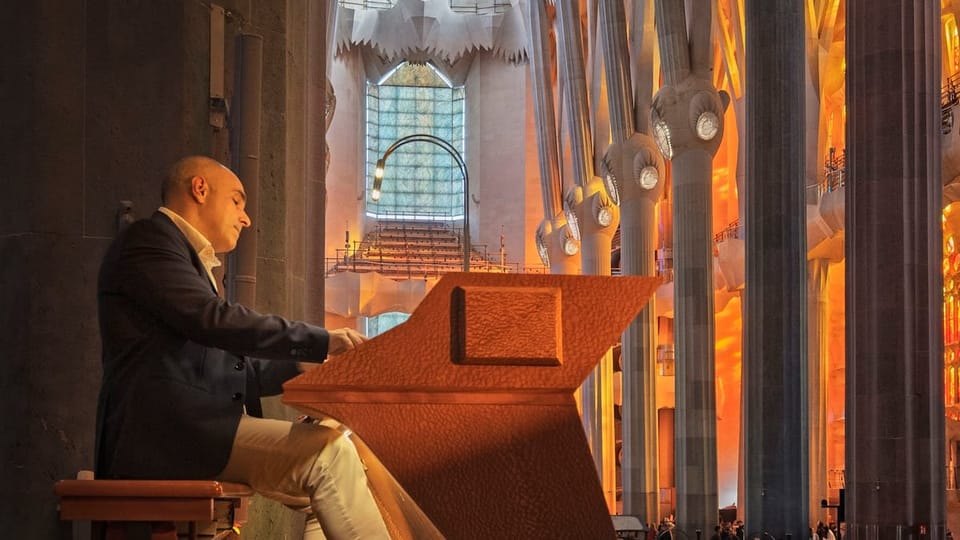
Barcelona is witnessing a remarkable resurgence of organ music, driven by centenarian virtuoso Montserrat Torrent and Sagrada Familia's titular organist Juan de la Rubia. This renewed interest brings a complex, centuries-old instrument into the modern era, attracting new audiences and performers across the city.
A Centenarian's Dedication
Montserrat Torrent, a Barcelona native, celebrated her 100th birthday on 17 April. She received the National Music Prize in 2021. Torrent first played an organ at 18 years old in a chapel in Santa Coloma de Farners, Girona. "It was a simple organ, without pedal registers, but it was good," she explains. She initially tried to play Chopin nocturnes, but they did not sound right. Back in Barcelona, she attended the conservatory. Her organ teacher initially refused to teach her if she was merely an amateur. "I told him no, it was a vocation. But it was a lie," she recalls with a smile. The teacher made her practise scales with her feet for months. One day, he gave her a Bach chorale to play. "Suddenly I saw that I could play three different sounds without needing other instruments, just by setting registers. I saw heaven open," Torrent states. She remains deeply passionate about the organ, practising daily from 05:00 despite hearing problems.
Torrent also spearheaded the creation of the organ at the Sant Felip Neri church, a baroque temple in the Gothic Quarter. This location offered ideal acoustics with its whitewashed walls and wooden tribunes. She began a fundraising campaign in the early 1960s. "I went to ask for donations at the exit of the Palau de la Música, at doctors' and lawyers' offices," she remembers. "Some gave me five pesetas, others a bit more." These early donations funded the first section, inaugurated in 1967. Public and private donations completed the instrument during her centenary celebrations.
The Instrument's Complexity
For many, the organ remains a mystery. It functions as a wind instrument; air, propelled by a motor, passes through pipes to create sound. It also operates as a keyboard instrument, controlled by two, three, or four manual keyboards, plus a pedalboard played with the feet. Organs contain many more pipes than keys. Each group of pipes produces a distinct timbre. The organist selects which pipes sound at any moment using levers called registers, which can evoke sounds like a flute or a viola. The Sant Felip Neri organ, built by Blancafort, features 49 registers and 3,481 pipes. It also includes settings to program registers in advance or to sound several simultaneously. Playing it demands synchronisation of hands, feet, and register combinations. It is an incredibly complex instrument, even requiring special footwear. A single person can control three voices and dozens of sounds through purely mechanical means, producing a sound volume capable of making an entire building vibrate.
Gaudí's Vision and Modern Appeal
Juan de la Rubia, 43, has served as the titular organist of the Sagrada Familia since the early 2010s. He mentions that before the industrial revolution, the organ was the most complex machine humans created. "Children are fascinated by big machines, and the organ, at first, captivated me because it was a big machine," de la Rubia explains. "If I hadn't been an organist, I would have liked to be an aeroplane pilot." The organ in the Sagrada Familia's presbytery, also from the early 2010s, is agile and useful for religious services. However, it does not match Antoni Gaudí's original vision. The Sagrada Familia architect conceived an organ placed 45 metres high. "That is the big question, and that is what the Construction Board is studying," de la Rubia responds. "At first glance it seems crazy, but so far Gaudí has proven right in many things that seemed improbable." De la Rubia directs the Orquesta del Miracle and teaches at the Escola Superior de Música de Catalunya (Esmuc). He observes that many people approach the organ through electronic music, as it reminds them of a synthesizer. "What they do not know is that the synthesizer comes from the organ," he adds.
Challenging Traditions
Composers like Messiaen, Ligeti, Górecki, and Glass demonstrate the organ's contemporary potential in the 20th century. British organist Anna Lapwood, 30, often performs Hans Zimmer's soundtrack for the film Interstellar. "I think Interstellar has done more to popularise the organ than any other recent work," Lapwood explains. "If you go on TikTok, it does not take five minutes to see a video with that soundtrack." Lapwood became the first woman to receive the organ scholarship at Magdalen College, Oxford. She notes that the English environment, linked to male choirs, often leads to condescending judgements towards women. Sexism, however, transcends nationalities. Montserrat Torrent received letters from men scandalised that "that girl" dared to play such a solemn instrument. Lapwood recalls a jury at 19 recommending she play "more like a man." "I was surprised, I did not know what he meant," she remembers. "I asked and he replied that I had to play with more power and authority. And that was what bothered me the most. That, instead of telling me that, he assumed that playing like a man is categorically better." A decade later, Lapwood is the titular organist of the Royal Albert Hall. Her concerts include contemporary music, works by women, and her own transcriptions of symphonic pieces and film scores.
A Global Movement
Lorenzo Ghielmi, 66, an Italian organist, participated in the creation of a Bach organ in San Simpliciano, Milan. He explains the importance of mechanical instruments for transmitting the sensitivity of the fingers to each note. "A piano virtuoso does very difficult things, but always in the same way," Ghielmi says. "An organ virtuoso can quickly change from one instrument to another, understanding it well and reacting quickly. That is why it is necessary to have played many different organs." Ghielmi will retire this year as a professor at Milan's municipal music school. When he enrolled, he did not even need an entrance exam; few students pursued organ studies. He has researched how to interpret forgotten works and dedicated a 2001 album to Arvo Pärt, the king of sacred minimalism. "Pärt told me that music must be worthy of the silence that surrounds it," he recalls. "The basilica is in a fairly quiet area, but when you open the microphone you hear the city noise. This noise vanishes at midnight, until 05:00. It is the moment of silence. The perfect time to record."
Nadal Roig Serralta, 26, from Mallorca, is a student of Lorenzo Ghielmi in Milan. He visits San Simpliciano daily to practise. "I have to arrange it, I go when it closes or at midday," he explains. "In other places they do not want to, so as not to bother tourists." Roig discovered the organ as a child in the Escolanía de Lluc. He continued his training in Berlin and now in Milan. He focuses on the ancient repertoire. In September, he placed second in the Paul Hofhaimer International Organ Competition in Innsbruck, Austria. "It was like going to an Olympic Games, I spent a year preparing and weeks meditating," he remembers. This new generation of organists, inspired by both historical masters and modern trends, ensures the instrument's continued presence in Barcelona's cultural life.
Come and join our Barcelona English Speakers community on WhatsApp.
Originally published by El País Barcelona. Read original article.