The Barcelona Provincial Council has launched an ambitious project to digitise and make freely available one million historical photographs of Barcelona and Catalonia online. This initiative will provide unprecedented public access to the region's visual past. Currently, 60,000 images are accessible, with 400,000 expected by late 2026.
Unlocking Barcelona's Visual Past
Jordi Vilamala, head of the Provincial Administration's General Archive department, stated that the online archive promises "great and very interesting surprises" soon, particularly in June. This digital collection aims to consolidate a fragmented photographic memory, previously scattered across various institutions. Other valuable collections reside with the National Art Museum of Catalonia (MNAC) and the Barcelona City Council archive. The Agrupació Fotogràfica de Catalunya, a private entity, also holds extensive funds.
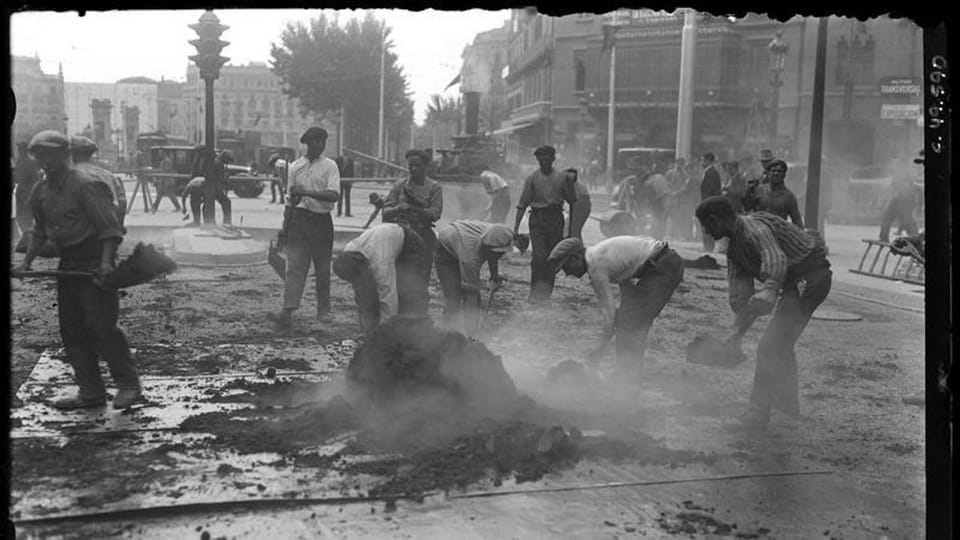
The archive offers rare glimpses into the city's transformation. For instance, it features images of workers paving the lower Rambla de Catalunya, near Gran Via, in 1928. Barcelona prepared for the 1929 International Exposition during this period. Another photograph shows the scaffolding used to construct the dome of the MNAC's Oval Hall, a sight previously unknown to most.
Filling Historical Gaps
Historians and enthusiasts often struggle to find visual records of specific buildings or moments. The Barcelona photo archive directly addresses this challenge. For example, few photographs exist of the building at Passeig de Gràcia 43 before it became Antoni Gaudí's iconic Casa Batlló. Most existing images focus on its neighbour, Casa Amatller. The new online resource will fill such gaps, offering a more complete visual history.
June will bring further additions, including the monumental catalogue of Barcelona, with its earliest entries dating back to 1915. This expansion will significantly benefit professional historians and local history enthusiasts. The project makes previously inaccessible images available to a wider audience.
Personal Stories Emerge
The archive also illuminates personal histories, offering a richer understanding of individual lives. Users can now reconstruct the life of Dr. Dolors Canals Farriols (1913-2010), a pioneering paediatrician and educator. Born into an affluent family in the Dreta de l'Eixample district, Dr. Canals developed an innovative early childhood education system in Barcelona. She implemented this system despite the Spanish Civil War, which began in 1936.
Dr. Canals later went into exile, living in Paris, Santo Domingo, and Cuba before settling in the United States. There, she achieved considerable fame for her expertise in paediatrics and pedagogy. The New York Department of Health and Education tasked her with managing the city's first wartime nursery. She applied the same criteria she had developed in Barcelona. For nine years, she hosted a weekly programme on CBS-Voice of America, promoting new paediatric practices. Her professional journey, previously told with few images, now gains visual depth through the digitised collection.
Noteworthy Photographers and Discoveries
The archive includes negative collections from influential photographers of the late 19th and early 20th centuries. Frederic Juandó Alegret (1882-1961), an economist, became known for his pioneering photojournalism. He captured landscapes, historic buildings across Catalonia, and various sports, including weightlifting contests. The collection also holds a 1934 photograph of Pablo Picasso, his son Paulo, and painter Joan Junyer in Boisgeloup, France. This rare image was found within the documents donated by the Canals-Junyer family.
Other images reveal forgotten aspects of Barcelona's past. Juandó Alegret's work provides a unique perspective of the Rambla de Catalunya and Aragó crossing in 1920. It shows the railway still running open-air along Aragó Street at that time. Narcís Ricart Baguer (1882-1961) contributed nearly 4,000 documents to the archive.
Glimpses of a Changing Europe
Ricart Baguer's collection includes a series from the Fourth International Camping Clubs Congress in Caldes de Montbui in July 1936. These photographs show flags from various European nations, including the United Kingdom and France. One particularly striking image features a swastika flag behind an orator, with campers seated in a circle. This event occurred just days before the Spanish Civil War began, and three years before the start of the Second World War.
The Barcelona Provincial Council's General Archive online is a growing resource. While 60,000 photographs are currently available, the collection will expand significantly. The goal is to reach 400,000 images by the end of 2026 and a full one million within two years. This will offer an unparalleled visual record of the region's history for residents, researchers, and anyone interested in Barcelona's past.
Sign up for our new entrepreneurs community Bizcelona, now accepting our second wave of applicants.
Originally published by El Periódico Barcelona. Read original article.