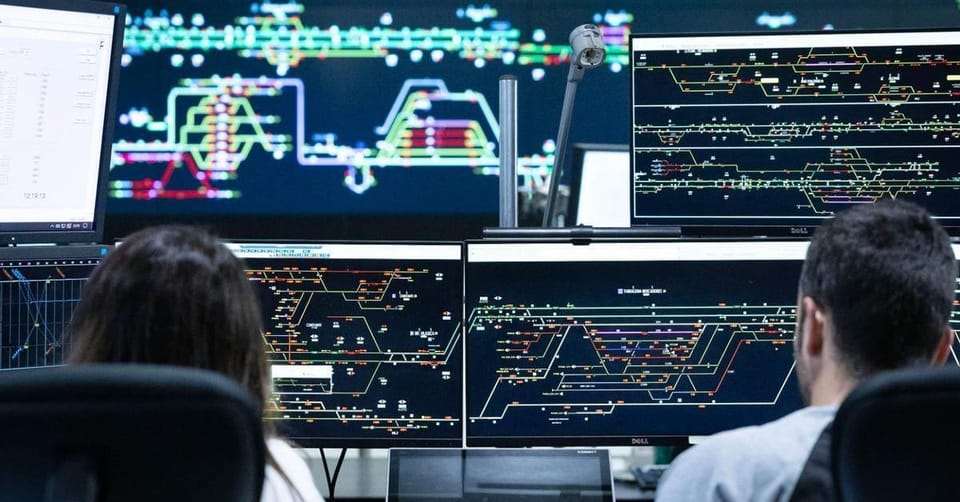
Barcelona's Circulation Regulation Centre (CRC), located at França Station and managed by infrastructure operator Adif, recently offered insights into its complex operations. This crucial hub directs the movement of more than 1,200 Rodalies commuter and freight trains across Catalonia daily. However, the centre has faced significant scrutiny following multiple software failures that have paralysed the region's rail network.
Past Outages and Network Paralysis
In February, the CRC experienced a critical double software outage. This left controllers without information and trains stranded across Catalonia. Adif sources confirmed an "error in the software" caused the primary Centralised Traffic Control (CTC) systems to fail simultaneously. Technicians quickly activated the emergency backup system. However, its software also failed. Adif sources admitted this incident "should never happen."
This severe disruption occurred on the same day the network was set to resume normal service after a fatal accident in Gelida. The February incident was not isolated. The control centre also suffered software problems in September 2022. This halted Rodalies services for hours. A similar event occurred in 2015. Following these incidents, the Catalan Government consistently labelled the situations "inadmissible." It demanded "guarantees" to prevent future recurrences.
Inside Barcelona's Train Control Hub
The CRC operates with 20 professionals per shift. This includes 14 circulation managers, a regulation technician, two inspectors, a multi-function operator, and two circulation assistants. They monitor train movements in real-time on a 10-metre-long screen. This screen displays the entire network. This modern facility represents the cutting edge of a historic profession. It evolved from manual station-to-station communication to a centralised digital system.
Adif sources state the first centralised control system launched in 1990. It has undergone continuous updates since then. Today's technology allows CRC staff to execute transport plans. They direct real-time circulation and intervene remotely during incidents. They can activate or deactivate track elements, signals, and points. This minimises human error. Despite these advancements, Adif maintains operators at some stations. They explain, "We have not yet found a better way to do it from these locations."
Addressing Future Challenges
The centre also manages planning, maintenance, and network capacity. It designs detailed schedules for every train crossing Catalonia. However, unforeseen events still pose significant challenges. Storm Harry, which struck Catalonia in late January, caught staff by surprise. Internal CRC sources described it as an "unprecedented situation." It "put us against the ropes." Each incident, and there were over a hundred during that period, requires extensive work to redraw train schedules.
Adif sources emphasise they do not improvise during incidents. Protocols dictate the necessary actions for every potential eventuality. The system detects cable theft or substation lightning strikes. It registers voltage drops and alerts controllers. However, some elements remain beyond automatic detection. These include landslides, stones on the track, or fallen trees. Currently, train drivers or security forces like the police or firefighters must report these issues.
Enhancing Safety and Reliability
Adif's Innovation and Development (I+D) department actively works to integrate sensors onto conventional rail lines. These are similar to those used on high-speed networks. This initiative aims to develop detection systems for landslides, for example. A clear solution for fallen trees, beyond preventive felling, remains elusive. Software reliability also continues as a key focus.
Following this winter's failures, Adif requested explanations from the software provider, Siemens. Adif also opened an investigation to audit the situation. This will determine if compensation is warranted. Despite this, Adif sources affirm Siemens has implemented all necessary updates. "Nothing indicates that what happened in February could happen again; we trust it will not," CRC sources stated. Adif sources added, "There is no better technology on the market." The system undergoes daily and weekly updates for improvements. Should another major incident occur, the emergency control centre at Sants remains the designated backup plan.
Come and join our Barcelona English Speakers community on WhatsApp.
Originally published by Ara Cat. Read original article.