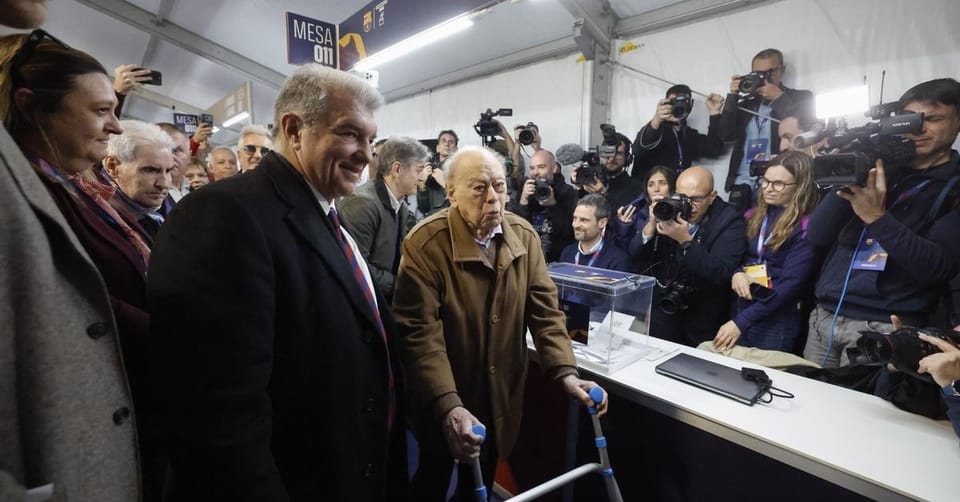
Former Catalan President Jordi Pujol, who turns 96 next month and suffers from severe mobility issues, must travel to Madrid on Monday for a court appearance. This order comes despite previous medical reports deeming him unfit to undertake such a journey.
In November, forensic experts determined that Mr Pujol was not "in physical or cognitive condition" to stand trial. Consequently, the court allowed him to follow the sessions from his home in Barcelona. However, the Audiencia Nacional in Madrid has now reversed this decision, ordering him to appear in person.
Mr Pujol faces a demanding trip, including an overnight stay and stressful travel. He will undergo examination by a forensic expert just 30 minutes before his scheduled statement, according to Overview of Catalan politics. This assessment will decide if he is fit to testify.
Court Order Raises Health Concerns
Dr Jaume Padrós, Mr Pujol's personal physician, previously stated in an interview with ARA that Mr Pujol was not "in a condition to defend himself or to argue dialectically." Dr Padrós added that Mr Pujol himself was not entirely aware of his own limitations. His family has also publicly warned about the fragility of his health.
Notably, Judge José Ricardo de Prada of the Audiencia Nacional has disregarded these medical assessments. The judge did not consider sending a forensic expert to Barcelona. He also chose not to rely on the judicial forensic experts available in Catalonia for a preliminary review. This decision has drawn significant scrutiny.
Political Leaders Call for Common Sense
Political parties in Catalonia have strongly criticised the court's decision. Junts and Esquerra Republicana de Catalunya (ERC) have described the move as "cruelty" and "mockery." The President of the Generalitat, Salvador Illa, has publicly called for "common sense" from the courts regarding Mr Pujol's treatment.
Additionally, Spain's Justice Minister, Félix Bolaños, commented on the situation. He stated that officials could have checked the former president's health in Barcelona. The tribunal's order did mention that "any modification" in Mr Pujol's health in the coming days would lead to an "appropriate decision." However, the current directive stands.
Broader Context of the Pujol Case
This trial enters a critical phase this week with the start of statements from the main defendants. First among them is Mr Pujol himself, if his health permits. Following this, his eldest son, Jordi Pujol Ferrusola, is scheduled to testify. The Anti-Corruption Prosecutor's Office seeks a 29-year prison sentence for Jordi Pujol Ferrusola. He faces charges of illicit association and money laundering.
Many in Madrid have held a long-standing animosity towards Jordi Pujol since the 1980s. This sentiment arguably stems from a historical misunderstanding of Catalonia and its political demands. Critics suggest the court's current actions may reflect this underlying feeling, treating Mr Pujol differently from other elderly individuals in similar circumstances. The outcome of this week's proceedings will show how the justice system balances legal process with humanitarian concerns.
Sign up for our new entrepreneurs community Bizcelona, now accepting our second wave of applicants.
Originally published by Ara Cat. Read original article.