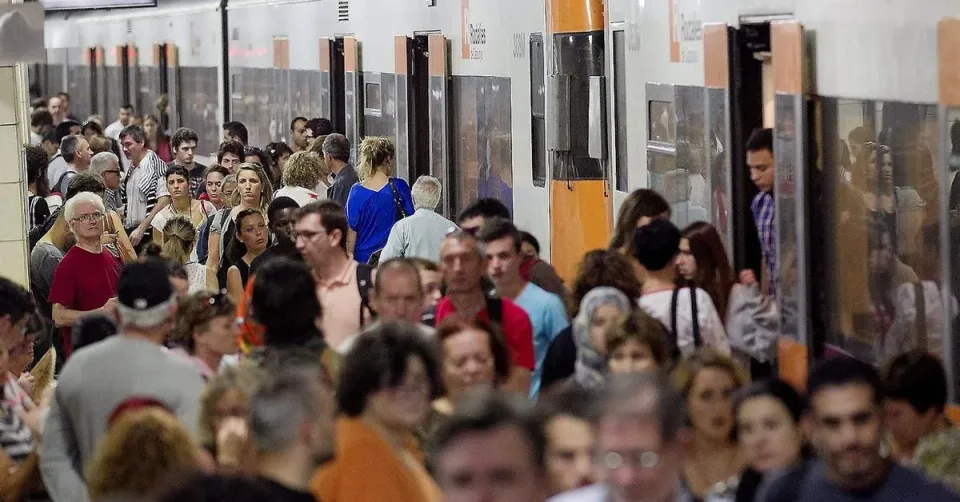
Renfe reported an average delay of just 2.5 minutes for its Rodalies train services in February, a period marked by widespread disruptions and a drivers’ strike across Catalonia. This official statistic sharply contrasts with the daily experience of thousands of commuters who faced significant service cuts and prolonged waiting times. February represented one of the most challenging periods in the Rodalies network’s history, with cuts on nearly all lines, multiple daily alerts, and unprecedented speed limitations.
The state-owned rail operator clarified that this average only accounts for delays directly “imputable to the operator,” excluding external factors such as infrastructure failures. Renfe’s monthly punctuality report for Rodalies services across all autonomous communities details this methodology. If only trains that actually ran late are considered, the average delay increases significantly to 26 minutes. Renfe spokespersons stated, “The publication of these data is a further step in the transparency policy that no other operator undertakes.” Álvaro Fernández Heredia, the company’s president, reiterated this position in a public message to Anna Gómez, spokesperson for the Dignitat a les Vies platform on social media platform X.
Official Versus Independent Delay Data
Renfe’s figures also indicate that 90% of delays attributable solely to the operator were under five minutes. However, when all circumstances are included, only 16% of trains arrived on time. Independent data from the website puntual.cat presents a starkly different picture of Rodalies train delays. This platform, which tracks real-time train movements, indicated that major Rodalies lines experienced total delays exceeding 20 minutes on average during February. Specific lines, such as the R2 Sud and R3, recorded average punctuality deficits of over 38 minutes. These lines are vital for commuters travelling into and out of Barcelona, connecting the city with towns across Catalonia.
David Cortés, a programmer, collaborator with puntual.cat, and member of Dignitat a les Vies, criticised Renfe’s methodology. He explained, “We calculate the scheduled arrival time of the train and the actual time it finally passes.” Cortés added, “It does not matter who caused it; we believe this is the useful data, not this propaganda data they want to provide, which serves no purpose.” He noted that the platform offered its open-data website, built using open data, to public administration, but officials rejected it.
Joan Carles Salmerón, director of the Centre d’Estudis del Transport Terminus, echoed this sentiment. Salmerón stated, “Society needs to know the complete data, delays attributable to Renfe and also the others, to get an idea of the entire panorama.” He acknowledged Renfe’s need to study its own imputable delays for improvement. However, he stressed that “users need to have all the information, including that of other operators, which is never discussed.”
The Renfe and Adif Divide
Industry sources suggest that the differing interpretations of delay figures stem from an ongoing dispute between Renfe and Adif. Both companies operate under the Ministry of Transport. They reportedly strive to avoid becoming solely responsible for the persistent service crisis. The European Union mandated the separation of Renfe, the train operator, and Adif, the infrastructure manager, in 2005. This move aimed to comply with liberalisation regulations, ensuring free competition by separating track management from train operations.
This structural separation, however, has drawn criticism. Salmerón highlighted that other European countries, such as France and Germany, manage their railway systems differently and more effectively. He explained, “In these cases, the operator and the infrastructure manager have remained, at minimum, within the same holding, with the same president and joint management.” He concluded, “Here, joint transparency work is needed that currently does not exist.” The Rodalies network, which serves millions of journeys annually, is critical for the economic and social fabric of Catalonia. Its reliability directly impacts residents’ daily commutes and the region’s connectivity.
Calls for Greater Transparency
The discrepancy in reported Rodalies train delays significantly impacts the daily lives of hundreds of thousands of residents across Barcelona and Catalonia. Reliable public transport is crucial for commuting, tourism, and economic activity. The ongoing debate over delay metrics underscores a broader need for integrated management and transparent reporting across the entire rail network. Moving forward, a unified approach to data collection and accountability could foster greater trust and improve service for all users. Experts advocate for a system that provides a comprehensive view of all delays, regardless of their cause. This would offer commuters a more accurate understanding of service performance.
Come and join our Barcelona English Speakers community on WhatsApp.
Originally published by Ara Cat. Read original article.