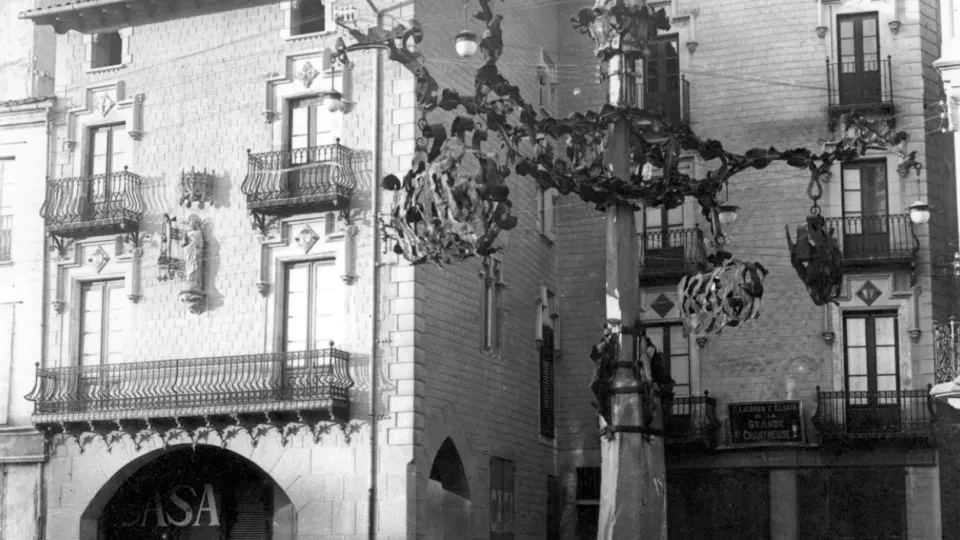
In 1910, Vic's Plaça Major unveiled two monumental lampposts, believed to be advised by Antoni Gaudí, only for the city council to dismantle them just 14 years later, repurposing their materials as scrap metal and street paving. This unique chapter in Catalan modernism saw significant architectural works reduced to ordinary urban infrastructure, according to a report by 20 Minutos Barcelona. The story represents a striking example of how public perception and political currents can dramatically alter a city's architectural legacy.
The obelisk-like lampposts, inaugurated for the centenary of philosopher Jaume Balmes' birth, stood prominently at the entrance to the square. They connected to the then-new avenue leading from the railway station. Despite their initial symbolic and monumental presence, public perception quickly turned negative. Óscar Farrerons Vidal, an architect and researcher from the Universitat Politècnica de Catalunya (UPC), documented early complaints from residents. "Among the complaints were the passage of carriages and vehicles, noises, the risk of detachments, and even the indecorous use of the space as an improvised urinal," Farrerons stated in his 2024 article, "Els fanals modernistes de la plaça Major de Vic," published in Revista de Vic. These grievances emerged surprisingly quickly, just two years after the lampposts' installation.
Gaudí's Advisory Role in Vic's Lost Heritage
Traditional accounts attribute the lampposts' design to Antoni Gaudí, although Farrerons' research suggests it was a collective effort with Gaudí acting as an advisor. Gaudí was in Vic during spring 1910 for medical reasons, amidst intense work on projects like the Sagrada Família and Palau Güell. During this period, he collaborated with key figures such as Josep Canaleta and Josep Maria Pericas. This collaboration led to the concept for the two distinctive monumental lampposts. The designs were not identical. One lamppost, notably taller, featured metallic arms resembling tree branches, from which decorative elements and the dates "1810-1910" for Balmes' centenary hung. The other presented a simpler, shorter structure, focusing on a single point of light. Both structures rested upon robust basalt columns, which originated from the volcanic region of Castellfollit de la Roca. This detail underscored the use of local, natural materials, characteristic of Modernist architecture.
Public Discontent and Unanimous Demolition
Public discontent escalated rapidly after the lampposts' inauguration. Residents began demanding their removal, citing various inconveniences. Despite these growing complaints, efforts were made to preserve the structures. Artisans, tradespeople, and city representatives signed petitions defending the lampposts. There were even proposals for a reform to address the issues. Gaudí himself acknowledged his involvement in the project through a letter, expressing his willingness to improve the design. However, the proposed reforms never materialised, and the structures' deterioration continued unchecked. Finally, on 11th August 1924, Vic City Council voted unanimously for their demolition. The dismantling process commenced without delay the very next day. Local historians often interpret this swift decision within the broader political context of the Primo de Rivera dictatorship. This era was frequently hostile towards certain symbols associated with Catalan identity, adding a layer of political significance to the architectural loss.
The Lampposts' Final Fate and Modern Revival
The lampposts' ultimate fate provides a poignant detail about lost heritage. According to the comprehensive UPC study, the metallic components of the structures were melted down and converted into scrap metal. The sturdy basalt stone bases, however, found a new purpose. Workers repurposed them as paving stones for Carrer Arquebisbe Alemany in 1926. This meant a significant work, attributed to Gaudí's circle, literally ended up under the city's feet, becoming part of its ordinary streetscape. Today, a century later, Vic reflects on this history with a different perspective. Óscar Farrerons Vidal has actively spearheaded academic projects at the UPC, including advanced virtual reconstructions of the lampposts. These innovative efforts aim to recover their memory and allow contemporary audiences to visualise their original grandeur. They also prompt reflection on how Vic's potential heritage and tourism projection might have changed had these unique Modernist structures survived. This ongoing academic work ensures the story of Gaudí's lost lampposts remains a vital part of Catalonia's architectural narrative.
Come and join our Barcelona English Speakers community on WhatsApp.
Originally published by 20 Minutos Barcelona. Read original article.