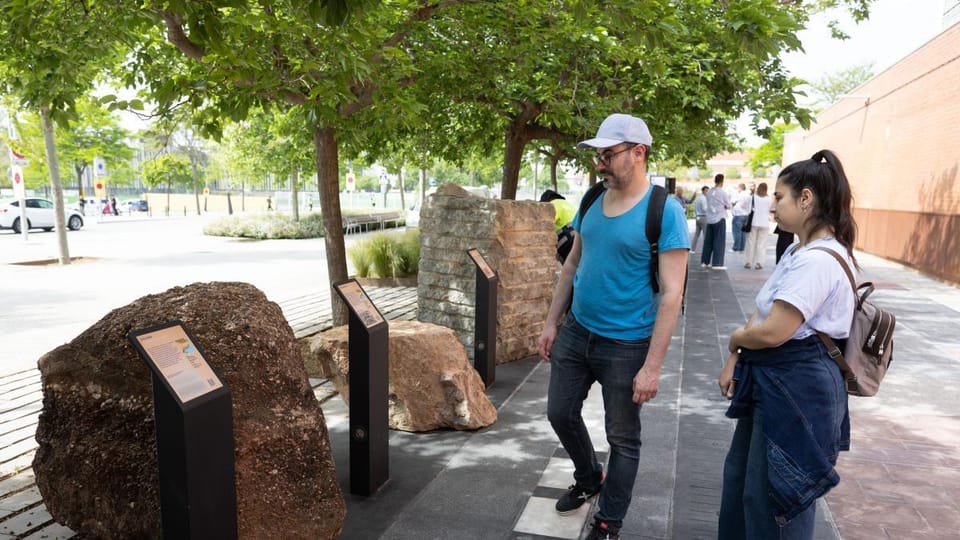
Barcelona has recently unveiled its first fully open-air museum, the Geological Garden, located at the Universitat de Barcelona's (UB) Faculty of Earth Sciences in the Les Corts district. This new public space offers free access to explore the Earth's 4.567 billion-year evolution.
The 1,830 square metre garden represents a significant €1.3 million investment. The majority of this funding, €1.2 million, came from European Next Generation funds. UB Rector Joan Guàrdia and Les Corts Councillor David Escudé officially opened the facility.
Councillor Escudé highlighted the project's community benefits. He stated, "Having a museum in the street is the most welcoming way to bring knowledge to people, and to make them co-responsible for caring for the space."
Albert Soler, Dean of the Faculty of Earth Sciences, emphasised the museum's role in connecting the university with the neighbourhood. He remarked, "Today, a dream comes true," adding that the museum aims for broad public dissemination, targeting schools, institutes, and local residents.
A New Public Space for Science
The Geological Garden is situated on Carrer Menéndez y Pelayo, specifically between Carrer Martí i Franquès and Avinguda Joan XXIII. Architect Eliana Crubellati designed the space, identifying the pavement as the integrating thread across its four distinct areas. Rector Guàrdia also stressed the importance of accessible science. He noted, "Science makes sense when it is useful, and it is useful when we are able to transfer knowledge to citizens in a divulgative way."
Visitors can learn about Earth's geological evolution while strolling through the garden. It features various educational displays, natural materials, exhibition pieces, and informative elements. The garden divides into four main sections, each offering unique insights into our planet's past and present.
Exploring Earth's Ancient History
The first area, "Geological Time," guides visitors through different geological periods. A 60-metre stretch of pavement, made from real Catalan rocks spanning the last 600 million years, illustrates the history of Earth, the evolution of life, and the movement of continents. This section provides a tangible timeline of planetary change.
The second section, "The Earth," acts as a gateway to knowledge about the planet's internal structure. Located on one of the faculty's access staircases, it displays the Earth's layers using materials representing their composition. This area also provides information on the Earth's magnetic field and the dynamics of the lithosphere, explaining how our planet functions internally.
Unveiling Planetary Structures
Adjacent to the faculty's main staircase, "The Geological Cut" presents a detailed cross-section of the Earth's crust. A wall, constructed with real rocks, helps visitors understand what lies beneath the surface. It also demonstrates how the lithosphere's structure gives shape to the landscapes we see on the surface, from mountains to valleys.
Finally, the "Geological Resources" space highlights the critical link between geological processes and essential societal resources. It showcases everything from water and various metals to lithium used in batteries and mobile phone chips. This section underscores society's profound dependence on geological resources for modern life.
Two Decades in the Making
The concept for the Geological Garden originated two decades ago. Miguel Ángel Cuevas, then Dean of the Faculty of Geology, initiated the project. Initial stages focused on developing thematic and museographic ideas to create a visually stimulating plan. RFArq Arquitectos, with Eliana Crubellati Benedetti as the author, handled the design. Museologist and populariser Jordi Vives Arumí, along with faculty professors, provided scientific advice throughout the development.
This new open-air museum offers Barcelona residents and visitors a unique opportunity. It provides an engaging and accessible way to connect with Earth sciences. The project aims to foster a deeper understanding of our planet's past and the vital role of geological resources in our future.
Sign up for our new entrepreneurs community Bizcelona, now accepting our second wave of applicants.
Originally published by La Vanguardia Barcelona. Read original article.